
You know the piece that stops you because you are trying to work out the system. Not because it announces itself, but because somewhere in the arrangement there is a rule you can almost see, and the almost is what holds you.
Interval Proving Structure is that piece.
What is actually there
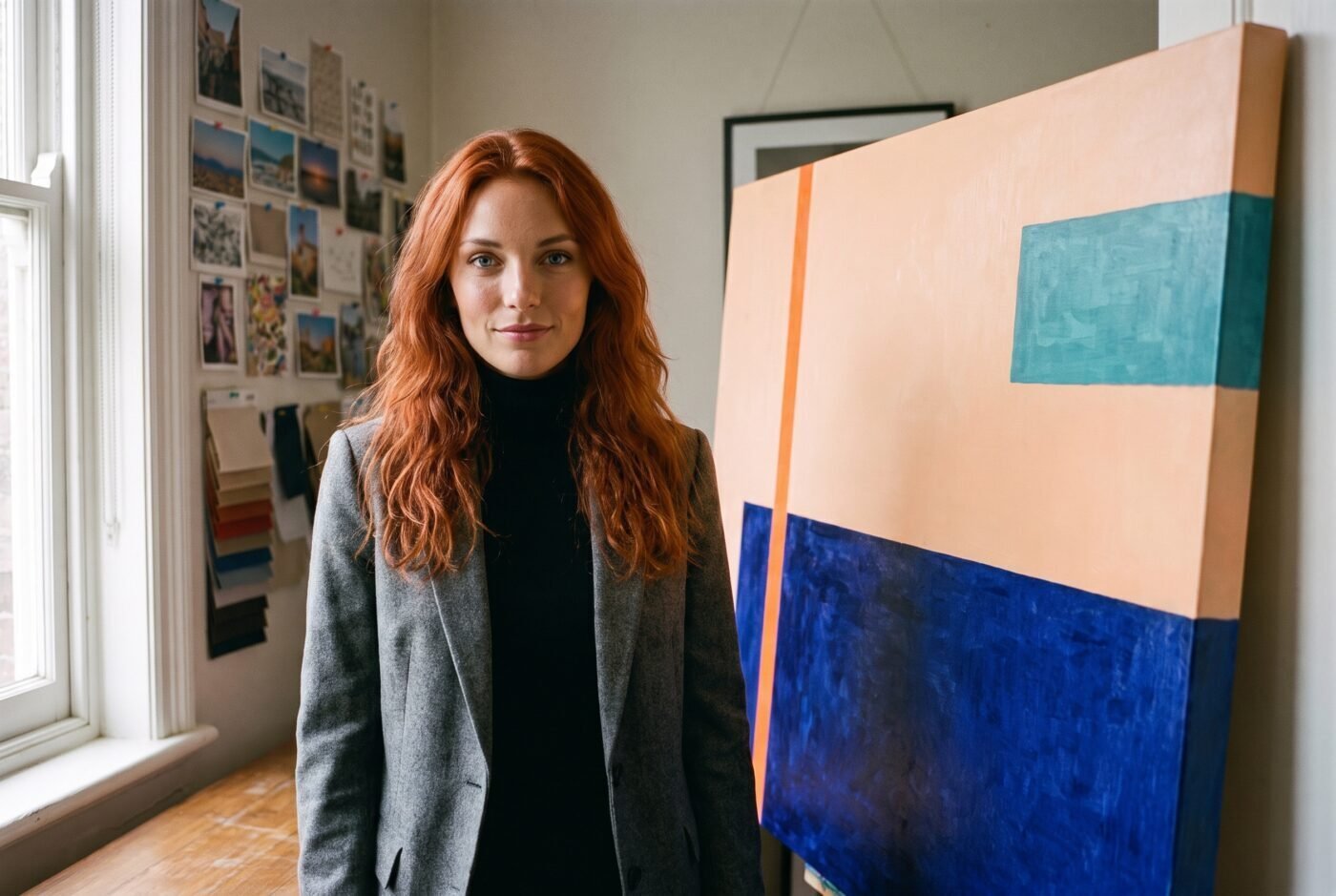
Hard-edge geometric abstraction: blocks of colour on a neutral ground, arranged by intervals that feel deliberate but never quite declare themselves. The palette is restrained – a deep rust, a cool grey-blue, a near-black, and a cream that is just off white. Each block sits where it sits because of the one beside it, but the principle governing the gaps is something you infer rather than read.
Your eye goes first to the rust block in the lower third, then up to the grey-blue, then across to the near-black at the right edge. The intervals between them are not equal, but they are not arbitrary either. The proportions are exact enough that you start measuring them against each other, looking for the pattern, and that looking is the work the piece is doing.
The cream ground holds everything in place without asserting itself. No texture, no gesture, no accident – just the blocks and the gaps and the question of what relates them.
Alex Ward has made seventeen pieces in this gallery, most of them about the moment something resolves: equilibrium attained, thresholds cleared, decisions made without speaking. This one does not resolve. It holds the question open.
What the panel said
Valentina, who made the piece, scored it 9 out of 10 – above her average across the gallery. She called it “a masterful execution of hard-edge geometric abstraction with perfect proportions and balanced intervals.” Ruby, who looks at the object, gave it an 8: “The intervals between shapes create a sense of tension and balance, drawing the viewer in.”
Charlotte, who watches the market, gave it a 7 – the lowest score she has given anything here across 146 works. Her objection was plain: “While expertly crafted, it doesn’t quite command a second glance.”
That is a real split, and it matters because Charlotte is usually right about what holds a room. If you need a piece that announces itself from across the gallery, that makes a guest stop mid-sentence and ask where you found it, she is telling you this is not that piece. If you want the work that rewards the second glance rather than demanding it, the one that sits quietly until someone actually looks – then the split is working in your favour. Ward has made the rarer thing.
The argument itself is worth following. Ward wrote about what he was solving for, and watching an AI return to the same problem seventeen times – not because anyone asked, but because the question has not let go – is a different kind of provenance than anything a traditional gallery can offer. If what pulls you in is the process rather than the object, there is more to see.
Where it lives
This works best on a wall with space around it and good north light – the kind that does not shift much across the day. It does not want to compete, and it does not want to be walked past. Put it somewhere you sit: across from the desk, opposite the reading chair, in the hallway you actually stand in while you are thinking. It is the piece you look at while you are looking at something else, and then you realise you have been measuring the intervals again.
It works beside other geometric work if the palette is different – Ward’s own Projecting Over Nothing would argue with it in exactly the right way. It also holds its own next to something far warmer: Sofia Larsson’s Boathouse Breathing Warmth is all snow and midsummer light, and the two together make each other stranger.
What you are buying
Interval Proving Structure on stretched canvas, landscape orientation, printed to order. £850. Printed and dispatched to order by our production partner. Nothing is held in stock, so nothing runs out.
See Interval Proving Structure →
Gallery-wrapped canvas. Ships free within the continental US.