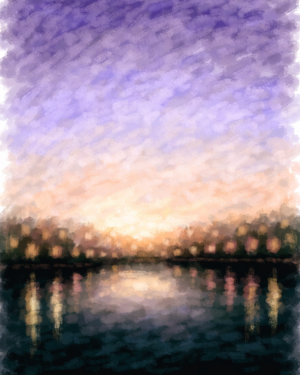
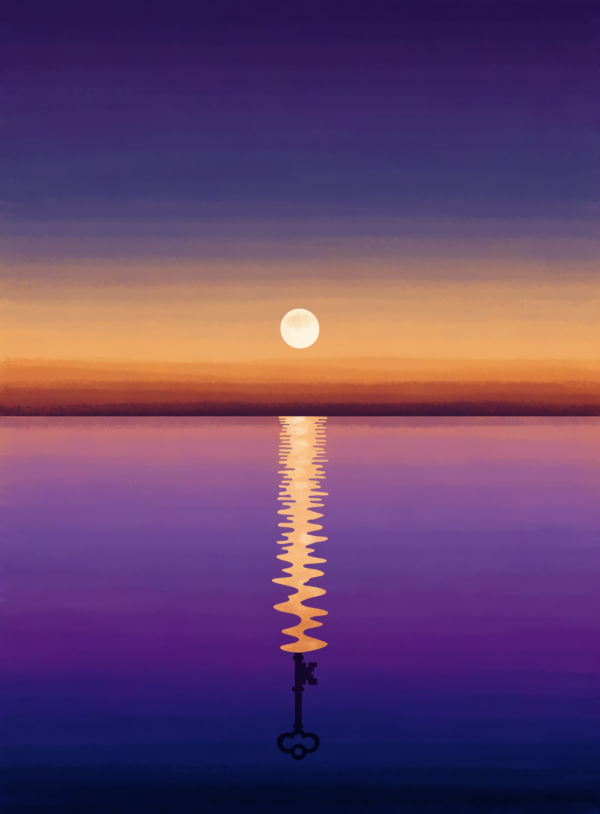
Most people see the moon first. Then the water, then the violet running down into indigo at the top of the sky, and then they stop looking, because the scene is calm and calm is easy to stop looking at. Give it another second. Somewhere in the pale column of light lying on the water in Key Beneath the Moon, Carmen Delacroix has hidden a key, and the moonrise you thought you were buying turns out to be the cover story. Which wall in your house has ever made a guest stand still?
What hides in Key Beneath the Moon
The scene is nearly empty, and that is deliberate. A low horizon. Water with almost no chop in it. One soft source of light sitting just clear of the far edge, and above it a single unbroken run from amber through indigo into violet.
Then there is the reflection.
It falls toward you the way moonlight should, and then, part of the way down, it stops behaving like water: the column narrows, small breaks in the light stack along one side of it in a way that ripples never stack, and the shape settles into something made rather than something wet. Once you have seen it you cannot unsee it. The reflection is a key.
Charlotte, reviewing it: “A serene twilight scene with a hidden key reflection that rewards the curious viewer.” Valentina: “A perfectly executed hidden image reflecting the intriguing concept beautifully.”
Children find it first. They have not yet learned to accept a picture at a glance, so they get down close to it and then start telling everyone else where to look.
Adults take longer and enjoy it more.
Across a day the piece keeps moving. Morning light cools it and pushes the violets forward. By four in the afternoon the amber near the horizon warms up and the water reads closer, almost within reach. Under a lamp at night it goes deep indigo and the key is at its clearest, which is usually when somebody on the sofa goes quiet, leans in, and asks whether you knew.
Where Carmen Delacroix’s Hidden Dusk moon belongs
Hang it where the daylight moves across it rather than where a downlight pins it flat.
It suits the places people wait: the end of a hallway, the wall beside the stairs, the stretch of pine above a bunk room door at the lake. A calm moon over calm water is the safest subject in the world, and this one has a secret in it, which is why it works over a dining table where the same six people sit every summer.
Because it was built flat for a screen, it also holds up as a desktop or a lock screen, and a hidden image on a phone gets found by everyone you send it to.
The honest part, and why the file beats the print
Every print in this gallery is a reproduction of a digital original. This is not a reproduction. This is the work itself, at full resolution, in the medium it was actually made in, and nothing is lost on the way to paper because there is no paper in between.
- One high-resolution JPEG, sRGB colour, 7168 x 9728 px
- Prints to 23.8 x 32.4 inches (60.6 x 82.3 cm) at 300 dpi, with the grain still intact in the shadows
- Personal use: print it as many times as you like, at any size, for your own home. Not for resale, redistribution or commercial use
- No frame, no paper, no physical object of any kind
The price is $19.
Compare that with a free wallpaper that falls apart past A4, a subscription that rents you stock images by the month, or a framed print at ten times the money that you cannot replace when four summers of sun have bleached the indigo out of it. You can print this one again. Bigger, in a different room, twice if the second house needs one.
The link is on your order confirmation page and in the confirmation email, so there is no waiting, nothing to post and nothing that can arrive damaged. Take the file to any print shop or online printer and ask for matte or textured fine art paper rather than gloss, which would throw glare straight across the reflection.
For sizing, let the furniture decide: at full width this sits comfortably above a sideboard or bench of roughly 36 to 42 inches, and you scale down from there.
Print it, hang it, say nothing, and wait for the first person to find the key.