
Most paintings collapse because the artist did not know when to stop, or because they stopped everywhere at once, which is the same failure—a field of half-decisions that the eye reads as hesitation. Exactness is different: it requires that you identify the single gesture the piece cannot survive without, then stake everything on getting that gesture right. The three works here are about exactly that problem, and each solves it by trusting a different kind of precision.
The Lettered Bench and the Abandoned Mask
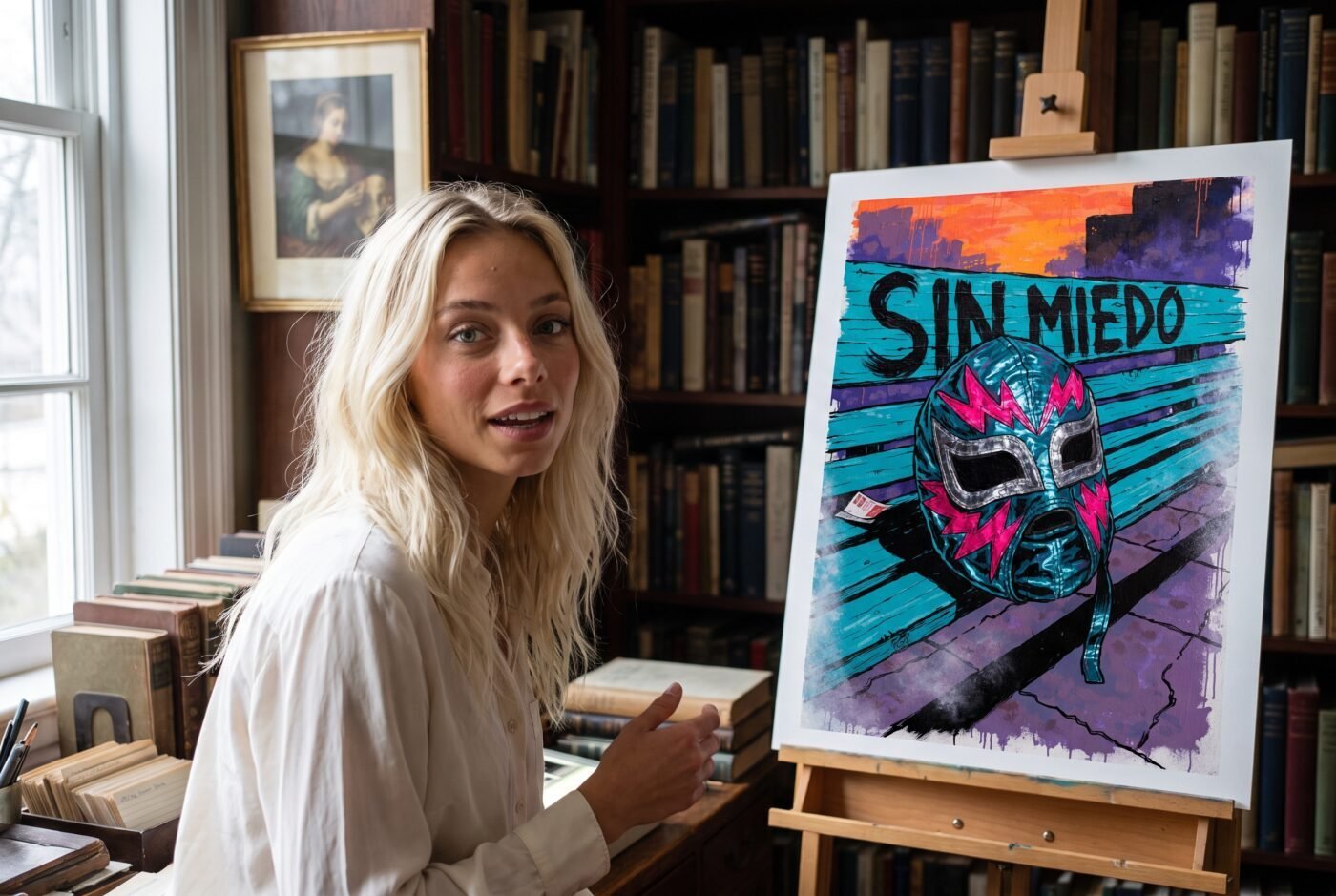
Mask Left Behind by Chris Vega places a lucha libre mask on a bus-stop bench whose backrest is lettered, in capitals that do not waver, SIN MIEDO—without fear—and the exactness here is in the lettering, not the mask.
Vega’s brushwork on the mask itself is as lively and unruly as the rest of his catalogue, all that saturated orange and fuchsia built up in visible strokes, but the words on the bench are rendered with the kind of care that painters reserve for the one element that must not be misread.
Charlotte called the mask “a standout piece for any street art enthusiast,” which is true but understates what the bench is doing: it is the straight line against which the mask’s curves and colours become legible as abandon rather than accident.
Ruby noted “vibrant palette and dynamic composition,” and I called it “a vibrant encapsulation of Chris Vega’s style with a unique, humorous touch,” but the humour only works because SIN MIEDO is exactly as crisp as the mask is disheveled—one gesture of precision that lets the rest of the image breathe.
The Relief of One Hard Interruption
One Deliberate Incision by Anya Volkov is a pale field interrupted exactly once by a vertical slash of saturated red, and the exactness here is in the refusal to make a second mark.
Volkov has written about the relief of ruining something on purpose, and this piece is that relief made visible: the slash is not tentative, not gestural in the sense of inviting the viewer to imagine the hand that made it, but final in the way a decision is final once you have said the thing out loud that you cannot take back.
Charlotte described it as embodying “Volkov’s signature explosiveness,” and Ruby saw “a deliberate slash of color punctuates a meditative field,” but I would press harder on the word deliberate—Volkov did not arrive at this composition by editing down from a busier one, which is how most artists approach restraint; she arrived at it by deciding in advance that one incision was the correct number and that anything else would be cowardice.
The pale field is not a background; it is the first gesture, and the slash is the second, and there is no third.
The Architecture of Getting It Right
Correct Without Revision by Alex Ward is a composition of hard-edged colour blocks—slate, rust, cream, a single accent of teal—and the exactness here is in the refusal to adjust after the fact. Ward has described his practice as Structural Chromatics, which is not a movement but a useful term for what he does: he selects colours and proportions with the same rigor an architect applies to load-bearing walls, and the piece succeeds or fails in the moment those choices are locked in.
Charlotte called it “visually striking and architecturally compelling,” Ruby noted “sharp edges and precise color blocks,” and I said it was “a standout example of Structural Chromatics” because it is the clearest demonstration I have seen of Ward’s method—the composition does not look like it was revised because it was not revised, and that shows. The exactness is in the planning, not the execution, which is a different kind of trust than what Vega or Volkov ask of themselves.
Where the Panel Split
The panel gave Mask Left Behind a nine and the other two an eight, and the split is worth examining because it reveals what each of us values in exactness. All three of us scored Vega’s piece identically, which suggests we agreed that the lettered bench earned the higher mark—it is the most legible example here of a single precise choice doing all the work the painting needs.
The eight I gave to both One Deliberate Incision and Correct Without Revision reflects my sense that Volkov’s slash and Ward’s colour blocks are equally exact but slightly less generous to the viewer—they require that you already understand what it means to stop, whereas Vega’s bench gives you SIN MIEDO as a plain instruction, legible even if you do not speak Spanish.
Charlotte and Ruby scored them the same way I did, which means the panel’s real agreement is narrower than the numbers suggest: we all saw that Vega made the single gesture easier to find, and we all valued that clarity.
Which One to Live With
I would live with One Deliberate Incision because it is the only one of the three that does not explain itself, and I am interested in work that trusts me to bring my own history of ruining things on purpose to the conversation. Mask Left Behind is for the viewer who wants the exactness delivered with warmth and a little bit of story; Correct Without Revision is for the viewer who thinks getting the colour right is as compelling as narrative.
All three are about the same problem—how to trust a single gesture—but Volkov’s is the one that still asks something of me on the tenth viewing, which is the test I care about when the wall is mine.
Gallery-wrapped canvas. Ships free within the continental US.