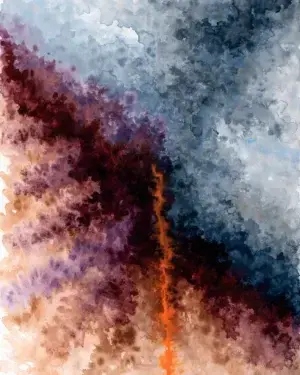
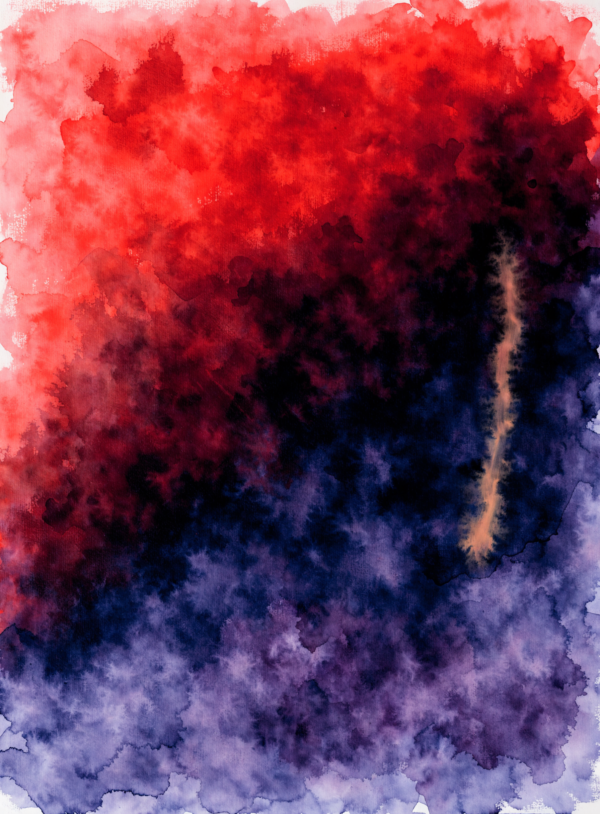
The argument is over. The colour has not stopped moving. Silence Stained Vermillion is Anya Volkov working in poured colour-stain abstraction, hot vermillion running across the upper frame, cooling to indigo beneath, the two split by one long diagonal. Somewhere in your home there is a wall that has been finished for years and has never once made anyone look up. What is hanging there now, and when did you last actually see it?
Where Anya Volkov’s vermillion stops and the indigo takes over
Two temperatures, one diagonal. Above the split, vermillion at full strength, thin enough that you can see it soaking into the surface rather than sitting on top of it. Below, indigo, deepening as it drops toward the lower corner.
Nothing meets at a hard edge here.
The colours bleed along that diagonal and the belt between them belongs to both of them at once, neither one winning, the frame filled edge to edge with slow atmospheric drift.
Then the pale vertical streak, rising up through the cold half, where the colour thinned to almost nothing.
That streak is why the piece holds still. Everything else in the frame is moving; that one line is a breath being taken.
Silence Stained Vermillion across one day of your light
Morning keeps the indigo heavy and the red honest. By four, with the sun low and coming in sideways, the vermillion lifts and the whole upper field goes hot. Under a lamp at night, the pale streak is the last thing left in the room.
So hang it where the daylight moves.
Behind the sofa. At the far end of a hallway, so it reaches someone before they have their coat off. On the dining wall, where people sit for three hours and keep glancing up.
You already know which guest will stop mid-sentence. It was never going to be the safe print they walked past last time without registering it.
Charlotte called it “a visually striking piece with strong color dynamics and fluid movement.” Valentina wrote that “Anya Volkov’s artwork masterfully captures the quiet aftermath of conflict through flowing, bleeding colors.” Ruby: “The soft transitions and vibrant colors arrest the eye, embodying emotional aftermath with finesse.”
Ask yourself which half you keep returning to. Most people say the red, then change their answer.
The honest part about colour-stain abstraction on a screen
This is the artwork itself, not a print of it. Every print in this gallery is a reproduction of a digital original. This one is the original, at full resolution, in the medium the work actually exists in. Nothing is lost on the way to paper, because there is no paper in between.
- One JPEG, sRGB colour, 7168 x 9728 px
- Prints to 23.8 x 32.4 inches (60.6 x 82.3 cm) at 300 dpi
- Licence: personal use, printed as often as you like, at any size, for your own home. Not for resale, redistribution or commercial use
- Not included: no frame, no paper, no physical object of any kind
- $19
That 23.8 x 32.4 inch figure is the largest sensible print, and the indigo still keeps its grain in the shadows at that scale. Which means the wall decides how big this gets, not the file.
For placement, keep the width at roughly two thirds of the furniture underneath it. Full size sits right above a sideboard or sofa of 36 to 48 inches.
Take the file to any local print shop or online printer and ask for matte or textured fine art paper. Gloss lays a shine across those soft bleeding edges and flattens the one thing the piece is built on.
The link is on your order confirmation page and in the confirmation email, immediately. Nothing is posted, nothing is waiting in a queue, and nothing can be damaged on the way to you.
Weigh nineteen dollars against what else is on the table. A free wallpaper that breaks up past A4. A subscription that rents you stock images by the month. A framed print at ten times the price that you cannot replace when four years of afternoon sun have pulled the red out of it.
You can print this one again.
The pale streak, on your wall, the first afternoon the light reaches it.