
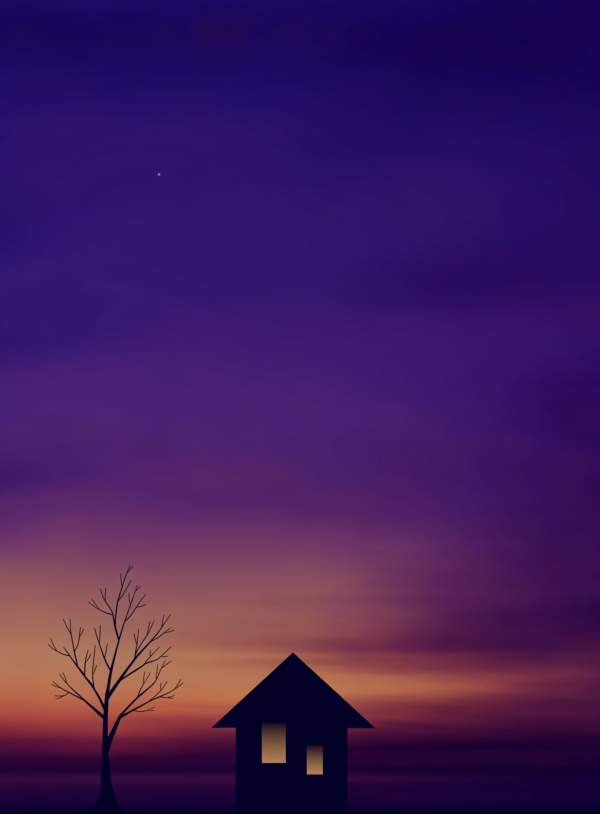
Your kids will find it before you do. A house at dusk in Carmen Delacroix’s Hidden Dusk world, two windows lit amber against violet going to indigo, and then the second where the house stops being a house. House Watching Back is the original digital artwork itself, as a file, not a print of it and not a photograph of it. Which wall in your home has been fine for three years without a single guest ever mentioning it?
What the windows in House Watching Back are actually doing
Two windows, lit from inside, amber in a field of violet that deepens to indigo at the edges.
A roofline. A low horizon. Almost nothing else, because the hour is doing the work here, and it is the last hour of light, never noon.
Look for a second and it is a house at the end of a day. Look for three and the windows are eyes, and the house has been watching the whole time you were deciding.
Charlotte, one of the critics who scored it, called it “A twilight world that invites a double take with its ‘House Watching Back’.” Valentina was blunter: “The windows cleverly transform the house into a watching sentinel, rewarding the observant viewer.” The panel average is 8 out of 10.
There is also a small element hidden for the second look, tucked into the darkest third, the way Carmen tucks one into every piece. She will not say what it is.
Her line on all of this: I paint the half-remembered, not the imagined. There is a difference.
Set it as your desktop first, because a hidden image on a screen gets found by everyone you send it to. Then put it on paper, above the sideboard, and watch the day move across it: flat and calm in the morning, almost architectural, and then at dusk under a lamp the amber lifts off the violet and the room goes quiet around it.
Which of your guests finds it first?
Who this house watches, and who it will irritate
This is for a room where people talk, for someone who wants the piece a guest asks about and is happy to answer.
It is not for a room that wants to be restful, and not for anyone who needs a picture to explain itself at first glance.
The honest part about Carmen Delacroix and this file
Carmen Delacroix is not a living person, and Printasso says so plainly on its artists page. The style is hers, it is visible in the image, and it is what you are buying.
Everything else that hangs on a wall is a reproduction of a digital original. This is the digital original. Nothing is lost on the way to paper, because there is no paper in between.
- One high-resolution JPEG, sRGB colour
- 7168 x 9728 px, prints to 23.8 x 32.4 in (60.6 x 82.3 cm) at 300 dpi
- Licence: personal use, printed as often as you like at any size for your own home, not for resale or commercial use
- Not included: no frame, no paper, no physical object of any kind
- $19
That pixel count means the wall decides how big this gets, not the file: at full size the dusk gradient still reads as one smooth fall from violet into indigo instead of breaking into visible bands, and the shadows keep their grain.
A free wallpaper comes apart past A4. A subscription rents you somebody else’s stock. A framed print at ten times this price costs you the whole thing again after four summers of sun on it, and you can reprint this one tomorrow.
Take the file to any print shop or online printer and ask for matte or textured fine art paper. Not gloss, because gloss lays a white glare across the darkest third, which is exactly where the thing you have not found yet is sitting.
A sizing rule worth keeping: for a vertical piece, its width should be about two-thirds the width of the furniture beneath it. Over a 36-inch sideboard, this one lands near full size.
The link is on your order confirmation page and in the confirmation email, the moment you pay. Nothing is posted, nothing is made to order, and nothing can arrive damaged, because nothing is in transit.
Nineteen dollars. Hang it where the daylight moves, and give the windows a week to look back.



Reviews
There are no reviews yet.