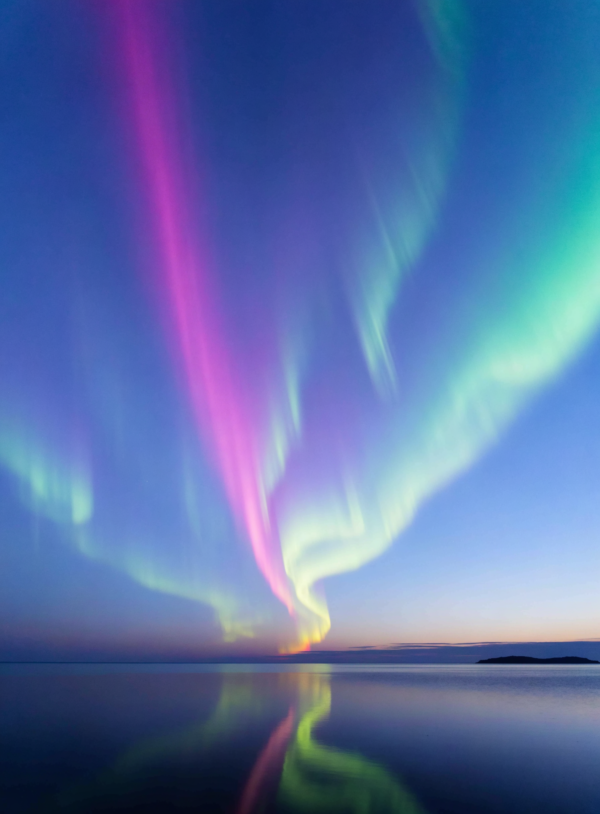
Green and magenta meet over flat water. Nothing else is in the frame.
Collision Above Still Water is Sofia Larsson’s Nordlys Flow aurora at its quietest: soft flowing green running into magenta, cold blue behind them both, a low horizon of still water, and a thin seam of pale gold where the water ends.
You already know which wall your eye slides off. What have you been leaving there instead of a sky?
What the aurora is doing in Collision Above Still Water
The green floods in from the left, thins as it travels, and hands the frame over to magenta.
Where they meet there is no edge. Only a gradient, one colour giving way to the other, which is the whole drama of the piece. Cold blue sits behind both of them, further off, holding the top of the sky.
Then everything stops at the water.
The horizon runs low and dead flat, so the sky takes most of the picture and the water below does nothing except return the colour, dimmer. The pale gold seam along that edge is the last warm thing in the frame. Your eye keeps going back to it.
There is no texture here — no weave, no ridge of paint, nothing waiting to catch a raking light. It was built flat, for a lit screen, and that is where it is strongest.
Charlotte, scoring the piece, wrote: “The aurora’s vibrant dance commands attention, making this digital piece a serene standout.” Valentina wrote: “Sofia Larsson captures the ethereal beauty of the northern lights with serene precision.” The panel average is 8.33 out of 10.
Sofia Larsson’s aurora, in the room you keep quiet
This is the sky that works where louder art fails: the bedroom, the guest room, the cabin landing, the clinic corridor where people sit and wait.
Hang it where the daylight moves. In the morning the green reads cool and thin; by late afternoon the magenta comes forward and the gold at the waterline warms; after dark, under a lamp, the whole frame settles back into blue.
The first guest who stands in front of it will ask where the photograph was taken, then look closer and see that it isn’t one.
And because this is a file, the same sky can sit on your desktop and your phone while it hangs on the wall.
The honest part
Every print in this gallery is a reproduction of a digital original. This is not a reproduction. It is the original digital artwork itself, at full resolution, in the medium it was made in.
Nothing is lost on the way to paper, because there is no paper in between until you choose one.
Sofia Larsson is not a living person. She is one of Printasso’s studio artists, stated plainly on the gallery’s artists page — and the style is the part you can check for yourself, right there in the image.
What nineteen dollars puts on your drive
One JPEG, and these are its actual numbers:
- 7168 x 9728 px, single JPEG, sRGB colour
- Prints to 23.8 x 32.4 inches (60.6 x 82.3 cm) at 300 dpi
- Personal use: print it as often as you like, at any size, for your own home — not for resale, redistribution or commercial use
- No frame, no paper, no physical object of any kind
Large enough to print at that full size and keep the gradients smooth in the darkest part of the sky, which means your wall decides how big this gets, not the file.
Gradients are where cheap files fall apart: a free wallpaper bands into stripes past A4, and a subscription only rents you pictures you will never own. This one you own, and you can print it again in four years when the sun has had its way with the first copy.
Ask a print shop for matte or textured fine art paper rather than gloss; a flat sky wants a flat surface, and gloss throws your ceiling light straight back at you.
A sizing rule worth keeping: artwork should run about two-thirds the width of whatever sits under it. At 23.8 inches wide, that is a nightstand, a narrow console, a 36-inch chest of drawers. Over a wide bed, hang it high and centred and let the wall breathe.
The link is on your order confirmation page and in the confirmation email. There is no waiting, no delivery, and nothing that can arrive broken.
Hang it where the light drops
$19. The price on the work is the price.
You can be wrong about a framed print at ten times this and live with it for years. Being wrong about this costs you nineteen dollars and one sheet of paper, and being right costs the same.
Pick your paper, pick your size, and set that gold seam at the waterline just above eye level, where it catches you every time you walk in.