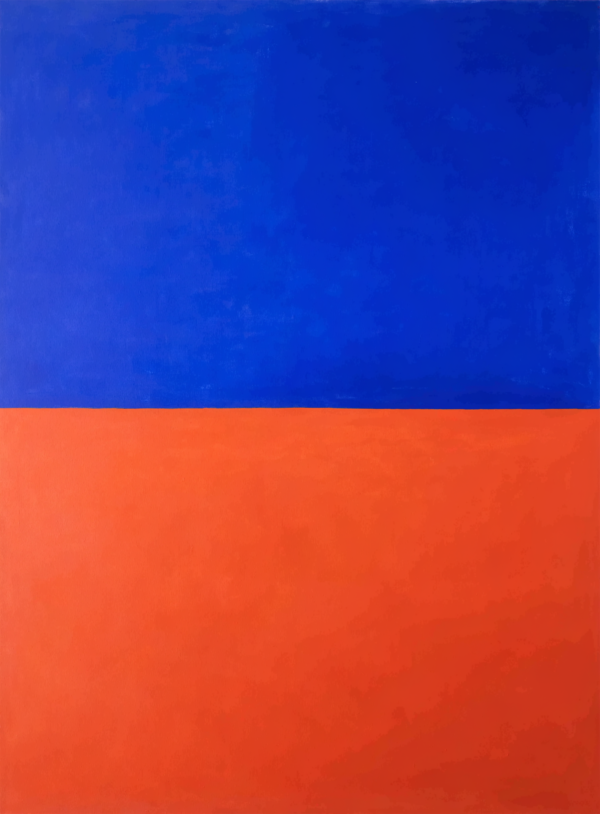
Two colours stop at the same line. Neither one blurs, neither one wins, and the edge between them sits exactly where Alex Ward decided to hold it. Held Until Agreement is reduced colour-field geometry from his structural chromatics work: two enormous flat planes filling the frame, one colour relationship, nothing else. No grid. No small shapes to squint at. You already know the wall, either the one that has been waiting or the one carrying a print you stopped seeing three years ago. What would you put there if restraint were actually an option?
The only event in Held Until Agreement is one edge
The composition is flat, calm and almost stubbornly simple.
Two vast fields of colour, meeting along a single clean line that crosses the frame and never wavers. That line is the whole picture.
No texture to read, no architectural detail, no cluster of little blocks doing tricks in a corner. What is left is one decision about how two colours sit beside each other, and it either resolves or it doesn’t. It resolves.
Flat colour behaves differently on a wall than a photograph does.
In the morning the lighter field takes the daylight and hands the room its brightness back. By four the two planes have moved much closer in weight, the darker one begins to hold the corner, and the edge is the only thing in the room that has not shifted since breakfast.
Look at it for a week and you stop looking at the colours and start looking at the join.
Where Alex Ward’s structural chromatics earns its wall
This is the piece for the wall where nothing else is allowed to be loud.
A lobby that already has wayfinding, signage and a brand palette to respect. A hallway between two doors. Above a console in a bedroom where you want the room resolved rather than entertained. It gives you one bold move to build a palette around, and permission to keep everything else quiet.
People notice it from across the room and then ask what the two colours are, which is a better conversation than asking where a landscape was photographed.
The critics landed close together on this one. Ruby: “The two color planes meet with precision, creating a calm and confident piece.” Charlotte: “The chromatic negotiation feels monumental and serene.”
Built flat for a screen, it also sits behind desktop icons without arguing with a single one of them.
What you get, and what the file will do
This is the original digital artwork itself, not a print of it and not a photograph of it. Every print in this gallery is a reproduction of a digital original. This one is not, because there is no paper in between. You get the work in the medium it was made in, at full resolution.
- One high-resolution JPEG, sRGB colour, 7168 x 9728 px
- Prints to 23.8 x 32.4 inches (60.6 x 82.3 cm) at 300 dpi
- Personal use licence: print it as often as you like, at any size, for your own home. Not for resale, redistribution or commercial use
- No frame, no paper, no physical object of any kind
Flat colour is unforgiving about resolution, which is why the pixel count matters more here than it would on a busy image.
At nearly ten thousand pixels down the long side, that edge stays an edge at full size. No soft step, no stair-casing, no fringe where the two fields meet. Print it smaller and you are simply leaving resolution unused, which is a comfortable position to be in.
The honest part about size and paper
Art above furniture wants to be roughly two-thirds the width of the piece below it. A console 36 inches wide asks for something around 24 inches across, which is where this file lands at full size without being pushed. The wall decides how big this gets, not the file.
Take it to any print shop or online printer. Matte or textured fine art paper suits these flat planes far better than gloss, which throws reflections straight across the edge and spoils the one thing you came for.
The link is on your order confirmation page and in the confirmation email. Nothing is posted, so nothing is delayed and nothing can arrive damaged.
What nineteen dollars is competing with
Nineteen dollars.
A free wallpaper falls apart past A4. A subscription rents you stock images for as long as you keep paying. A framed print costs ten times this and cannot be replaced when four years of afternoon sun have quietly drained it, whereas you can print this one again on Tuesday.
Choose the wall, and let the edge do the rest.