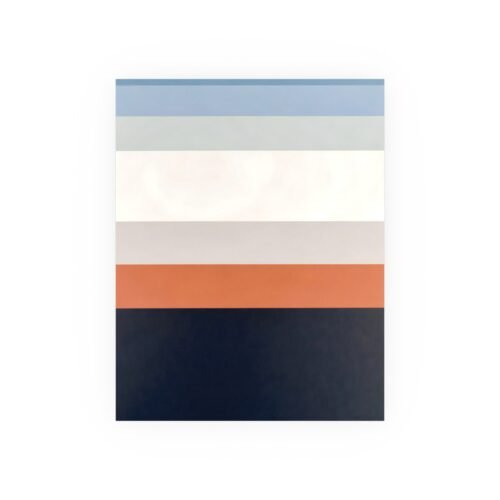
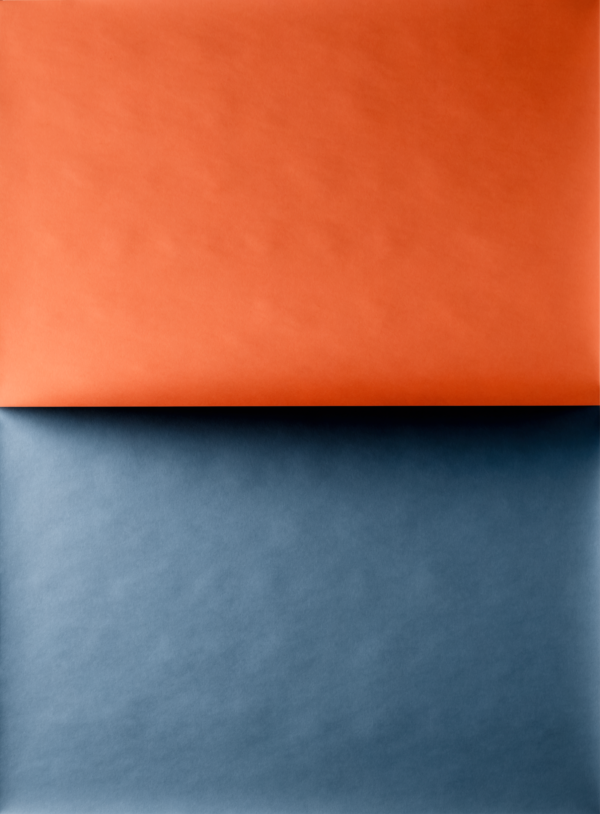
Two colours. One edge. Nothing else asked for. Held Equilibrium is Alex Ward working at the far end of his structural chromatics line: reduced colour-field geometry, one warm plane meeting one cool plane on a single clean edge, filling the frame corner to corner. No grid. No small shapes. Which wall in your home has been waiting three years for someone to make a decision on it?
What Held Equilibrium is doing to the wall
Stand back from it and there is genuinely nothing to solve.
The edge runs true across the frame, and the two fields on either side of it hold each other in place — the warm side pushing forward, the cool side sitting back, neither one winning. That is the whole event. Portrait format, tall rather than wide, so it reads as a column of colour rather than a landscape you look into.
Then the day starts moving over it. Morning light flattens both planes and the edge gets almost architectural, like a joint in the wall itself. By four in the afternoon the warm field has warmed further and the cool side has gone quieter, and the edge appears to have shifted a few millimetres without moving at all. Watch it for a week and you will start checking it the way you check a window.
Alex Ward’s structural chromatics, reduced to one decision
Ward built this one flat, for a screen, which is why it behaves so well.
Nothing recedes, nothing textures, nothing competes. Put it behind a row of desktop icons and every icon stays legible — a busy composition would have fought them for the rest of your working life.
Charlotte, reviewing it for Printasso, called it “the kind of visual silence that lets everything else in a room breathe.” Valentina put it closer to the mechanics: “the visual silence of two colours agreeing to stop, held in perfect tension.” Ruby landed on the same note as Charlotte — “the kind of visual silence that lets everything else in a room breathe.” Critic average, 8 out of 10.
Where this one goes, and who notices it
Hang it where the daylight moves — a hallway with one window, the wall behind a reception desk, the narrow stretch beside a doorway that nothing else has ever fitted.
It works above a sideboard because it does not argue with what you put on the sideboard. It works in an entrance hall because it gives an arriving guest one thing to land on instead of six. Designers specify it in multiples for lobbies and apartments for exactly that reason: one bold decision, then quiet.
People ask about it at the second visit, not the first. That is the compliment.
The honest part
This is the artwork itself, not a print of it and not a photograph of one. Every framed piece you have bought before was a reproduction of something else; this is the file Ward made, at full resolution, in the medium it was made in. Nothing is lost on the way to paper, because there is no paper in between.
What you receive:
- One high-resolution JPEG, sRGB colour, 7168 x 9728 px
- Prints cleanly to 23.8 x 32.4 inches (60.6 x 82.3 cm) at 300 dpi
- Personal use licence: print it as many times as you like, at any size, for your own home. Not for resale, redistribution or commercial use
- No frame, no paper, no physical object of any kind
Seventeen dollars. A wallpaper site gives you something that falls apart past A4, and a subscription rents you stock you never own. This one you keep, and reprint in four years when the sun has had its way with the first copy.
What happens after you decide
The link is on your order confirmation page and in the confirmation email, straight away. Nothing is posted, nothing is in transit, nothing can arrive damaged.
Take the file to any print shop or online printer and ask for matte or textured fine art paper — gloss puts a shine across two flat fields and undoes the calm.
For sizing, measure the furniture below it and print to roughly two-thirds of that width: a 36-inch console takes the full 23.8 inches comfortably, and a narrower shelf takes it scaled down without losing the edge.
Then hang it, and let one clean edge hold the room.