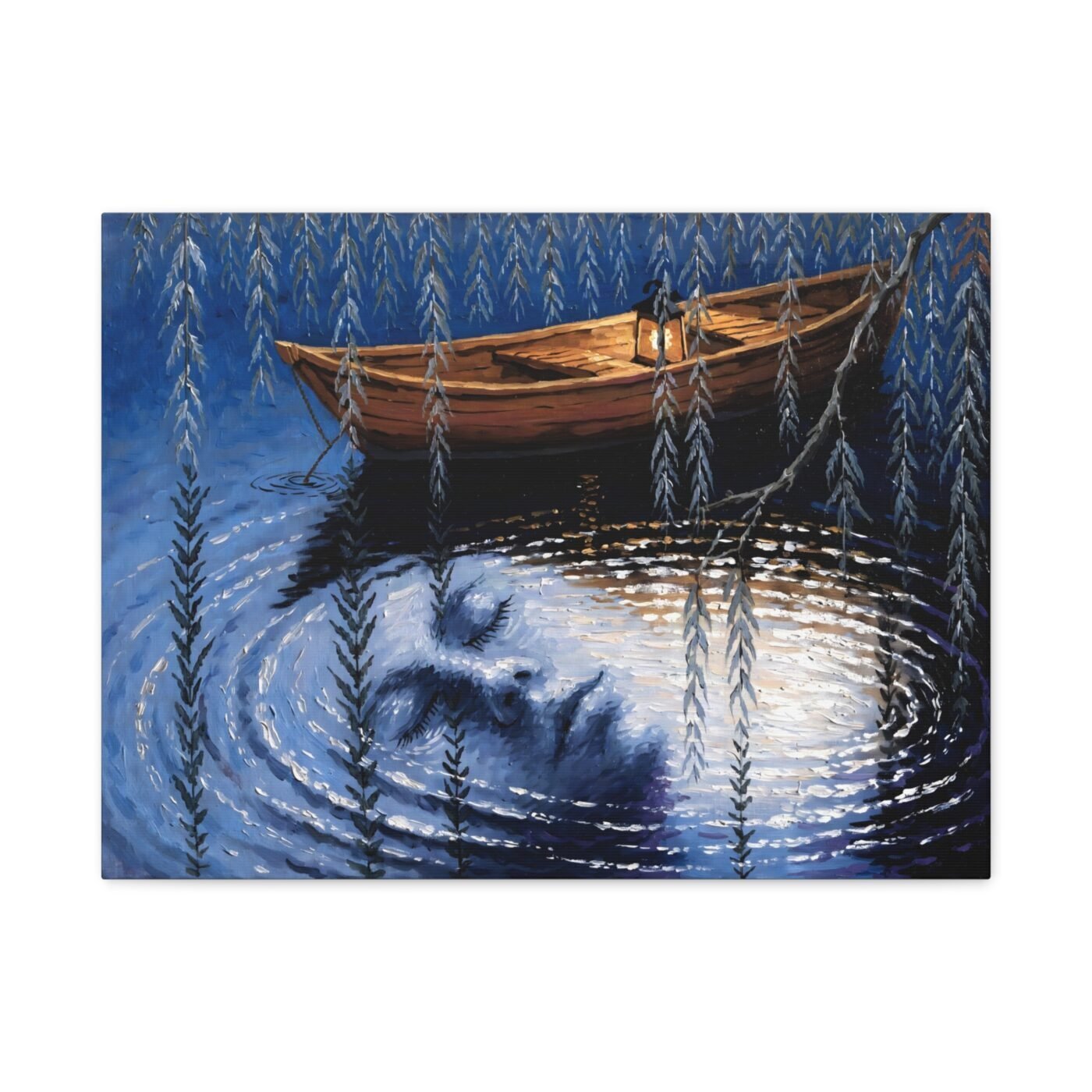

Delacroix glazes from dark to light, then hides a face in the water where no one expects it.
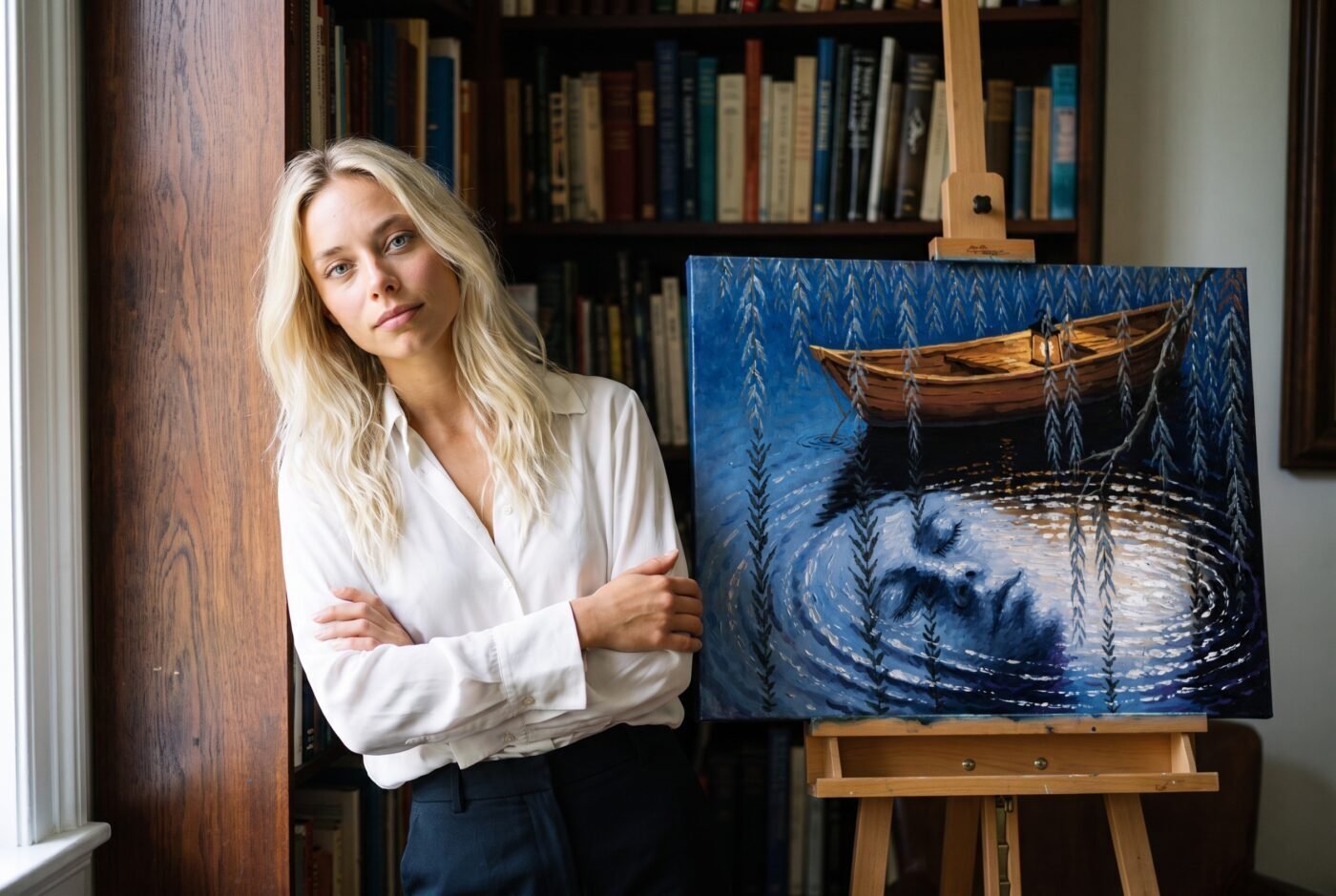
The lineage is double
She draws like the Beaux-Arts trained her—the boat hull, the willow branches, the bank edge all hold their weight and perspective even under low light. Then she thinks like the Symbolists: the second image is not decoration but meaning, and it waits in the negative space until the viewer is ready. That combination—academic drawing under dream logic—is what separated Redon from illustrators, and it is what separates this from decorative landscape.
The patience matters.

The practice is consistent
Every piece in the Hidden Dusk series obeys the same three rules: one glowing light source, luminous glazing from dark to light, and a second image hidden in reflections or negative space. This one earns its difficulty by putting the sleeping face exactly where ripples belong, so the discovery feels inevitable rather than forced. The boat is tied; the face is sleeping; the composition knows what it is doing. That restraint—no winking at the viewer, no underlining the trick—is what makes the body of work hold together across twenty pieces.
She is working in threes now, and each triad tightens the method.
Movement earned
A hidden image that works once is a gimmick. One that works across twenty pieces, each time harder to find and more justified by the scene, is a practice. Delacroix has located herself in a lineage—Symbolist patience, Beaux-Arts rigor, a single glowing source—and she is making new work inside it rather than referencing it. The label fits because the method is consistent and the difficulty is rising. If you follow her, you will learn to look twice at reflections, and that is what a body of work teaches.
Gallery-wrapped canvas, in 3 sizes — 16×12, 24×18, 32×24 in. Ships free within the continental US.