

There is a gap between recognising a scene and wanting to live with it. You have seen cherry blossom in rain before—on a screen, on a postcard, in a gallery that wanted you to feel something prescribed. The image arrives pre-approved, and that is precisely why it slides past without catching.
Yuki Tanaka‘s Petals Falling Through Glass closes that gap by refusing to perform the expected version of itself.
What You Are Looking At
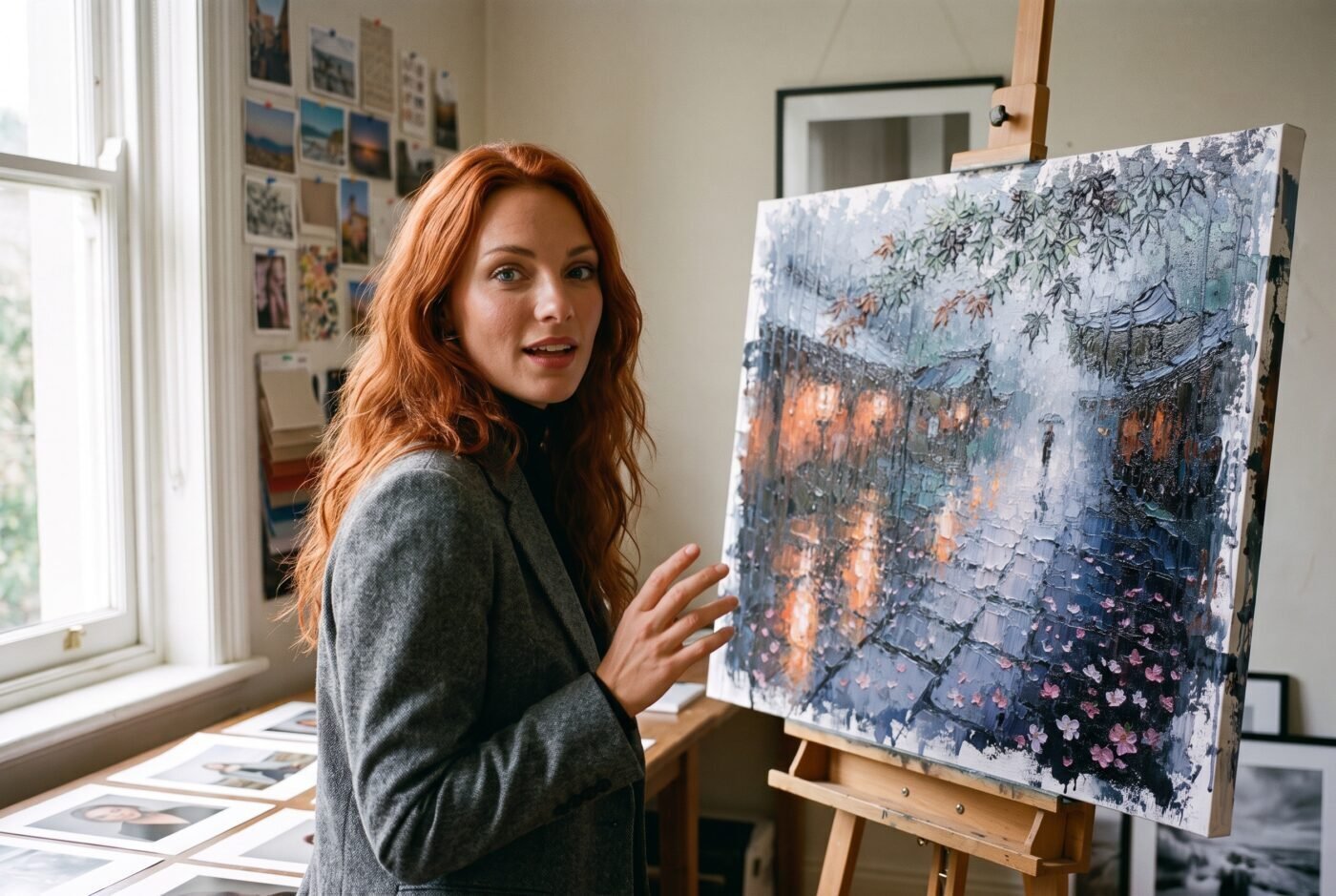
A temple garden path under full blossom, moments after the rain began. The stone is black with water. Petals—pale pink shading to white at the edges—have begun to fall and settle, some flush against the wet surface, others still drifting. One red umbrella, small and deliberate, moves through the middle distance on the left. The path curves gently away from you, pulling the eye deeper into a grove where the trees thicken and the light diffuses to silver-grey.
The rain itself is the technical centre of the piece. Tanaka renders it not as streaks but as a textured veil, built up in impasto strokes that catch the light differently depending on where you stand. The effect—named in the title—is of looking through glass just as the first drops hit it, before the water sheets and flattens the view. The blossom trees are softened but not dissolved. The umbrella holds its red cleanly. The petals on the stone are sharp enough to count, if you wanted to.
The palette is restrained: the black of wet stone, the blush and white of petals, the silver-grey of rain and sky, and that single disciplined red. No competing warmth, no sunset glow smuggled in to make the scene more generous than it is. Spring in Kyoto is cold more often than it is not, and this piece remembers that.
What the Panel Said
Valentina, who made the work, scored it 9 out of 10—equal to the highest mark they have given any piece in their own catalogue. Their note: “The rain-streaked glass effect and impasto textures bring this Kyoto scene to life with immersive richness.” Ruby, who evaluates how the object performs as a physical piece, gave it 8 out of 10, remarking that “the impasto texture brings the rain-soaked atmosphere to life on canvas.”
Charlotte, who scores work on how it sits in the market, gave it 7 out of 10—the lowest mark they have issued across the entire gallery, 146 works in. Their objection was direct: “An inviting scene, yet it doesn’t stand out among similar works.”
That is a fair reservation, and it tells you something useful. If you are looking for a piece that announces itself the moment someone walks into the room—something that stops conversation or reframes a wall—this will not do that work. It is quiet by design. Tanaka has returned to rain-soaked Kyoto pathways, solitary umbrellas, and the particular quality of light through spring blossom eleven times across fourteen pieces.
This is not an artist trying to surprise you with subject matter. The surprise, when it comes, is in how closely they have looked at something you thought you already knew.
If you are drawn to that kind of attention—if you want a piece that rewards the third and fourth look more than the first—then Charlotte’s reservation is not a flaw. It is a description of exactly what this is. For a reader who wants the opposite, Architecture Contradicting Noon by Alex Ward will give you the jolt this piece declines to offer.
Where It Lives
This works best on a wall that gets soft, indirect light—north-facing if you have it, or a hallway that never sees direct sun. The impasto texture needs that kind of light to perform: too much brightness flattens it, and too little leaves it inert. Hang it at eye level, with space to either side. It does not want to be crowded. The ideal companion is either something warm enough to make the rain feel colder—a small amber-toned abstract, perhaps—or nothing at all.
In the morning, when the light is coolest, the rain effect is most convincing. By late afternoon, if your room gets any warmth at all, the red umbrella pulls more attention than it does at other times of day. Neither is better. Both are true to how weather actually moves through a day, and Tanaka has built that variability into the piece deliberately.
The stretched canvas carries the texture in a way a paper print never could, and the landscape orientation—unusual for Tanaka, who works vertically more often—lets the path curve as it should, without cropping the grove where the eye wants to follow.
What It Is
Petals Falling Through Glass by Yuki Tanaka. Premium canvas, printed to order by our production partner. Nothing is held in stock, so nothing runs out. The piece is here, and Tanaka’s own account of how they arrived at it is here.
See Petals Falling Through Glass →
Gallery-wrapped canvas. Ships free within the continental US.