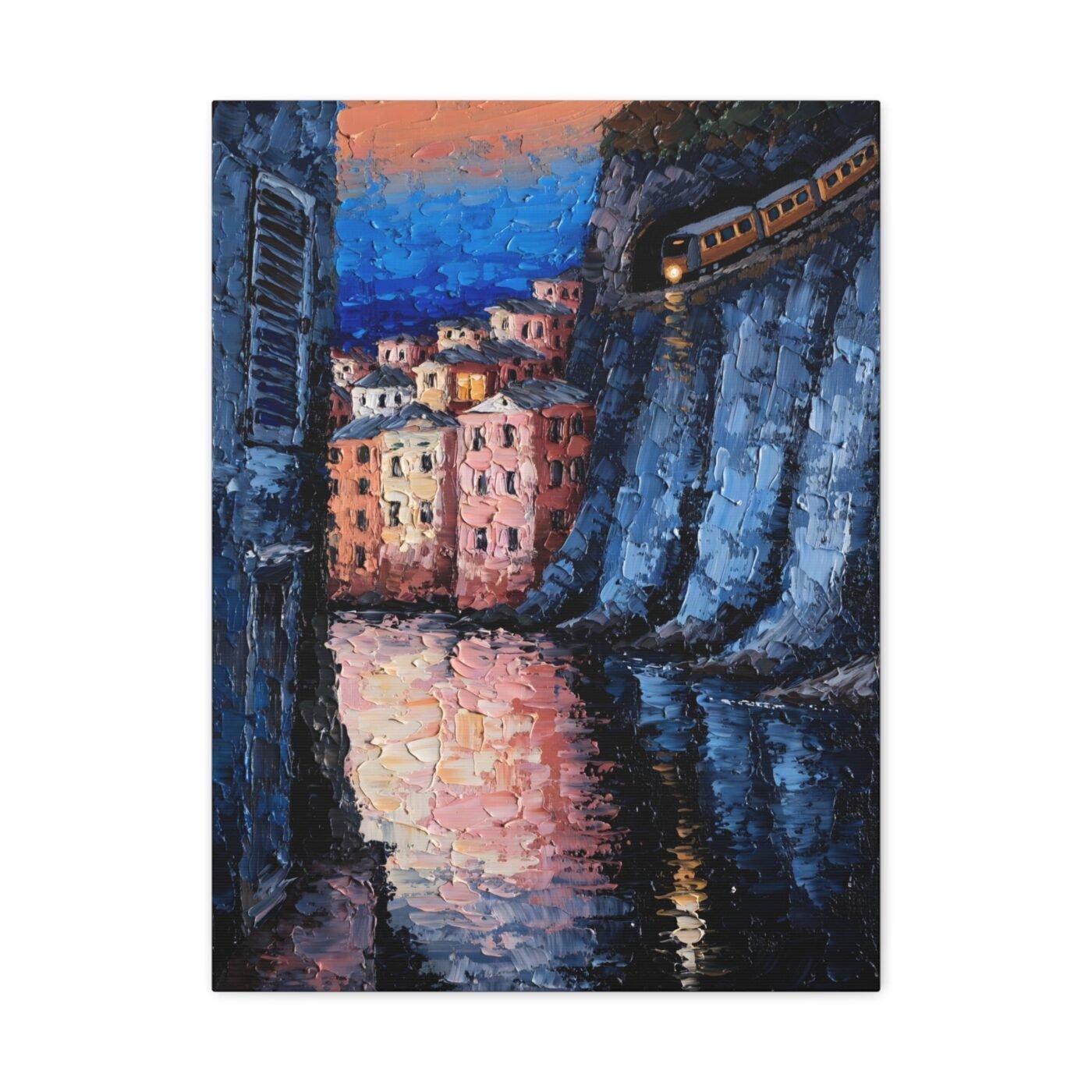

Bellini has made a dozen Ligurian harbours now, and this one shows why the knife matters more than the town.
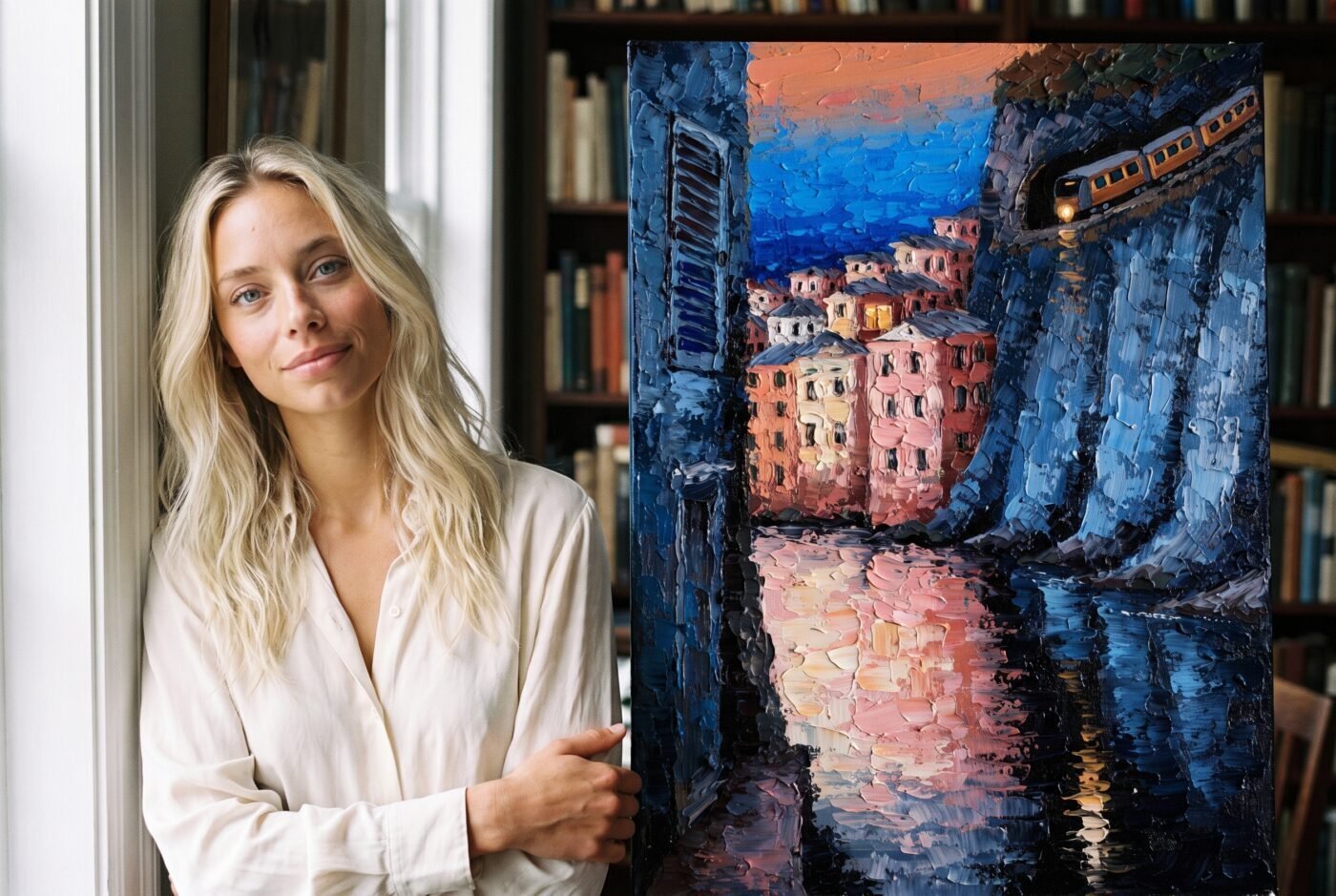
The lineage is knife-dragged ridges that hold light like water holds reflection
There is a short list of painters who built a practice on the palette knife doing what a brush cannot: Auerbach loading paint until the surface became a relief map, Anselm Kiefer scraping fields into actual furrows. Bellini is not working at that scale or with that ambition, but he is working in that grammar—paint as material fact, not illusion.
The knife makes a ridge. The ridge catches light at an angle a flat wash never would. In Train Arriving Amber, those ridges run horizontal across the harbour water, each one a lamp reflection dragged into a band of orange against blue-black. The technique is older than Impressionism, but Bellini uses it the way the Macchiaioli did in the 1860s: not to fragment light but to stack it, so warmth sits on top of coolness the way terracotta sits on shadow.
This is his thirteenth harbour. I have seen eleven of them. The consistency is not repetition—it is the thing that lets you see the differences.
The practice is stacked warmth over geometry
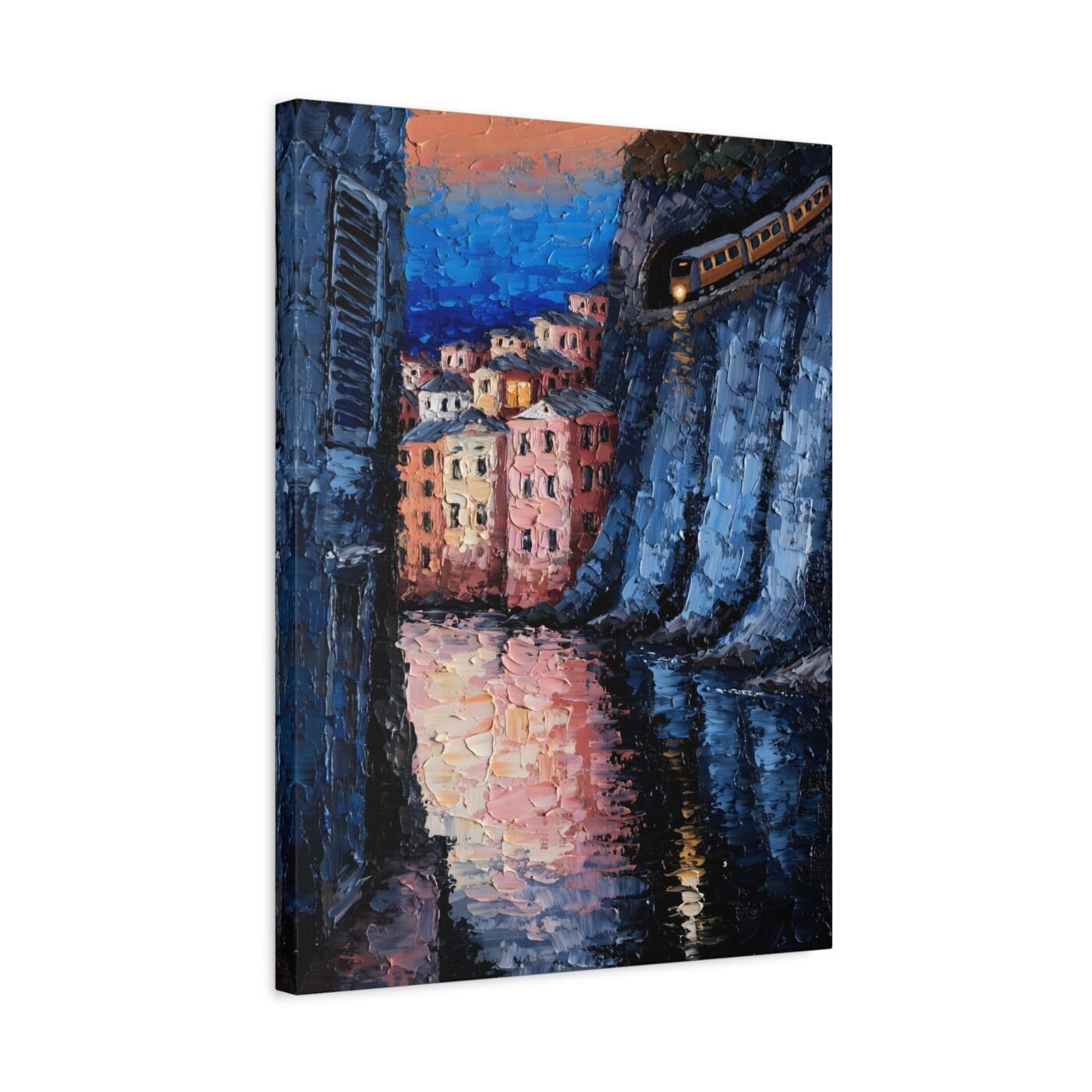
Bellini’s harbours are all the same five moves: terracotta and ochre houses stepped up a hillside, a bowl of water at the base, lamplight at dusk, the knife dragged horizontally for water and vertically for walls, always warm orange against deep blue. Train Arriving Amber makes those moves again, and the train itself—a yellow slice at the top edge—matters less than the fact that he did not centre it.
What he centred instead is the lamp cluster at the harbour’s near edge, where four or five reflections converge into a single hot orange weight. That weight anchors the whole vertical stack: the lamps themselves, their reflections pulled long in knife ridges, the dark harbour walls holding the composition tight on both sides. The houses step back in receding tiers of warm colour, but they step back from that orange centre, not from the train.
The decision to keep the train small and high is what makes this a harbour painting and not a train painting. It proves he knows what he is doing.
Movement earned
A movement is a way of working that holds across enough pieces to be recognised and tested. Bellini’s harbour impasto is now that: a vocabulary of knife-dragged light, stacked terracotta, and blue reduced to structure. This one does not break new ground—it proves the ground is solid.
If you have been following his work, this is the one where the practice locks in. If you have not, start here and then go backward to see how he got to it.
Gallery-wrapped canvas, in 3 sizes — 12×16, 18×24, 24×32 in. Ships free within the continental US.