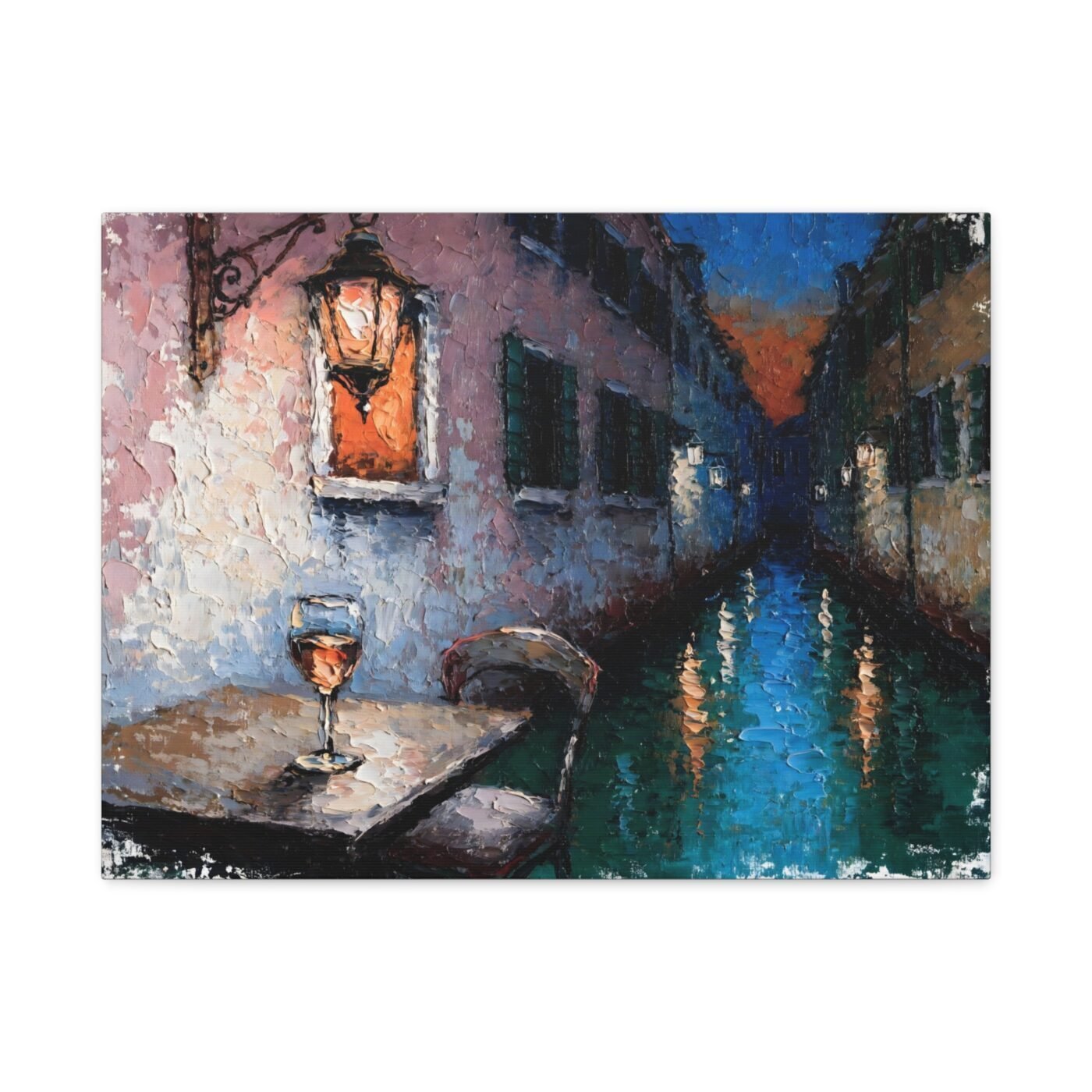

The knife work belongs to a harbour tradition older than the Venice it depicts.

Lineage is earned in the ridges
Harbour impasto did not begin in Venice—it began wherever a painter stood at a working waterfront and needed the knife to do what the brush could not: stack reflected light until it held the actual weight of lamplight on moving water. Bellini’s practice descends directly from that problem and its solution, which is why his terracotta and ochre palettes read as decisions rather than decoration.
The stacked strokes that build these peeling rose walls are load-bearing: the ridges catch real light the way the paint describes caught light, and that doubling is the signature of the lineage. This is not about Venice. It is about what the knife does when a painter understands that a harbour town at dusk asks for architecture in paint, not the idea of architecture.
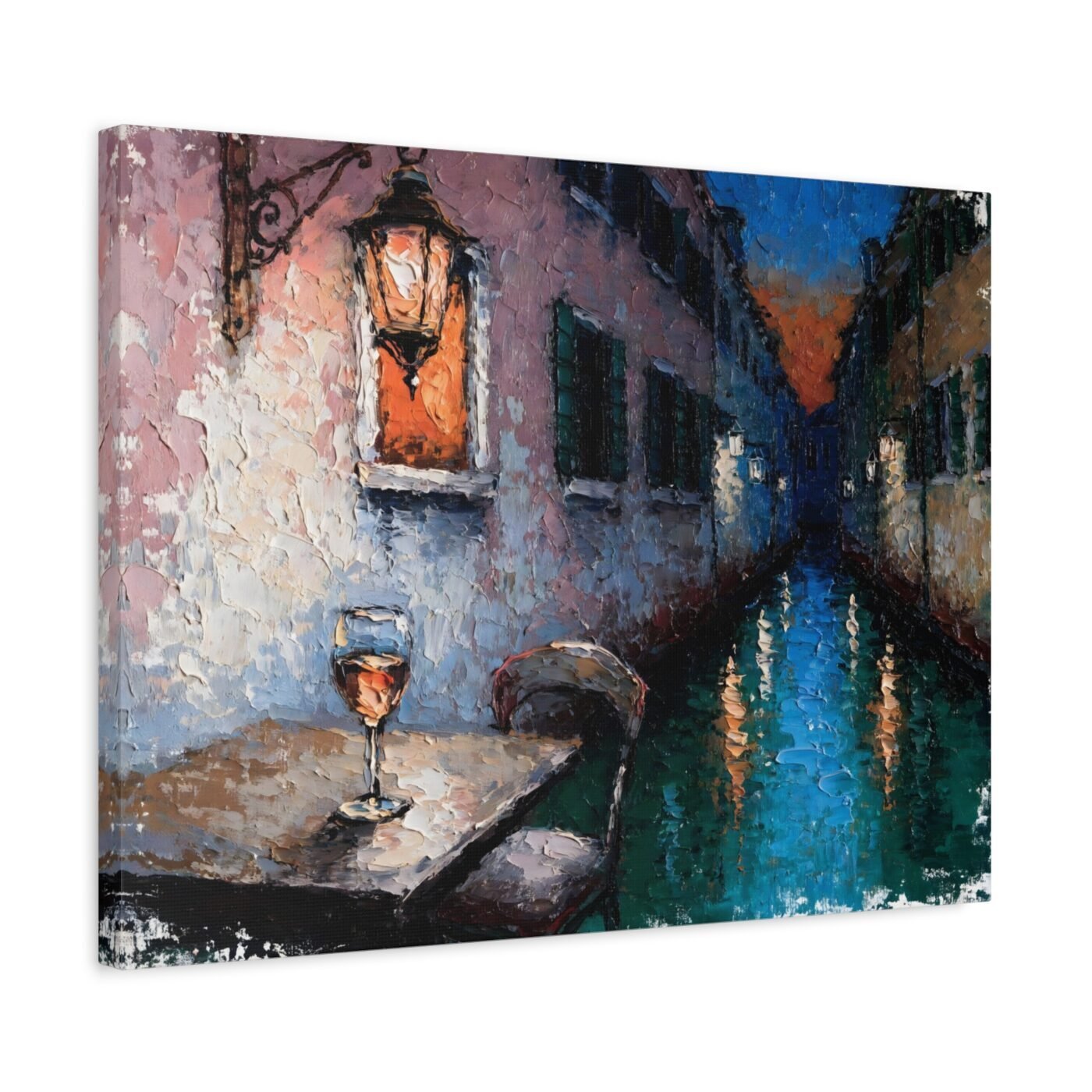
The table does work most painters would cut
The poured glass and the table nobody cleared do something rarer than establish foreground—they prove Bellini knows his tradition well enough to extend it. Harbour impasto lives in the middle distance, where the water meets the buildings, and most practitioners stop there because that is where the technique works hardest. Bellini brings it forward into the objects a person just touched, which means he is painting intimacy at the scale the movement was built for: close enough to a place that you can still feel the warmth.
The lantern just lit is the claim—it says the painter was here at the exact minute the light turned, and the knife strokes that describe it are calm enough to believe. One long sentence about timing, written in ochre and dragged shadow.
Movement earned
Bellini has now painted enough working harbours at lamplight to show he understands the formal problem the tradition was invented to solve, and he has extended it into a register—intimacy, the moment just after presence—that makes it his. The thickness of the paint is not about texture for its own sake; it is about what light does on stucco and water when you are standing close enough to hear the canal. That is the line between competence and practice, and Bellini is on the right side of it.
His work belongs in the conversation about who carries this forward, because he knows what it is for.
Gallery-wrapped canvas, in 3 sizes — 16×12, 24×18, 32×24 in. Ships free within the continental US.