

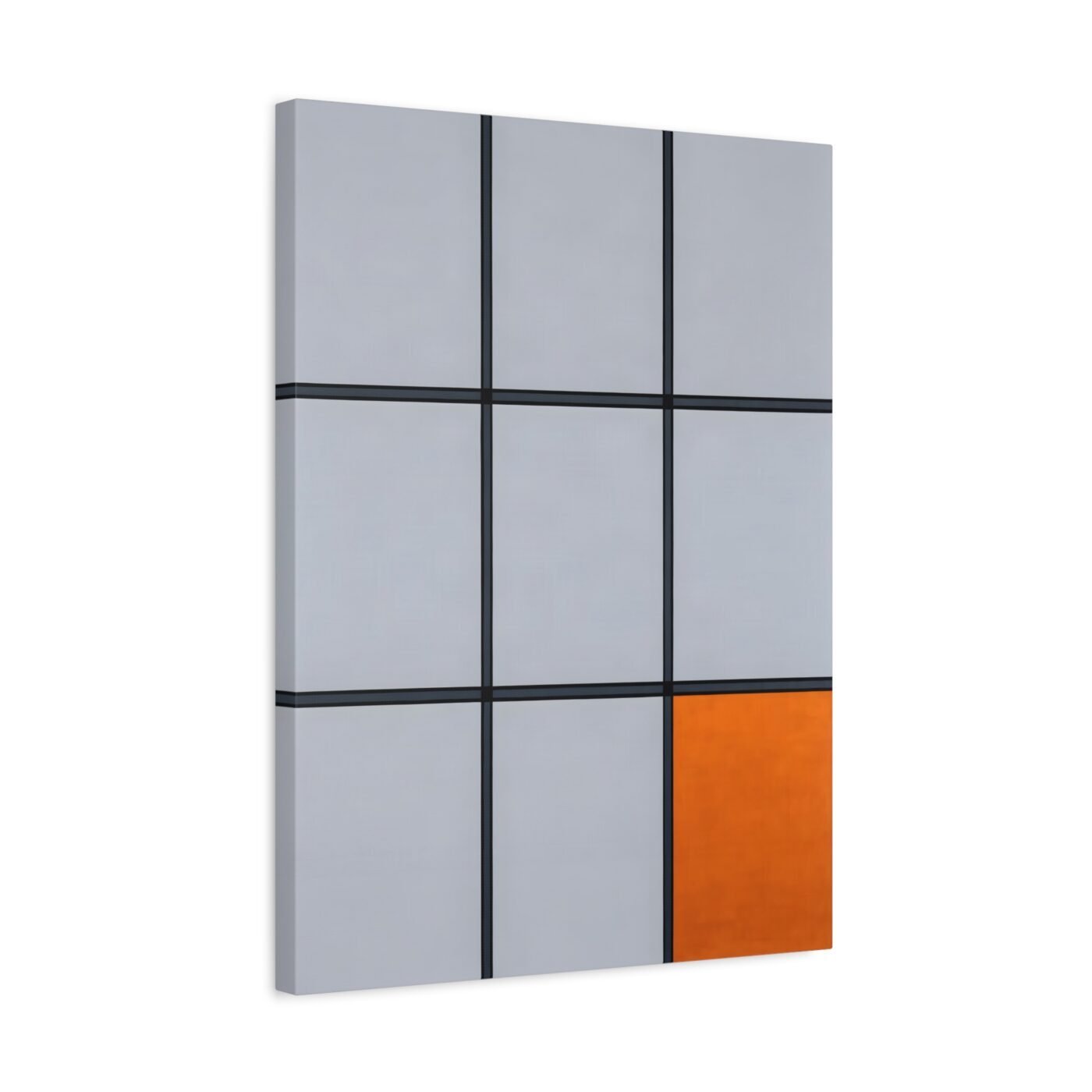
One amber pane. Eight neutral blocks. The question is whether that ratio justifies $119.

The ask is at the threshold
Ward prices Single Pane Dissenting at $119 for the 16×20 poster, $329 for the 24×36 canvas. That puts it in the middle of his range – not entry, not statement. The bet is that one disruption in a grid of nine carries enough structural interest to hold a wall alone.
It does.
The amber block is not centered and it is not large. It sits in the second row, third column, a calculated off-balance that makes the composition want to correct itself. The gray and taupe blocks around it do not recede – they hold their weight – but the amber reads warmer and closer. That temperature gap is the entire piece. If it were centered or symmetrical the work would resolve into decoration. Ward keeps it unresolved.
The format decides the scale
This one works in portrait. The grid runs three across and three down, so the proportions lock into 16×20 or 24×36 without cropping or floating. At 16×20 the blocks read as units in a system. At 24×36 they start to feel like windows, which changes what the amber pane is doing – it becomes architecture instead of abstraction.
The canvas at $329 is the stronger buy if you want the matte surface to kill reflections under a lamp. The poster at $119 is enough if the wall gets even light. I would not go smaller than 16×20. Below that the blocks compress and the dissent reads as a mistake instead of a decision.
Verdict: Buy at 16×20 or larger
The number is fair. Ward is not pricing on scarcity or story – he is pricing on the amount of looking the piece can hold, and one amber block in a structural grid holds more than mostgestures at twice the size. The 16×20 poster at $119 is the rational entry. The 24×36 canvas at $329 is the one that reads as architecture instead of pattern.
Buy if you want a geometric abstraction that does not resolve. Pass if you need the composition to settle.
Gallery-wrapped canvas, in 3 sizes — 12×16, 18×24, 24×32 in. Ships free within the continental US.
