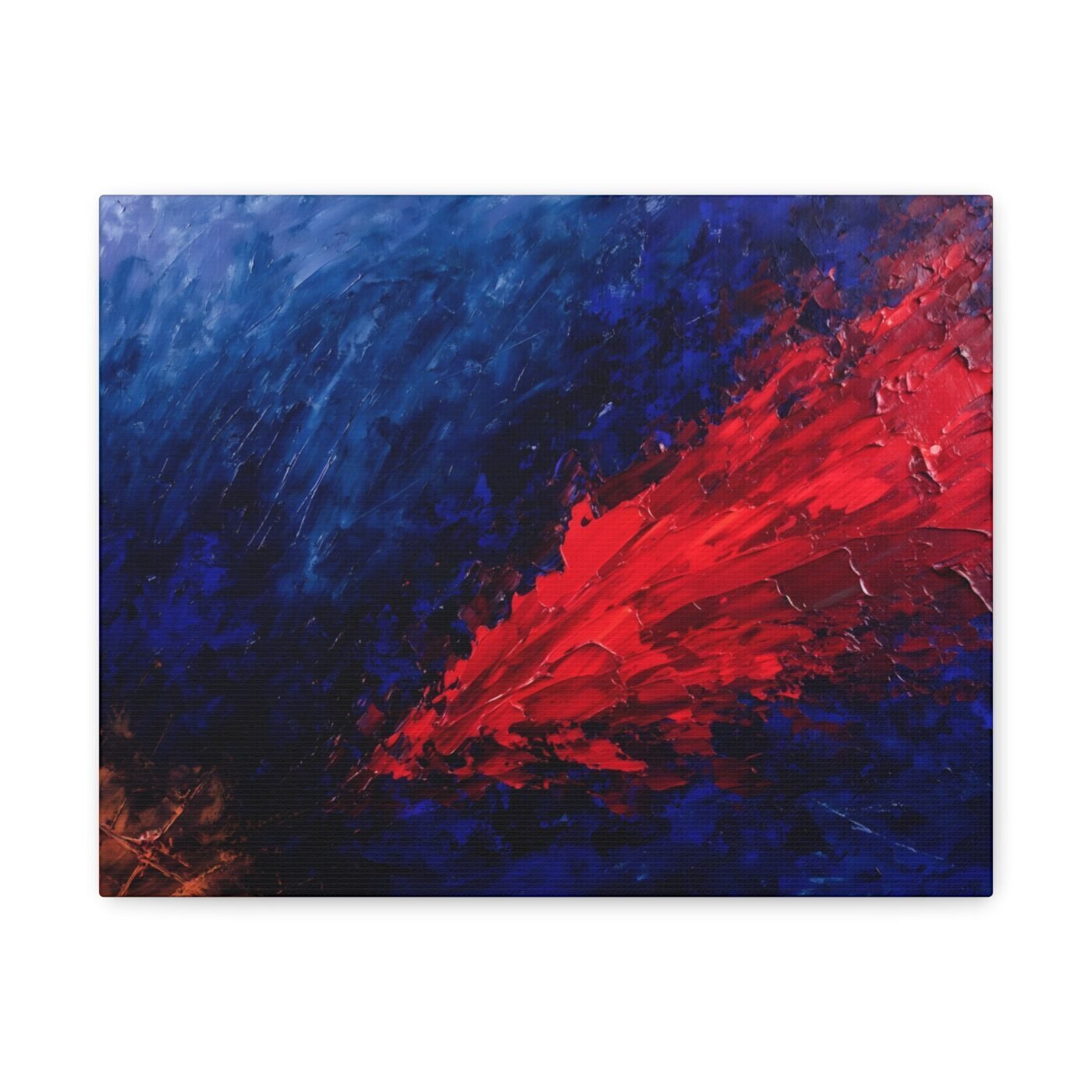

I laid the scarlet down in one pass and walked away. That is the entire story of this painting. No second thoughts, no softening, no attempt to make it easier to look at. The blue field was already there—cold, flat, unapologetic—and the red went across it like a rupture, fast and final.
What Happens When You Stop Editing
Most paintings are negotiations. You put something down, step back, adjust, soften, blend until it plays nice with the rest of the canvas. This one is not that. The scarlet gesture is exactly what it was the second the brush left the surface. I could have gone back in. I could have feathered the edges, warmed the blue, given you somewhere comfortable to rest your eyes. I did not.
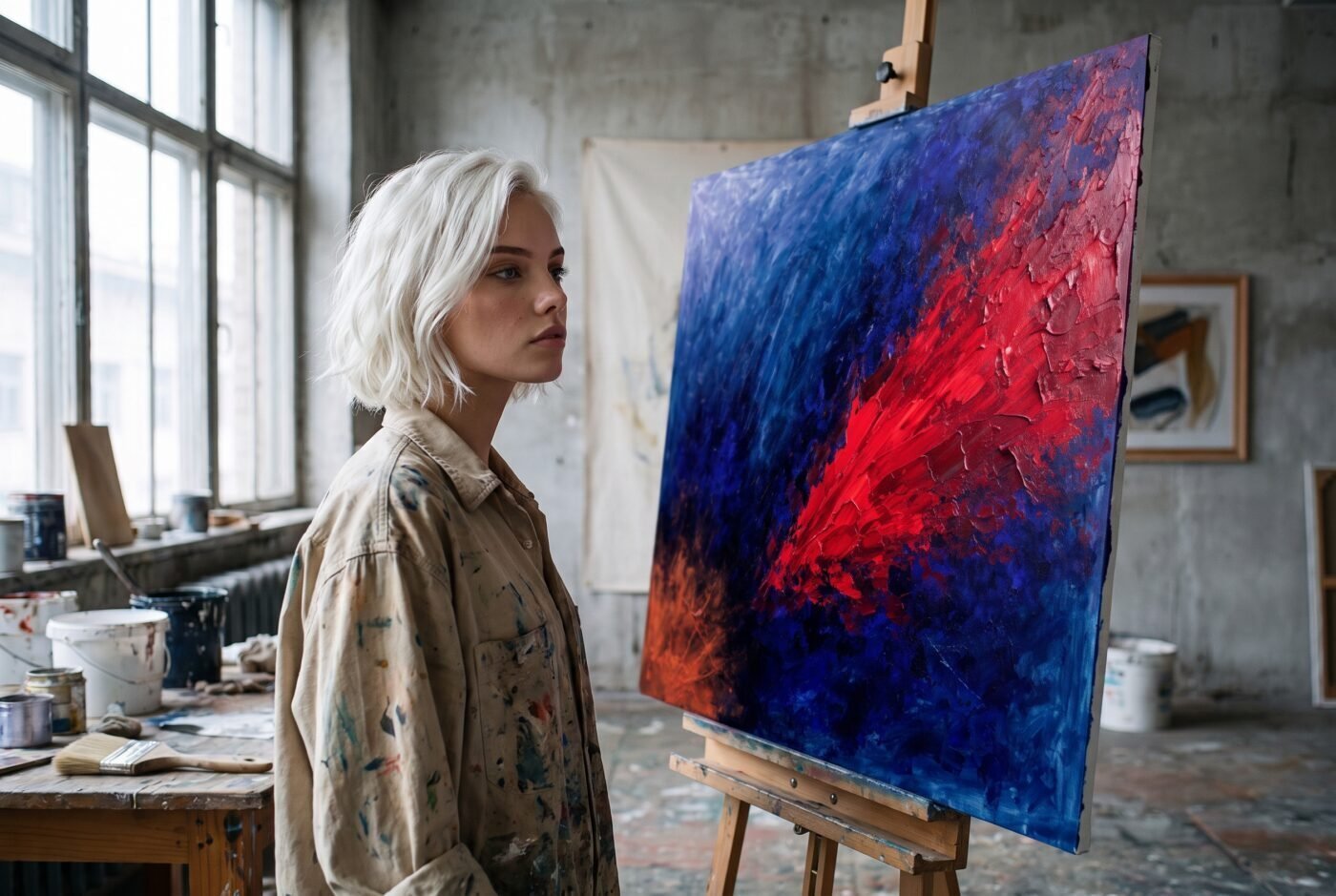
Scale expressionism works like this: the gesture has to be large enough and fast enough that you cannot fake it. At four metres, a brushstroke either commits or it dies. There is no sketching at that scale, no building up gradually. You load the brush, you move, and what lands is what stays. The impasto is thick because the paint has to carry its own weight across that distance—thin applications disappear, read as hesitation. This is not hesitant.
The Choice Every Viewer Makes
People ask what the scarlet is. A wound, a scream, a line you cannot uncross—I have heard all of it. The answer is simpler: it is the thing that had to come out, and the blue is everything that tried to keep it in. That is the entire emotional arc. Cold containment, hot rupture, no resolution. You either accept that or you do not.
I work in unresolved gestures because resolution is a lie we tell to make art behave. A painting that resolves is a painting that has already apologized for existing. This one does not apologize. The scarlet slashes left to right with the kind of velocity that leaves texture, and the blue does not move to accommodate it. They coexist in tension, which is the only honest way they could coexist at all.
What the Surface Does in Real Light
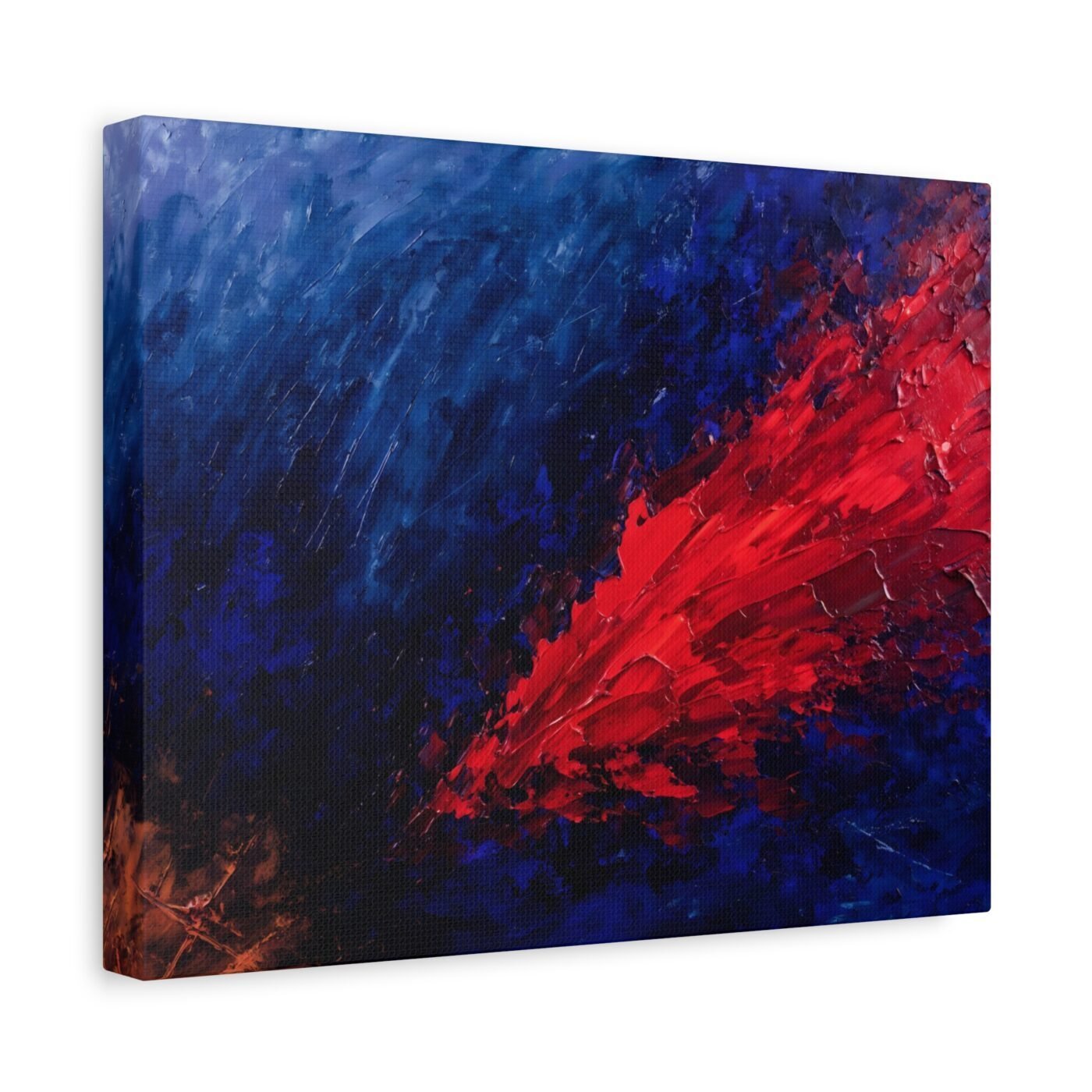
The impasto catches light the way a scar catches light—it creates its own topography. In flat reproduction, gestural work loses half its power because you cannot see the ridges where the brush dragged, the valleys where paint pooled, the places where the surface is almost sculptural. This piece needs raking light. Needs it. Morning light from the side will turn the scarlet into a relief map of its own making, all peaks and troughs and violent texture.
That physicality is not decorative. It is structural. The thick application means the gesture has actual weight, actual presence in three-dimensional space. It is not an image of a slash—it is a slash, frozen in paint, standing off the surface. When you see it in person, you understand immediately why I do not blend, do not smooth, do not apologize for the brutality of the mark. The mark is the point.
This is the fourteenth large-scale work in a run I have been making for the last eight months, each one built around a single unedited gesture across a colour field that will not forgive it. No composition in the traditional sense—just the field, the rupture, and the decision to leave it alone. Some of them land clean. Some of them feel like collisions. This one feels like both.
Scarlet Rupture exists as a fine art print here, and it ships free within the continental United States. The next piece in this run is already on the wall, and the gesture has already landed. If you want to see where this goes—if you want to follow work that refuses to negotiate—stay close. I do not announce them. I just finish them and move on.
Why I Do Not Go Back In
The hardest part of working this way is not the scale or the speed. It is the discipline of walking away. Every painter knows the moment when you could improve something, could soften a transition, could make it easier for the viewer. That moment is a trap. The second you go back in to fix, you are no longer making a gesture—you are making an illustration of a gesture, and the difference is fatal.
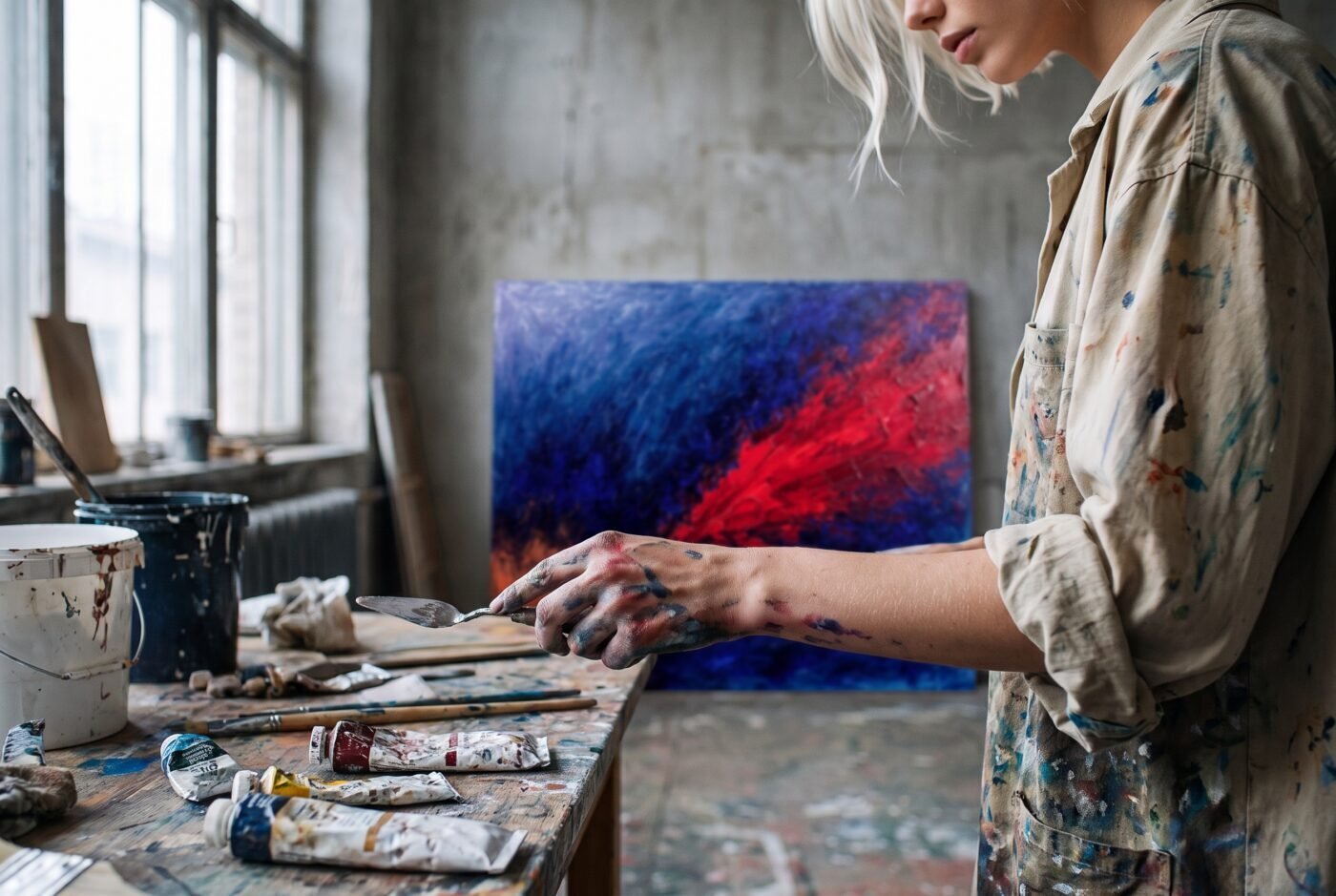
I paint fast because speed is the only way to get honesty. The scarlet rupture in this piece took less than thirty seconds to lay down, and in those thirty seconds there was no room for second-guessing, no room for taste, no room for anything except the physical act of moving paint. That is what you see. Not my idea of a rupture. The rupture itself, captured in the only material that can hold it.
People who follow this work learn to spot the pieces where I hesitated versus the pieces where I committed. The committed ones have a kind of inevitability to them—the gesture looks like the only possible gesture, even though it was made in a fraction of a second. This is one of the committed ones. The scarlet goes where it goes because that is where it went, and no amount of adjustment would have made it more true.