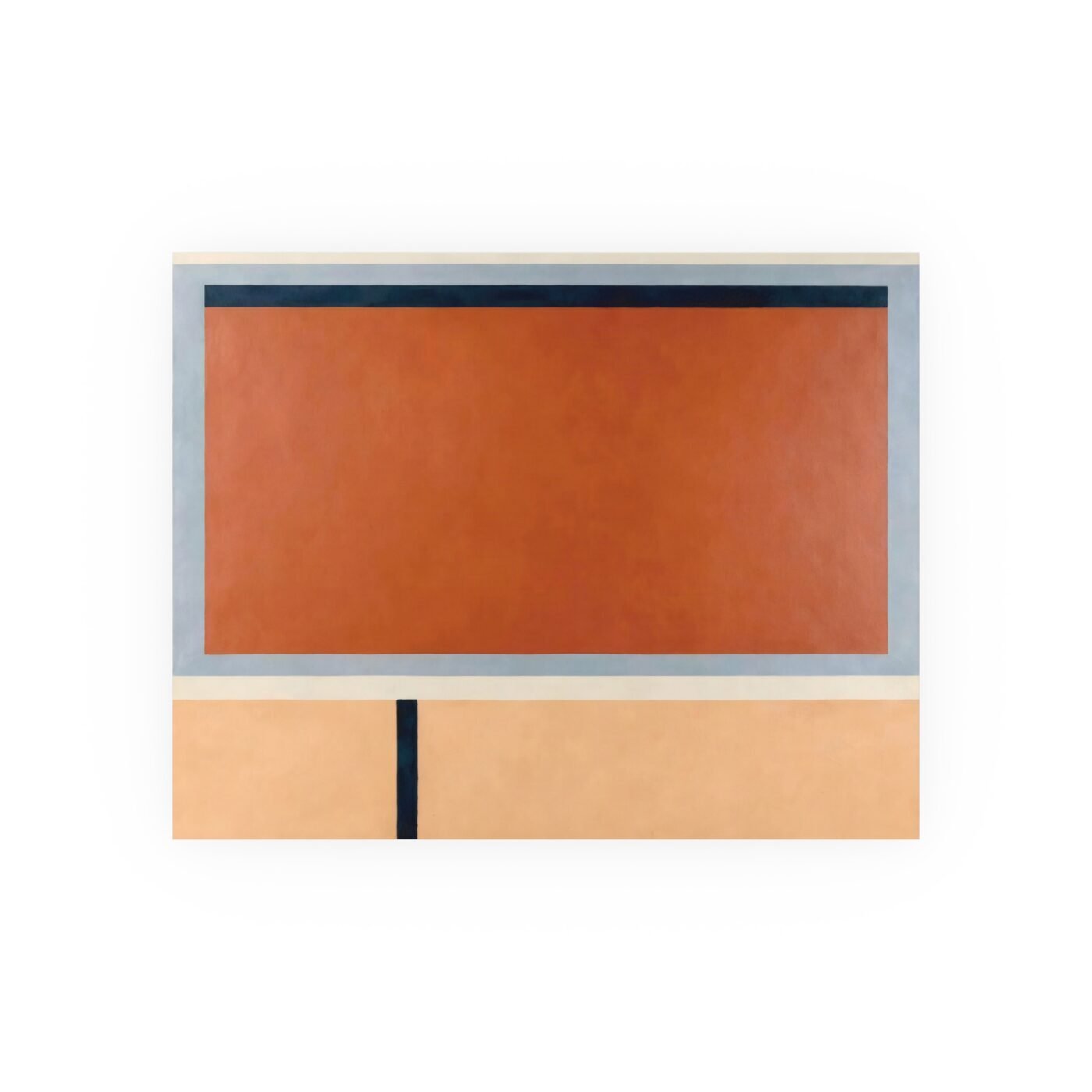

Hard edges fail on gloss. Ward knew that.

What arrives in the box
The print ships flat, unframed, on archival matte archival stock—gsm is paper weight per square meter, and 200 puts you firmly in fine art territory. The finish is fully matte, which means zero sheen even under direct light. That matters. Geometry this clean needs a surface that holds still, and gloss would turn every viewing angle into a different picture. You open the tube and the colour blocks sit exactly where Ward put them, no shimmer pulling your eye somewhere else.
The ink is pigment-based, not dye. Dye fades under UV within a decade. Pigment lasts a century if you treat it right, and the dmax—maximum black density—reads high enough that the dark passages have actual weight. The edges between colour fields are sharp to within a pixel. No ghosting, no registration drift. You can run your eye down a vertical and it doesn’t waver.
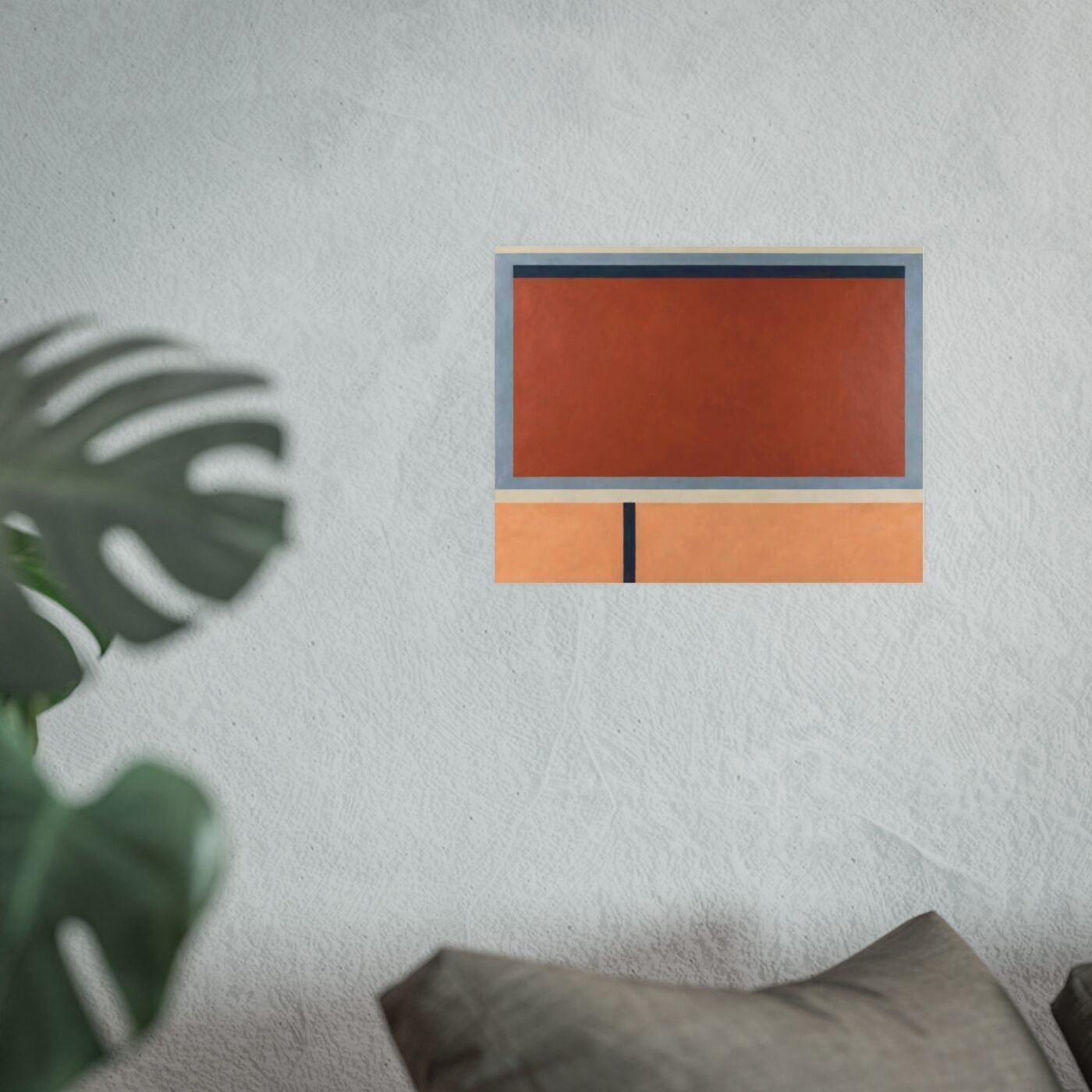
Why matte matters for hard-edge work
Ward works in calculated proportion and flat colour, which means the architecture of the piece is everything. A glossy surface introduces a second layer of information—where the light is, where you are standing—and that competes with the structure. Matte eliminates that. The geometry becomes the only thing happening.
The colour palette here is restrained: a warm ochre, a cool mid-grey, a near-black, and a cream that reads as negative space. On matte stock, those relationships stay fixed. The ochre doesn’t flare under a window. The grey doesn’t go cold in shadow. What you see at ten in the morning is what you see at eight at night, and for work this precise, that consistency is the whole point.
Resolution is 300 DPI—dots per inch—which is the threshold where the human eye stops resolving individual pixels at normal viewing distance. At arm’s length, the edges are clean. At two feet, they are seamless. The print does not give up detail as you step back, which is exactly what you want from abstraction that depends on proportion.
The format worth owning
This is a poster-grade print on archival stock, and that is not a compromise. Ward’s work does not need the texture of canvas or the ceremony of a gallery wrap—canvas would introduce a weave that competes with the flatness, and the geometry would fight it. The matte surface and the precision of the ink are doing exactly what the composition asks them to do, which is to disappear and let the structure speak.
If you frame it, use museum glass and a float mount so the edges stay visible. The proportion is the idea, and matting it down to fit a standard frame loses that. Ships free within the continental United States. See the full run of Ward’s structural work at printasso.com.
Verdict: Poster. The matte stock and pigment ink are exactly what this geometry needs, and the format honours the flatness Ward built the piece around.
Matte fine art poster, in 3 sizes — 14×11, 20×16, 24×18 in. Ships free within the continental US.