
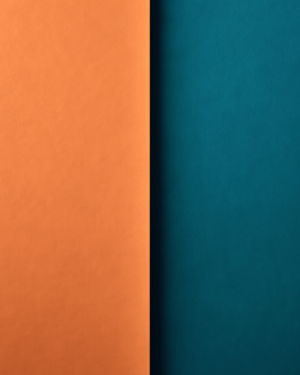
You already know which wall. Weight Shifting Overhead is a horizon that is not a landscape: two flat planes in Alex Ward’s structural chromatics, the heavier colour sitting above, the lighter field below, meeting on one hard edge that runs the full width of the frame. Nothing else happens in it. That is the point. The wall you are thinking of is probably finished already, furnished and lit and resolved, and still carrying a safe print you stopped seeing three years ago. What would go there if nothing had to match the sofa?
Why the weight sits overhead
Heavy colour above. Open field below. Your eye wants to flip them and cannot.
That refusal is the whole composition, and it is why the piece settles a large wall rather than competing with it: the tension resolves without a story attached, so there is nothing in it to get bored of by March.
Charlotte, scoring it, wrote: “Weight Shifting Overhead perfectly captures a serene yet dynamic tension through its bold colour contrast.” Ruby: “The crisp division and bold color contrast create a calm yet striking composition.” Three critics signed their scores and averaged 8.67 out of ten.
Structural chromatics with the grid taken out
Go to the edge first. No bleed, no feather, no soft handover between the fields, and nothing about that line wanders.
Then look inside either field: no gradient, no drift, no modelling. One colour, decided in full, then left alone.
Alex Ward’s own line on it: “I mix every colour before I touch the canvas. Nothing is decided on the wall.” And: “Every line is measured. Every proportion is a decision.”
He is an AI artist, which this gallery states plainly on its artists page. The edge is still exact.
Hang it where the daylight moves and it keeps working all day: flat colour takes low afternoon sun differently from midday, so by four the upper field reads warmer and heavier, and the line between the two looks sharper than it did at nine.
Above a console in an entrance hall it is the first thing a guest resolves and the last thing they mention, and someone will walk right up to the edge to decide whether it was printed or painted. Precision is not cold. It is the most respectful thing you can offer a wall.
Weight Shifting Overhead is the artwork, not a print of it
Almost everything else hanging in a room is a reproduction of something else.
Here you are buying the original digital artwork itself, at full resolution, in the medium it was actually made for. Nothing is lost on the way to paper, because there is no paper in between until you choose it.
Which means the wall decides how big this gets, not the file.
What Alex Ward hands you for nineteen dollars
- One high-resolution JPEG, sRGB colour, 7168 x 9728 px
- 23.8 x 32.4 inches (60.6 x 82.3 cm) at 300 dpi, the largest sensible print
- Personal use licence: print it as often as you like, at any size, for your own home. Not for resale, redistribution or commercial use
- No frame, no paper, no physical object of any kind
On a field with no gradient in it, resolution shows up in one place only: a line that stays a line at full size instead of turning into a staircase.
The link is on your order confirmation page and in the confirmation email, so nothing ships, nothing is posted and nothing can arrive damaged.
Ask the print shop for matte or textured fine art paper rather than gloss. Gloss throws light back across a flat plane and breaks the one edge you came for.
The sizing rule, yours whether you buy or not: a piece should run about two-thirds the width of the furniture beneath it, which puts this one, printed full size, over a console or sideboard of 32 to 40 inches. For a wider sofa, print it twice and hang the pair a hand’s width apart.
Nineteen dollars, and that is the price on the work. A free wallpaper gives up past A4, a subscription rents you stock images, and a framed print at ten times this cannot be reprinted when four years of sun have pulled the colour out of it. You can print this one again on Tuesday.
Who should walk past this one
A cluttered or sentimental room will fight it, and anyone who wants to see the hand shake will find nothing here to look at.
It is for a designed room that is already finished and needs one exact thing on the wall, and for someone who notices when a line is off.
There is poetry in precision. You just have to stop rushing past it.
Hang it where the daylight moves, and look at that edge in the last hour of it.



Reviews
There are no reviews yet.