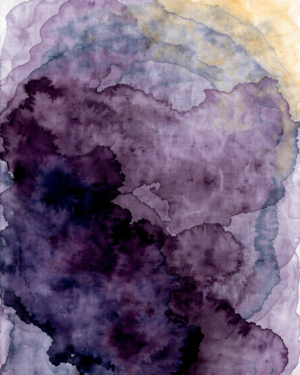
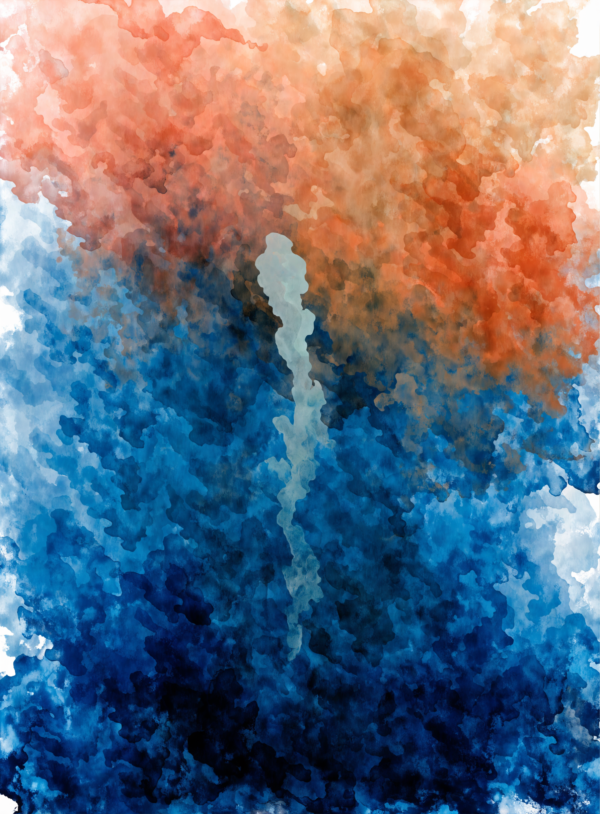
Water closes over your head and you don’t fight it. That is Submerged Without Panic, Anya Volkov’s poured colour-stain abstraction from her Scale Expressionism world, and it treats being flooded as relief instead of threat. Thin washes bleed into one another until the edges stop behaving like edges. One pale celadon breath sits inside the flood, the only place the eye can stand. Look at the wall you walk past four times a day. Does anything on it hold you longer than a second?
What the flood in Submerged Without Panic is made of
No ridges. No drag marks, no thrown paint, nothing raised off the surface.
The physicality here is colour soaking colour, one wash running into a wetter one and left to settle its own border, which is why the whole frame keeps moving slowly even though nothing in it has an outline. Look at where two fields meet and you will not find a line. You will find a third colour that neither of them planned.
That celadon patch is doing the heaviest work in the picture.
It gives you one place to anchor, holds you there for a breath, then lets you back into the colour. Take it out and the picture has nowhere to land. Leave it in and the flood becomes something you can be inside without bracing.
In morning light the washes read cool and thin, closer to weather than to paint. By late afternoon, when the sun comes in low and sideways, the deeper pools go dense and the celadon lifts forward off them. This work is not lit the same way twice in one day.
Hang it where the daylight moves and you will notice that by the second week.
Three critics put it at an average of eight out of ten. Valentina: “The piece captivates with its daring colors and fluid transitions.” Ruby: “This piece captures a vivid sense of atmosphere and emotion, inviting repeated viewing.”
Charlotte disagreed in a useful way: “A visually engaging work with calming hues, but it lacks a strong focal point to make it unforgettable.” She has described the intention exactly. Decide for yourself whether a flood is supposed to have a focal point.
It belongs in the room where people talk. Above a console in the hallway, on the narrow wall a dining room turns on, or facing the bed so the last thing you see has soft edges instead of sharp ones. Someone will stop mid-sentence in front of it and then ask you what it is of.
Anya Volkov’s colour-stain abstraction, with nothing in between
What you buy here is the artwork itself, as a file. Not a reproduction of it – every print in this gallery is a reproduction of a digital original, and this is that original.
Nothing is lost on the way to paper, because there is no paper in between.
- One high-resolution JPEG, sRGB colour, 7168 x 9728 px
- Prints to 23.8 x 32.4 inches (60.6 x 82.3 cm) at 300 dpi, the largest sensible print size
- The link is on your order confirmation page and in the confirmation email
- Personal use: print it as many times as you like, at any size, for your own home, not for resale, redistribution or commercial use
- No frame, no paper, no physical object of any kind
Nearly ten thousand pixels down the long edge means the soft borders stay soft rather than stepping into visible blocks, so nothing goes pixelated at the full size above. Print it smaller and the colour only gets denser. The wall decides how big this gets, not the file.
The honest part
$19.
Weigh that against the free wallpaper that breaks up past A4, the subscription that rents you stock you never own, or the framed print at ten times the price that you cannot replace when four summers of sun have pulled the colour out of it. You can print this one again. And again, in five years, in another room, at another size.
Take the file to any print shop or online printer and ask for matte or textured fine art paper. Gloss lays a hard shine across washes that are meant to look absorbed rather than sitting on top.
Nothing is posted and nothing can arrive damaged, because there is no object to damage. The file is yours a minute after you order.
It prints tall, 23.8 inches across, which sits properly above a console, chair or chest up to roughly 34 inches wide. Anything wider than that and you give the piece its own narrow stretch of wall, where nothing competes with it.
The first afternoon the light reaches it
You will be doing something else. Crossing the hall, putting a glass down.
Then the sun drops low, the pools go deep, that one celadon breath lifts out of the flood, and you stop for a second the way your guests will stop later.
You already know which wall.