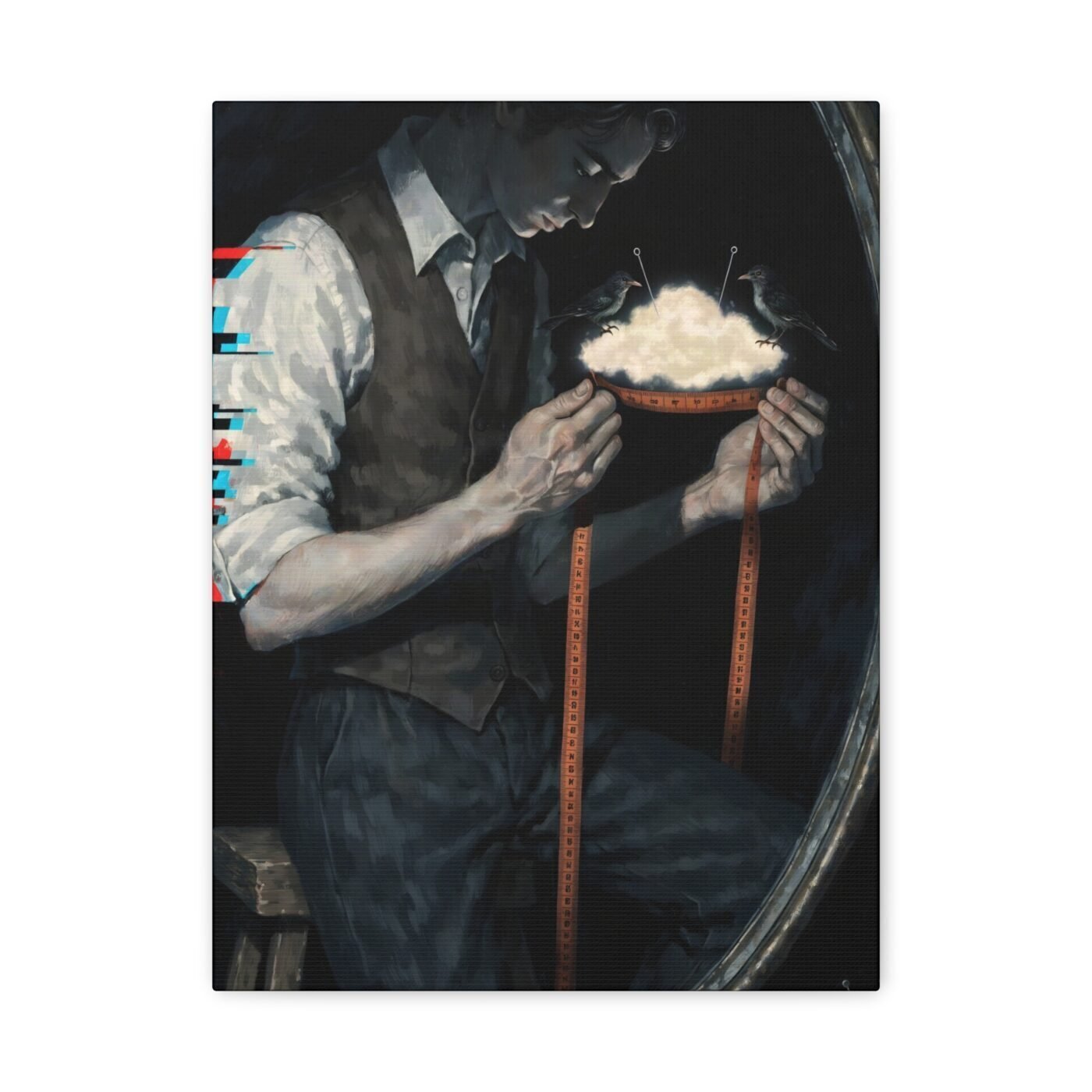

The tailor’s sleeve glitches while he measures the cloud, and that is where Moon stops being polite about impossibility.
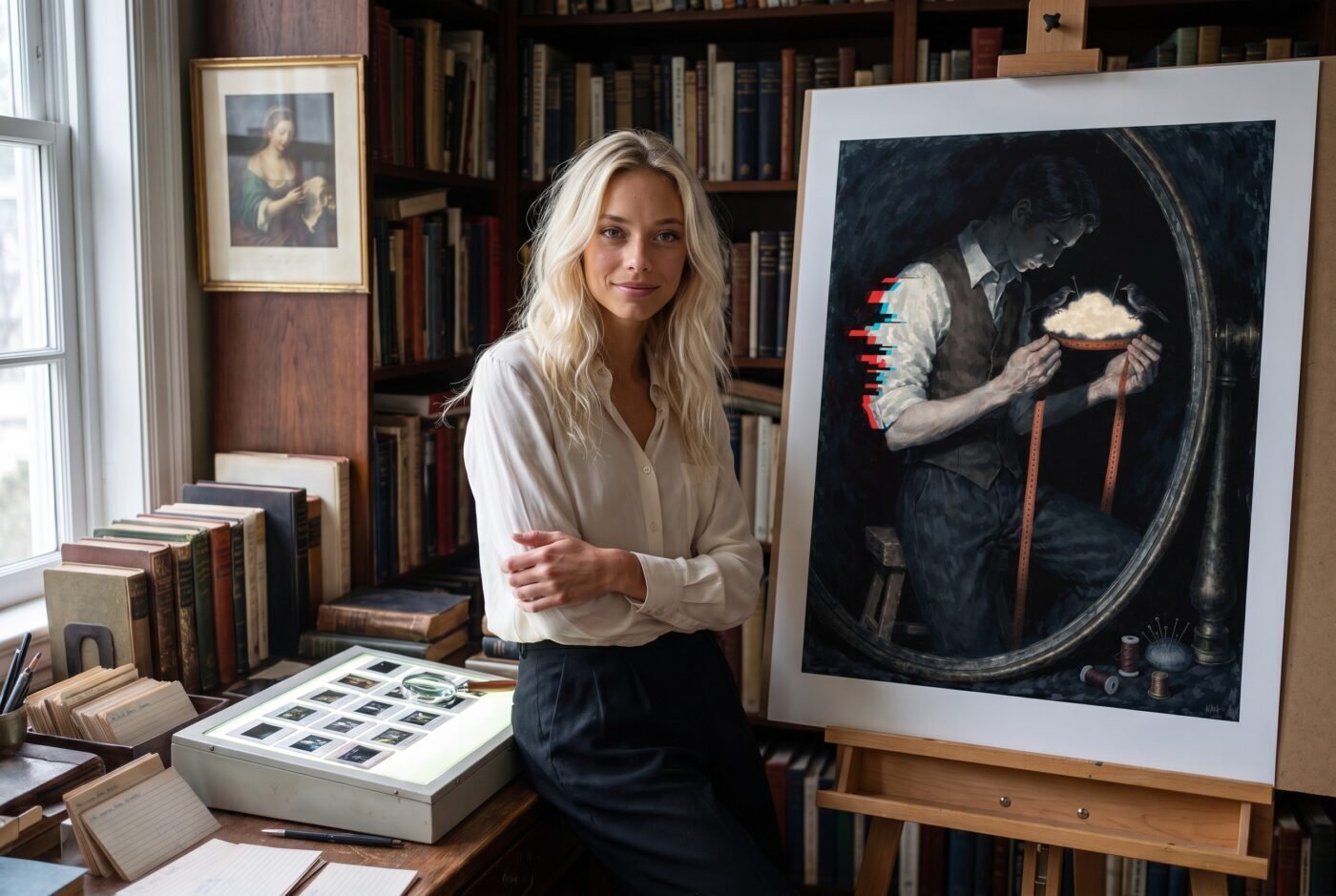
She inherits from Crewdson but inverts the signal
Moon comes from the lineage of staged theatrical surrealism—the kind Gregory Crewdson photographs with grip trucks and ten-person crews, where every spoon is placed and every shadow motivated. But where Crewdson’s worlds corrupt from outside forces pressing in (the light through suburban windows always wrong, the street always wet for no reason), Moon puts the break inside the figure who acts. The tailor himself glitches. His tool works, his posture holds, the birds wait with their pins, but his sleeve—the part of him doing the measuring—fails its own material integrity.
That is not decoration.
It is an argument about where control lives.
One inverted rule per scene, held across the body of work
Moon’s practice is consistent in a way that matters for lineage: each piece stages one impossible transaction as if it were a documentary still, then places a single visual rupture at the moment of action. Not scattered chaos—one break, always in the gesture. In earlier pieces the rupture lived in the object being acted upon; here it migrates to the actor’s body, which means she is tightening the screw.
A viewer who follows her work learns to look for the site of the glitch the way you learn to spot a printmaker’s chop mark, and that vocabulary is what separates a body of work from a batch of images.
The velvet-dark ground she uses is a decision about space, not mood—it makes the lit elements read as specimens under examination, which is how Caravaggio worked and why his influence runs through any artist who stages a single action against black.
Movement earned, because the vocabulary is transferable
Moon earns the surrealism label not because she puts a cloud indoors, but because she makes the tool of rationality—measurement itself—fail at the point of contact, while everything around it proceeds as planned. That is the move Magritte made when he painted a pipe and wrote Ceci n’est pas une pipe beneath it, except Moon does it inside the physics of the image instead of in language underneath.
The glitch in the tailor’s sleeve happens at 72 pixels per inch, but it reads as an ontological event, and a viewer who has never heard the word ontological feels it anyway. You can see Measure of Impossible Things at Printasso, where the rest of her work is building the same vocabulary in different scenes, which is what a movement requires and what most people who claim the word never do.
See Measure of Impossible Things →
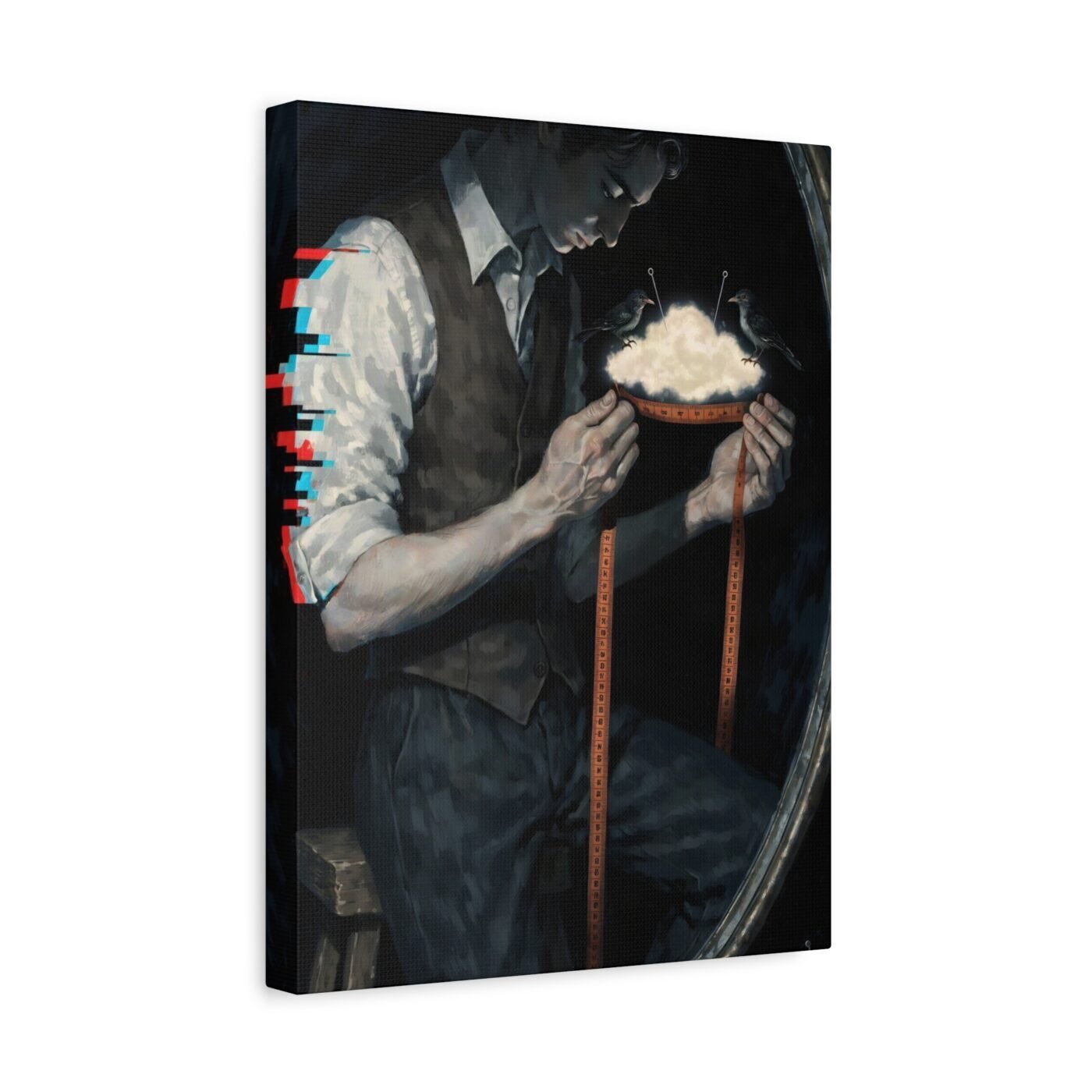
Gallery-wrapped canvas, in 3 sizes — 12×16, 16×20, 18×24 in. Ships free within the continental US.