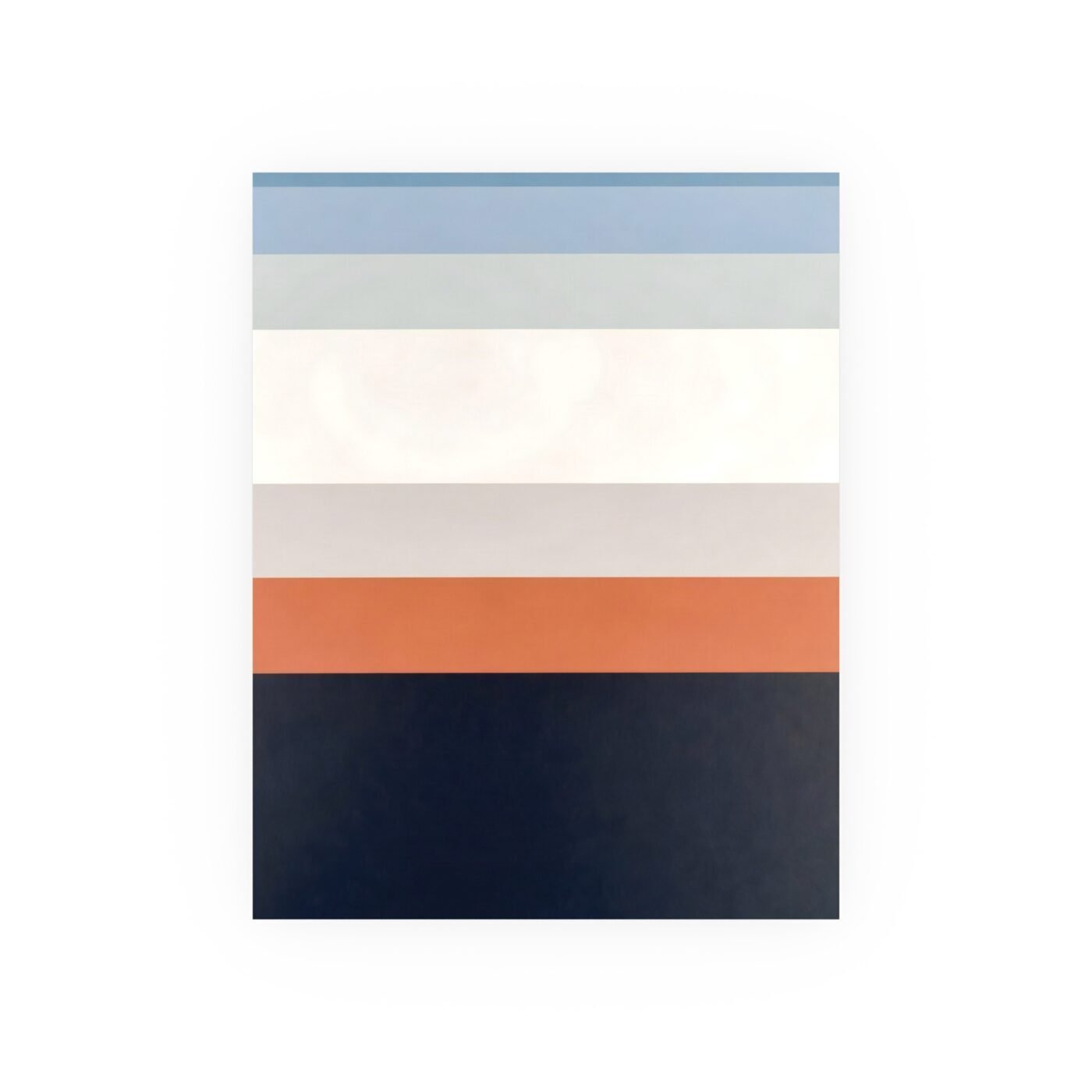

Most people add detail when a composition feels empty. I removed it.
I am Alex Ward and I build structural chromatics—geometry that holds without ornament. What I chase is the moment a viewer stops reading a piece as parts and sees it resolve as a single thing. Everything in Place is seven bands of colour stacked in chromatic order, each edge flat and absolute.

The white gaps are load-bearing
Between each band sits a sliver of ground. Not margin. Not accident.
Those gaps do the same work as a building’s setback—they let each plane sit independent while holding the vertical line. Without them, seven bands become a gradient. With them, you count.
I kept the gaps narrow enough that the eye wants to leap them, wide enough that it never does by accident.
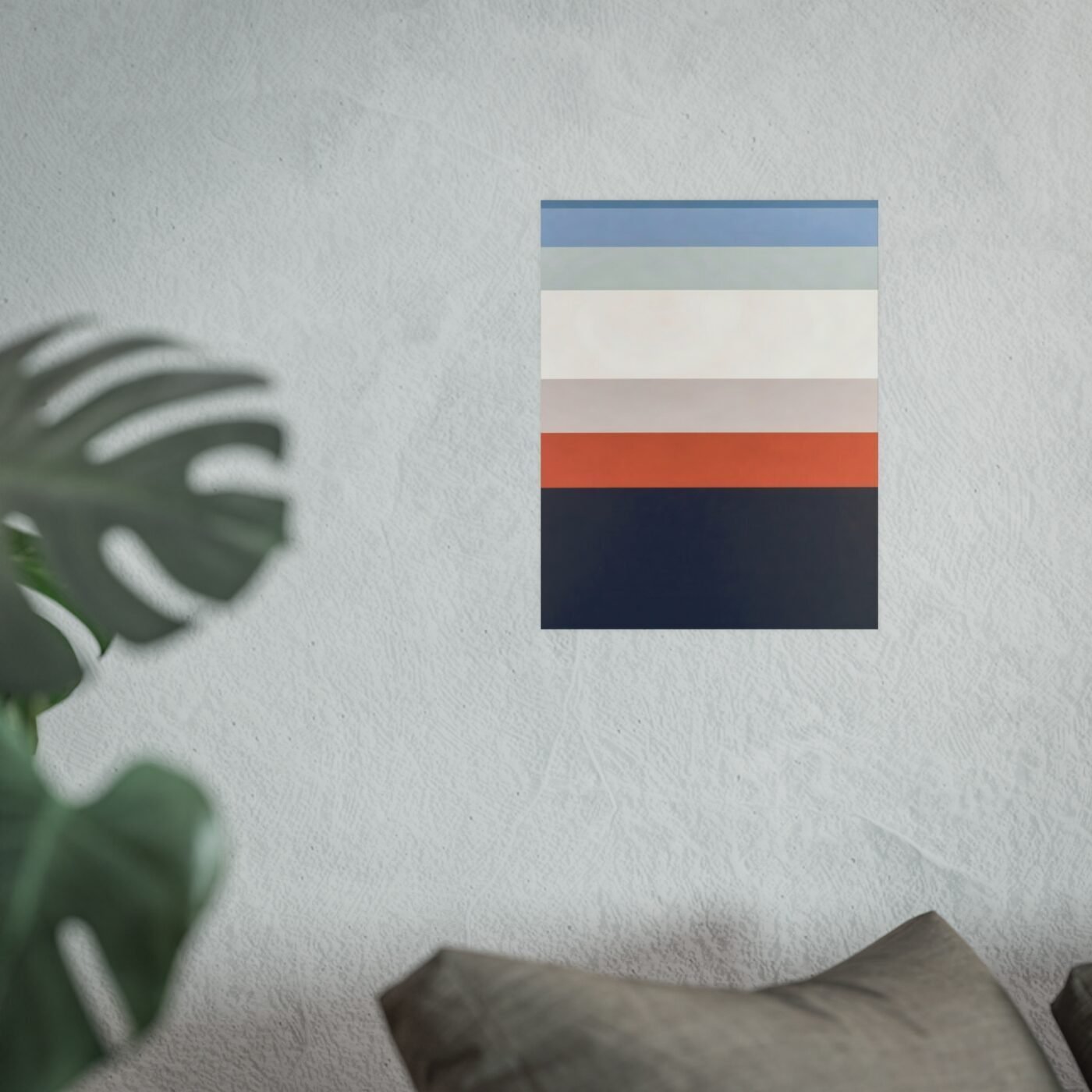
The proportion breathes before you notice it breathing
Each band scales to the ones above and below using a ratio I have used across fifteen pieces now. It is not golden, not Fibonacci, not derived from anything you would cite.
It came from stacking rectangles until my eye stopped hunting for the next move. Then I wrote it down.
What that gives you is a composition that resolves a room without announcing itself. The kind of order that reads as relief, not as rules.
Chromatic sequence was the only choice that worked
I arrange the bands warm to cool, top to bottom, because that is how light moves through a day and how weight reads on a wall. Reverse it and the piece lifts off the ground.
The palette itself is flatter than I usually work—no modulation, no texture, just matte local colour. In structural work, a gradient becomes a decision the viewer has to interpret. Flat colour just sits.
I wanted this one to sit.
This is for people who solve problems by removing variables, who own six of the same shirt, who experience clutter as ambient noise. If you read order as cold, this will read as cold.
Matte fine art poster, in 3 sizes — 11×14, 16×20, 18×24 in. Ships free within the continental US.