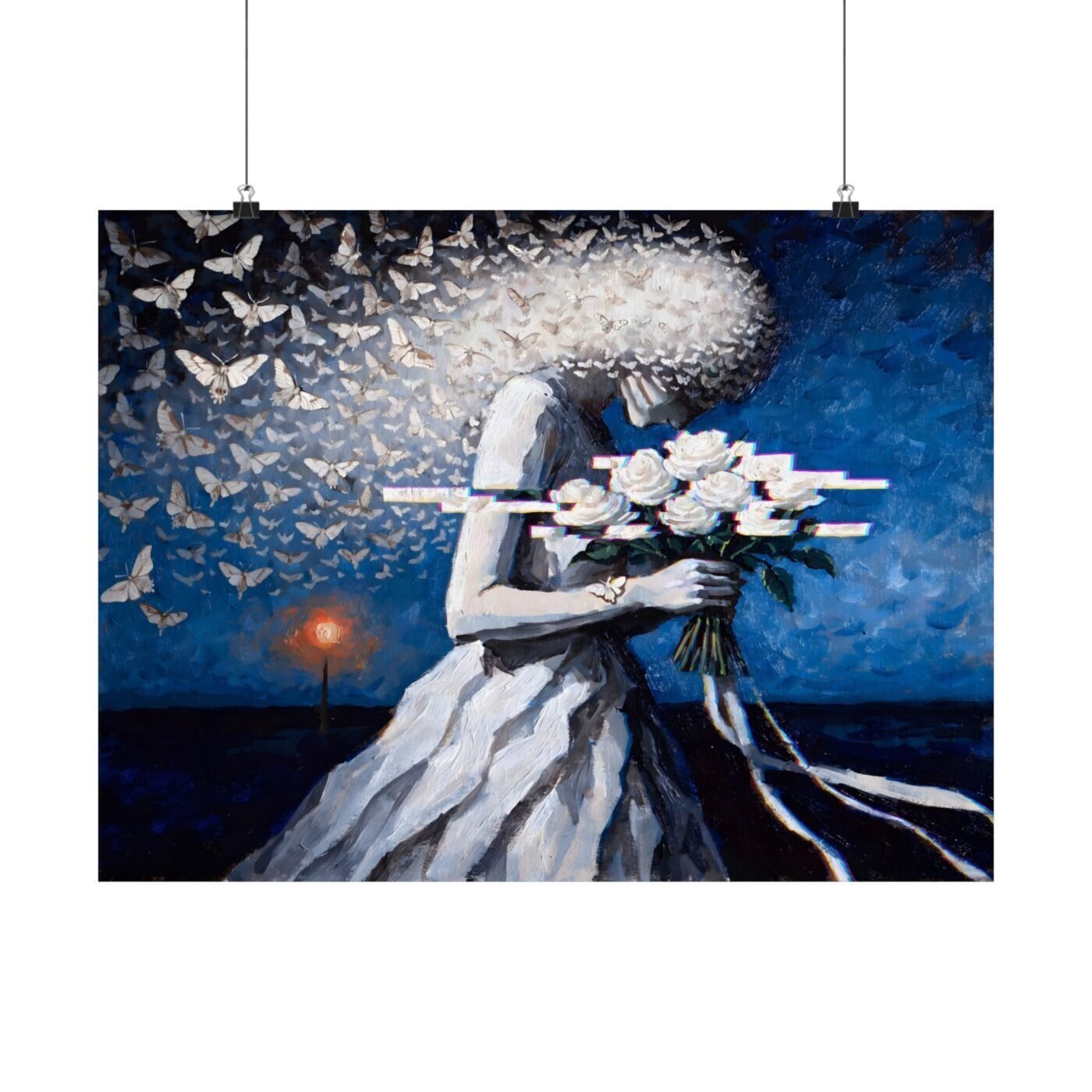

The bouquet corrupts at $79.

The glitch is priced as subject matter, not effect
Zara Moon sells theatrical surrealism where one element breaks the rules. Here it is the bouquet – the object a bride is supposed to hold intact dissolves into pixels while everything else stays whole. That inversion is not decoration. It is the premise. The bride, the veil of moths, the velvet-dark ground: all of those frame the corruption. You are paying for a glitch that earns its place as the main event, not a filter someone ran because they could.
At $79 for an 18×12 poster, this sits at the threshold where a visual idea becomes worth owning. The composition is dense enough to fill wall space. The moths read as texture from across a room. The pixel corruption stays legible at distance, which matters – effects that only work up close do not justify a print.

The panel scored it 8.33, and the scores line up
When three critics from different beats land within half a point of each other, the work is doing what it says it does. Valentina called the velvet-dark ground an anchor. Ruby noted the texture invites conversation. I said it works as a statement wall, and I meant it – this piece wants to be seen, and it rewards looking. The bride is secondary. The bouquet is the subject. That hierarchy is clear, and clarity is what makes surrealism sell.
The 18×12 landscape at $79 is the right entry. The 24×16 at $129 is defensible if you have the wall. The 36×24 at $229 is too much money for a premise this singular – the glitch does not gain meaning at that scale, it just gets bigger.
Buy at the 18×12
This is not about whether you like surrealism. It is about whether the work justifies its ask. The bouquet corrupts on purpose, the composition frames it cleanly, and the price reflects an idea executed with control. Buy the smallest size and hang it where people stop to look twice. That is what it is for.
See Bouquet Dissolving Pixel →
Matte fine art poster, in 3 sizes — 16×12, 24×18, 32×24 in. Ships free within the continental US.