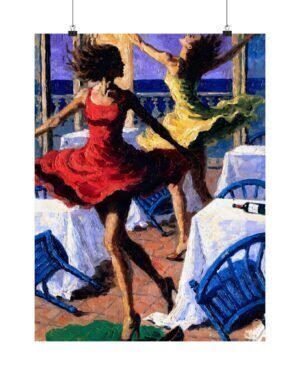
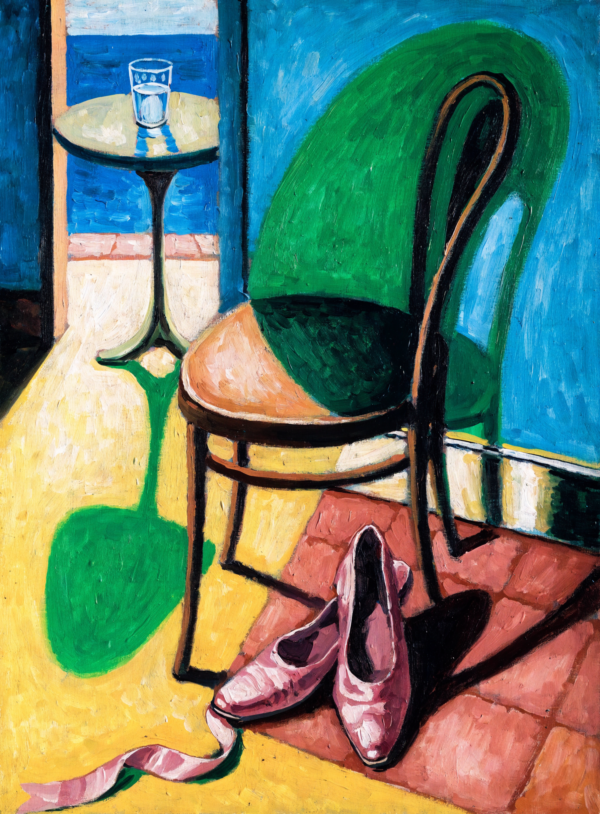
The shoes are off, and nobody has come back. Satin Resting Turquoise is Isabelle Moreau’s Cafe Fauve at its quietest: a chair pushed back from the table, a pair of satin dancing shoes set down beneath it, warm side light arriving off a window onto the sea. Under the shoes, a shadow in green. Cool green, in a room made of cadmium and chrome yellow, where no green has any right to be. Which wall in your home has been waiting three years for something this warm?
The green shadow under Satin Resting Turquoise
Look at the floor first.
The light is low and it comes in from the side, and by every rule of that hour the shadow should be the colour of weak tea. This one is green. Cool, deliberate, sitting beneath the satin like a note played against the key of the room.
Everything else agrees with the afternoon: flat fields of cadmium red, chrome yellow and cobalt with soft transitions between them, no outline, no clutter. A fan left open on the table. A shawl over a rail, still holding its fold, and a glass half finished that nobody is coming back to finish.
No figure anywhere in it.
You arrive a minute after she leaves, and the room is still moving.
Charlotte, writing on this piece, said: “The satin shoes and vivid shadows capture the eye, drawing you into a dance of color and light.” Ruby put it more plainly: “A vibrant depiction that invites the viewer to feel the warmth and quietness after the dance.”
Valentina was cooler about it, and fairly so: “The composition is true to Moreau’s aesthetic, yet it doesn’t push beyond the established boundaries.” This is Cafe Fauve doing the thing it does well rather than arguing with itself.
Where Isabelle Moreau’s Cafe Fauve shoes belong
Hang it where the daylight moves.
Early on, the cobalt holds the picture together and the green reads almost grey. By four the reds lift, the yellow goes to honey, and that green shadow becomes the only cool thing in the building.
In lamplight it goes velvet.
It is a tall, narrow shape, so it likes tall, narrow walls: the strip between a doorway and a bookcase, the far end of a hallway, above a console, the panel beside a kitchen window that nothing has ever fitted.
People will ask about it. Not about the shoes, and not about the sea through the window, but about the green. What do you want the last hour of your day to be looking at?
What nineteen dollars actually buys
This is not a print of the artwork. It is the artwork. Every framed piece in this gallery is a reproduction of a digital original, and this is the digital original, at full size, in the medium it was made in.
Nothing is lost on the way to paper, because there is no paper in between.
- One high-resolution JPEG, sRGB colour, 7168 x 9728 px
- Prints to 23.8 x 32.4 inches (60.6 x 82.3 cm) at 300 dpi
- $19, personal use licence
- No frame, no paper, no physical object of any kind
That pixel count means the wall sets the size, not the file. At 32 inches tall you keep the grain inside the shadow and the soft edge where cadmium meets yellow, with nothing going soft or blocky along the way.
Set it against a free wallpaper that falls apart past A4, or a subscription that rents you stock images you never own, or a framed print at ten times this price that you cannot replace when four summers of window light have pulled the reds out of it.
You can print this one again.
The link sits on your order confirmation page and in the confirmation email, there within a minute of paying. Nothing is posted, nothing is packed, and nothing can arrive damaged, because nothing is on its way.
Take the file to any print shop or online printer and ask for matte or textured fine art paper, since gloss lays a glare across flat colour fields and fights them.
For scale, let the frame sit at roughly two thirds the width of whatever stands beneath it, so 23.8 inches wide suits a console or sideboard around 36 inches across. Smaller wall, smaller print, same file.
Print it as often as you like, at any size, for your own home. Not for resale, redistribution or commercial use.
That is the whole licence, and there is nothing else to read.
You already know the wall. The green shadow will be the first thing anyone standing in front of it tries to explain.