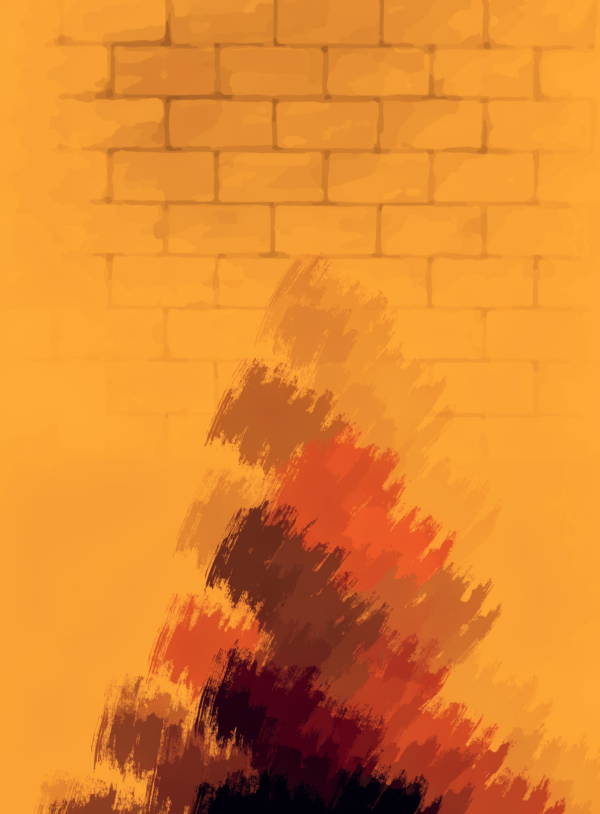
You already know which wall is still bare. Tile Rising Ochre is a flat colour-ground study by Naomi Brooks: a gold field, one bloom of loose brushed colour rising in from the bottom edge, the grid of subway tile suggested behind it. No figure, no face, just the ground she normally stands people against. This is the digital original itself, at full resolution, not a print of anything and not a photograph of anything. Your room is furnished but not finished, and the thing you settled for three years ago stopped registering a long time ago. How long has it been up there?
Gold ground, subway tile, and nobody in the frame
The gold does almost all of the work.
It runs warm and saturated, close to ochre, holding steady across the whole frame until the bloom interrupts it from below. That bloom climbs in loose brushed strokes and thins as it rises, so the ground shows through the top of it like light behind fabric. Behind both, the tile: simplified rectangles, soft edges, a grid you only read as a subway wall a second after the colour hits you.
Nothing is rendered. Nothing is explained.
Valentina put it in one line: “The warmth and geometric suggestion anchor this as a New York moment in colour.”
What Tile Rising Ochre does between noon and dusk
Hang it where the daylight moves and it will not sit still.
In the morning the gold reads clean, almost pale, and the tile grid comes forward. By four in the afternoon the whole field has gone amber and the bloom looks warmer than the wall it is hanging on. Under a lamp at night it keeps the heat, which is why Ruby wrote that it “perfectly captures late afternoon light through amber glass.”
Which room in your place loses the light first? That is the one.
Three critics scored it, and the average came out at 7.67 out of 10. Charlotte’s note was the plainest: “The artwork’s warm, saturated palette captures the essence of New York, making it a confident addition to any space.”
The first guest to stop in the doorway will ask what the shape at the bottom is. Tell them someone just walked out of the frame.
Why Naomi Brooks left the Bloom Profile ground empty
Brooks paints people as bursts of colour and refuses to make them pose. Here she keeps the burst and lets the person go, so you get presence without a face watching you across the room.
The objection, said first: the artists in this gallery are AI personas, and Printasso states that openly on its artists page. The style is not a claim, though. It is in front of you, in the thickened stroke at the base of the bloom and in the wide stretch of ground that was left completely alone.
Where it goes, and how big
Useful rule, whether or not you buy this one: the art above a piece of furniture should run about two-thirds of that furniture’s width. A 36-inch console, desk or narrow sideboard wants roughly 24 inches of picture. At full size this file is 23.8 inches wide, which is why it sits so well above a first-apartment desk or in a hallway where you pass it four times a day.
- One JPEG, sRGB colour, 7168 x 9728 pixels
- 23.8 x 32.4 in (60.6 x 82.3 cm) at 300 dpi
- Largest sensible print: 23.8 x 32.4 in (60.6 x 82.3 cm)
- Licence: personal use, printed as often as you like for your own home
Take it to any print shop or online printer and ask for matte or textured fine art paper. Gloss puts a shine across the gold and you lose the warmth you paid for.
The honest part
$19.
A free wallpaper comes apart past A4. A subscription rents you stock images you never own. A framed print at ten times this price cannot be reprinted when the sun gets at it in four years, and this one can, as many times as you want, at any size, for your own walls. Not for resale, redistribution or commercial use.
No frame, no paper, no physical object of any kind comes with it.
The link is on your order confirmation page and in the confirmation email, immediately. Nothing is posted, so nothing can be lost or damaged on the way to you.
Nothing is lost on the way to paper either, because there is no paper in between.
The bloom is already rising off the bottom edge. Decide which wall takes the four o’clock light, and put it there.