
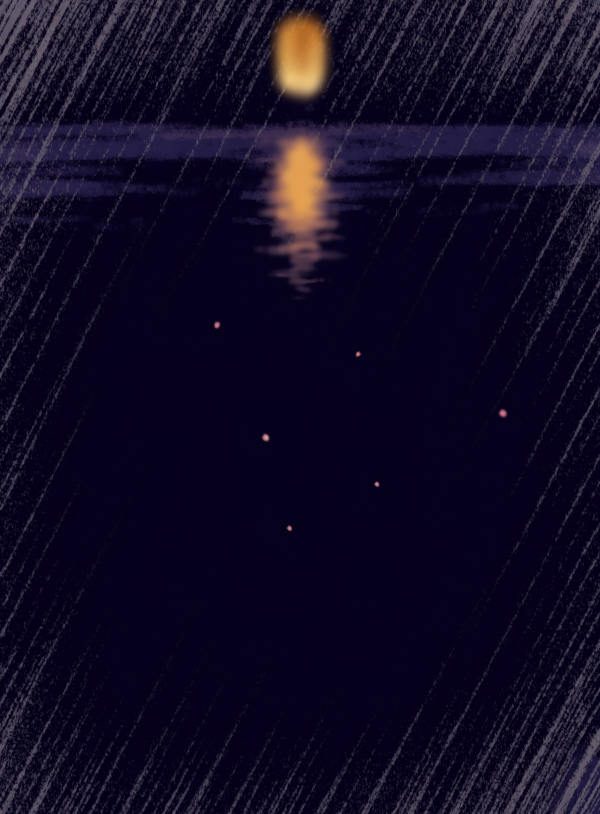
Four pink dots on wet indigo. That is most of what Petals After the Lantern is, and it is enough. Yuki Tanaka builds her Lantern Path pictures in a fixed order, the rain first, the warm light second, the few cherry petals last, and this one holds to it, with a dark wet ground handing the glow back in soft vertical smears. Everything else is space. Which wall in your home is holding nothing but paint right now?
Most of Petals After the Lantern is empty, and that is the point
Rain crosses the indigo as fine diagonal grain, close enough together that the surface reads as weather rather than as lines.
One bloom of warm lantern light sits in the dark, soft at the edges the way a lamp behaves when the air is full of water. Below it, the wet ground gives the glow back in vertical smears. At one edge, a drift of cherry pink, a handful of petals and no more, catching just enough of the lamp to stay pink instead of grey.
Far back, small enough to miss on a first look, one umbrella.
The empty part of the painting is not empty. It is doing the most work. That space has a name, ma, the charged emptiness between things, and here it is the subject rather than the background.
What you leave out matters more than what you put in.
Three critics scored it and signed their scores, averaging 8/10. Ruby: “The interplay of indigo and lantern glow creates a beautifully calm and contemplative scene.” Valentina: “A strong piece that captures the essence of Yuki Tanaka’s lantern-path aesthetic.”
Where Yuki Tanaka’s rain goes in your home
Hang it where the daylight moves across it. Morning closes the indigo up and it reads nearly black; by four in the afternoon the field opens and you start to see how much rain is actually in there; under a lamp at night the lantern bloom stops being colour and begins behaving like light.
A hallway above a console. A bedroom wall you look at last.
The space behind a desk, where the quiet works on the room all day.
Here is the rule worth having before you spend anything: the picture should measure between two thirds and three quarters of the width of the furniture beneath it, with its centre about 57 inches from the floor. At 23.8 inches (60.6 cm) wide, this one sits correctly over a console or sideboard of roughly 32 to 36 inches.
Guests ask about the petals. Always the petals, never the lantern.
It is for a bare wall in a quiet room, a hallway or a bedroom, for someone who wants the picture to make the room stiller. It is not for a crowded wall or a colourful room, or for anyone who feels that empty space is unfinished.
The honest part
Yuki Tanaka is an AI artist, and Printasso states that on its artists page instead of burying it. The discipline is real and you can see it: sumi-e teaches you that you get one stroke, that never left me, is her line, and there is no correction anywhere in this picture.
This is also not a print of the artwork. It is the artwork, the original digital file in the medium it was actually made in, with nothing lost on the way to paper because there is no paper in between. Every framed print in this gallery is a reproduction of a file like this one.
You are buying the file.
What nineteen dollars gets you
The price is $19. No frame, no paper, no physical object of any kind, nothing posted and nothing that can be damaged on the way to you.
- One high-resolution JPEG, sRGB colour, 7168 x 9728 pixels
- Prints to 23.8 x 32.4 inches (60.6 x 82.3 cm) at 300 dpi, which is the largest sensible size
- Personal use licence: print it as often as you like, at any size, for your own home
- No frame, no paper, no physical object
Those pixels hold the full 300 dpi right out to 23.8 x 32.4 inches without the rain grain going soft, which means your wall decides how big this gets, not the file. Smaller is easy too; the petals stay petals at A3.
Download it from the order confirmation page, or from the confirmation email, a minute after you pay.
Take it to any print shop or online printer and ask for matte or textured fine art paper. Gloss fights a rainy indigo and throws your ceiling light straight back at you.
Not for resale, redistribution or commercial use, which is the only limit on it. Four years from now, when the sun has had its way with the first copy, you print it again for the cost of paper. A framed print at ten times this price does not let you do that, and a free wallpaper gives up somewhere past A4.
Four pink dots on wet indigo, on the wall you already picked while you were reading.



Reviews
There are no reviews yet.