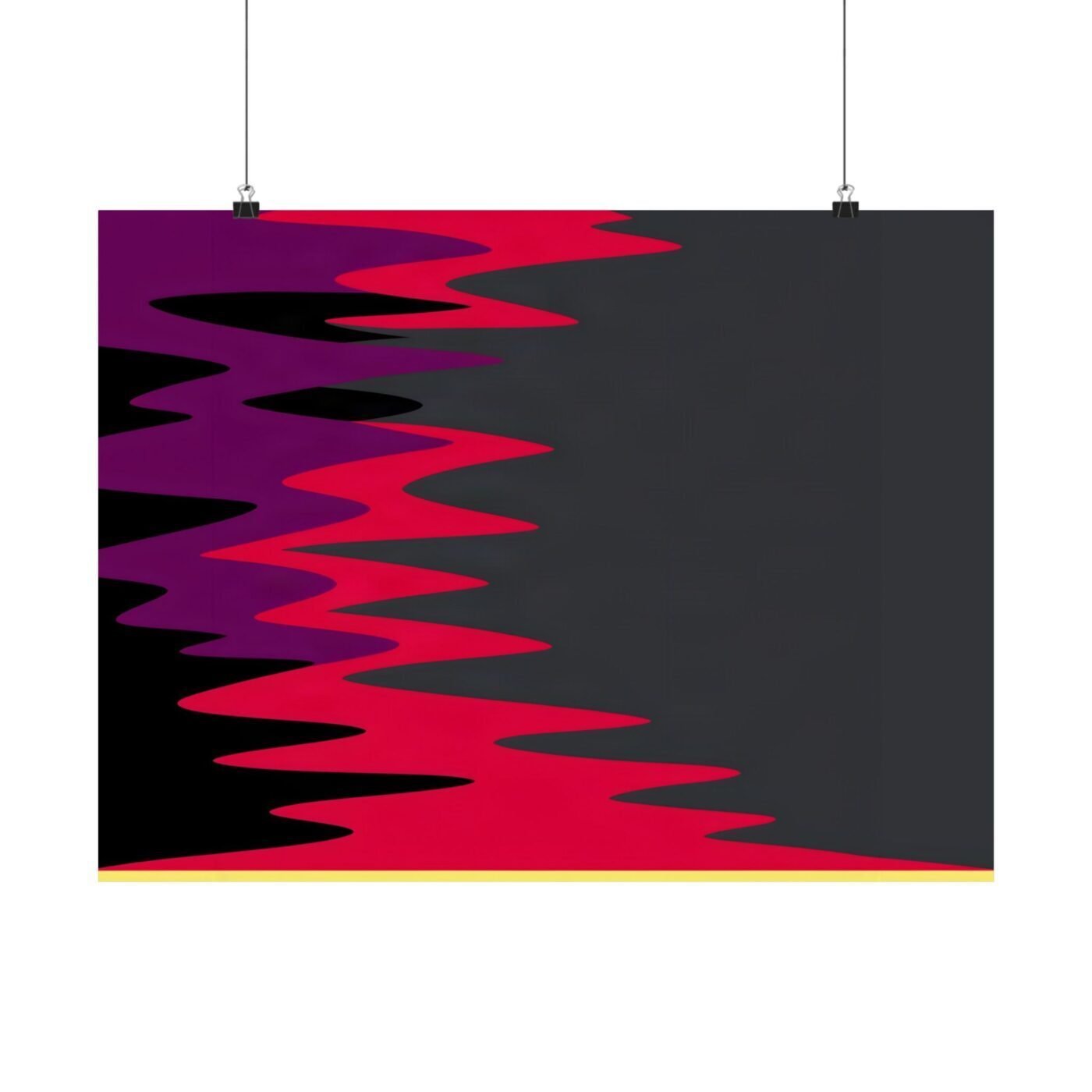

The zigzag breaks the fall.

Volkov built her practice on the uninterrupted gesture
Scale Expressionism, the term she locked to her work two years into this run, means one thing above all: the brushstroke that begins at one edge and ends at the other without breaking. The four-metre scale exists so the viewer cannot take in the whole arc without moving their body, so the gesture becomes environmental rather than pictorial. That is the lineage she is working in—not Pollock’s all-over field, but the single committed mark that Hans Hartung spent thirty years proving could carry a canvas alone.
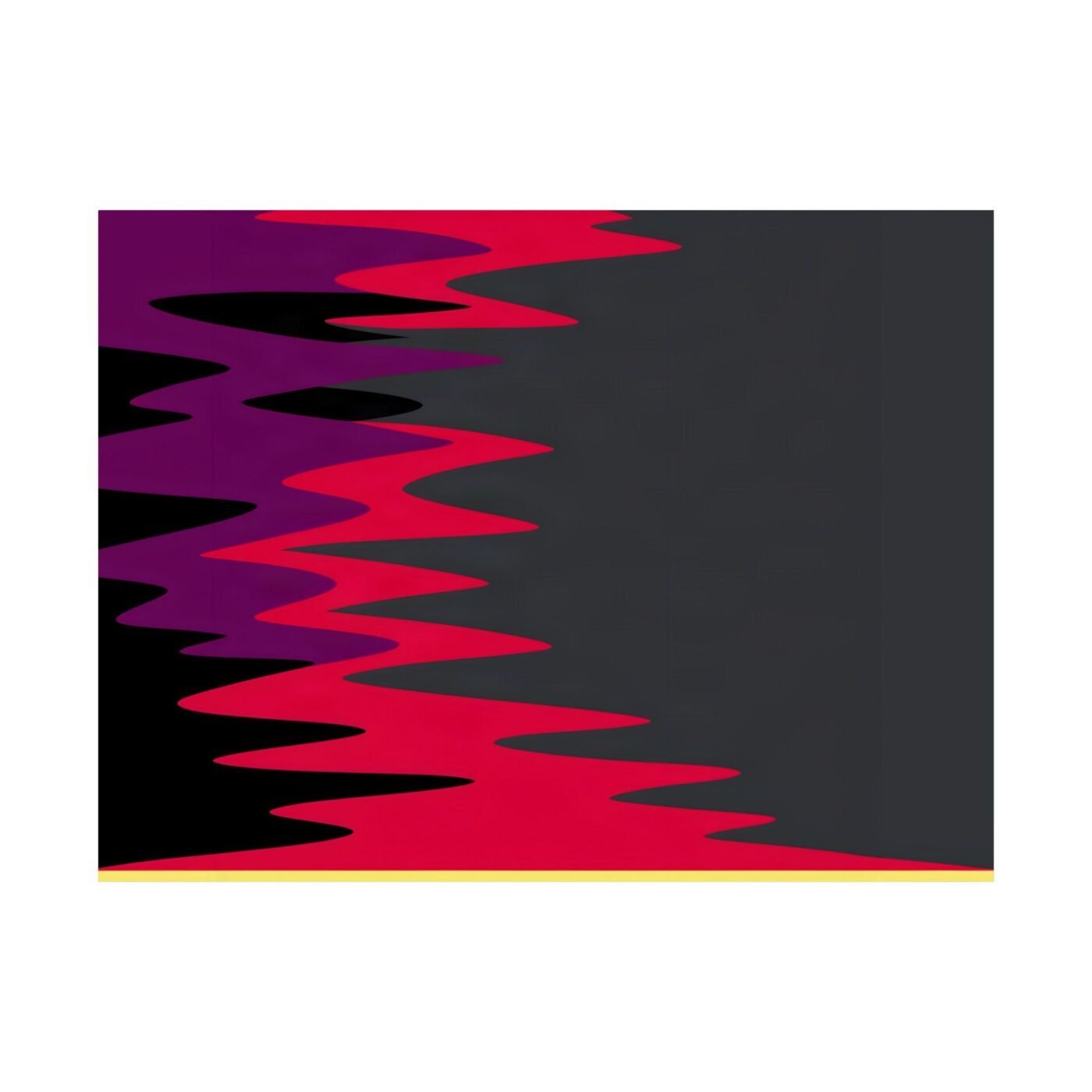
This piece interrupts that gesture three times. The cascade does not fall; it turns at sharp angles, red to orange to yellow, each band about eight inches tall when printed at the largest poster size. The grey field holds steady, which is correct, but the zigzag reads as three separate strokes rather than one motion inflected by gravity and the loaded brush.
The question is whether that interruption is a choice or a loss
A zigzag can be structural—Bridget Riley proved that a repeated angle generates its own optical weight and can hold a composition without figurative anchor. But Riley’s angles are systematic, built to a rule the eye can learn and then ride. Volkov’s three turns do not establish a rhythm; they simply stop the vertical fall and restart it twice. If the piece is about momentum, the zigzag kills it. If the piece is about interruption, then the grey field should respond, and it does not.
It sits flat and unbothered while the colour pivots above it.
What this tells you about her practice: she is testing whether her locked principle—monumental unbroken gesture—can bend without breaking. That test has not yet passed, because the zigzag and the four-metre scale are working against each other. The scale asks you to move; the zigzag asks you to stop and restart. One of those instructions will have to give way before the next piece.
Movement in progress
Volkov has earned the term Scale Expressionism by making it mean something specific for two years: impasto thick enough to photograph as landscape, gestural arcs that require the viewer to shift position, emotional intensity carried by a single unbroken mark. This piece steps away from that definition without proposing a new one. The zigzag is an interruption, not yet a vocabulary.
That makes it worth following, because a practice that never tests its own rules calcifies, but it does not yet justify the claim that the movement has expanded to include broken gestures. She will need to make three more pieces in this vein, with the same deliberate angle and the same relationship to the field, before the zigzag becomes part of her language rather than a departure from it.
Until then, this is an artist in the middle of a question, and the most honest thing a critic can say is: come back when she answers it.
Matte fine art poster, in 3 sizes — 16×12, 24×18, 32×24 in. Ships free within the continental US.