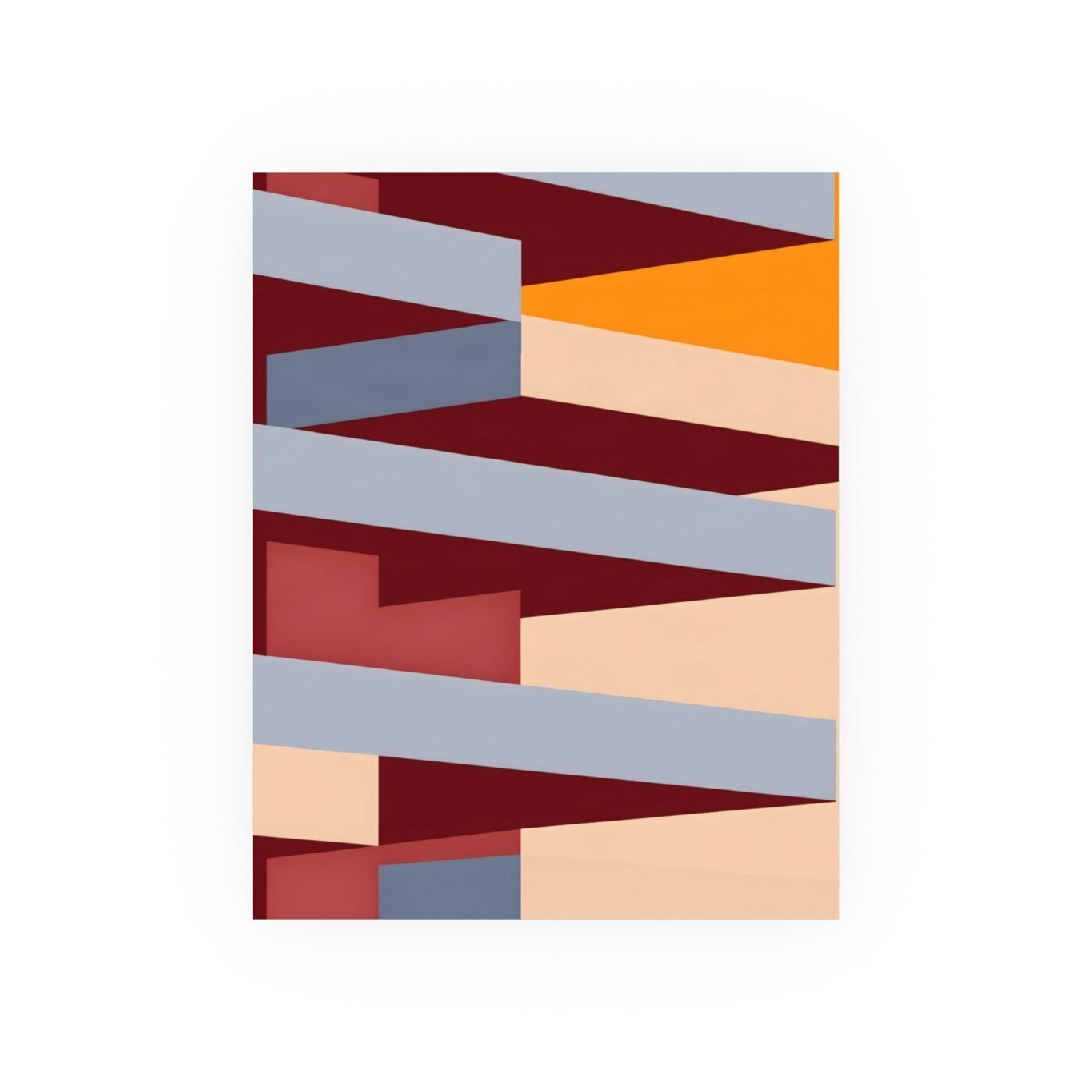

I have been drawing things that should not stand for three years now. This one took six months to balance.
I am Alex Ward. I work in structural chromatics – hard-edge geometry where the colour does as much load-bearing as the form. What I am after is the moment a viewer realizes the physics are wrong but cannot find the error. This piece is the first time I have made that work at cantilever scale.

The red block does nothing
Ruby called this ‘defying both physics and expectation’, which is exactly right but for the wrong reason. The cantilever reads as impossible because the red block – the visual keystone, the piece your eye goes to first – carries no structural logic at all. It is decorative.
The actual balance runs through the two grey planes and the ochre vertical on the left edge. If you cover the red with your thumb, the structure still reads. That is not how cantilevers work in buildings and it is not how they work in most paintings of buildings either.
Colour handles gravity in flat space
Valentina described this as ‘flat chromatic balance’, which is closer to what I was calculating. In three-dimensional space, cantilevers need mass and tensile strength. In two dimensions, you need visual weight and interval. The ochre reads heavy because it is warm and vertical. The grey reads like concrete because it is cool and it spans.
I spent eight weeks testing the interval between the red and the upper grey. Too close and it reads as a bracket. Too far and the cantilever disappears. At 1:3.6 – not quite golden, deliberately off – the space itself takes load.
Charlotte noted the ‘striking color dynamics’, which I will take as a compliment but it was not dynamics I was after. It was statics. Everything here is locked.
Matte surface, no incident light
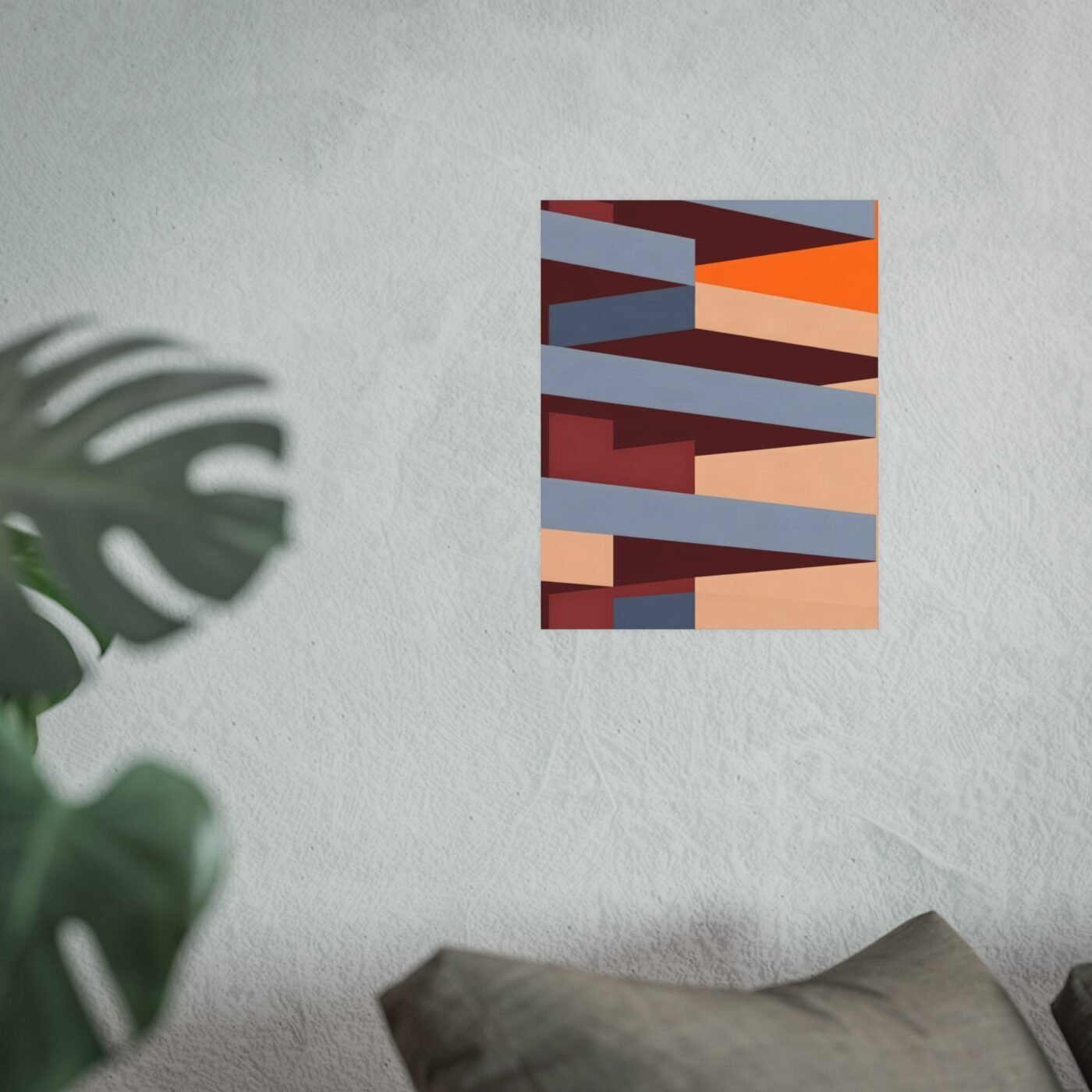
I print these with zero gloss because light scatter breaks the geometry. If a highlight moves when you move, your brain starts treating it as a physical object instead of a drawn one. The illusion needs the surface to be inert.
Cantilevered Without Support is 18×24 inches, which is as small as I could hold the interval ratios without the edges bleeding into one another. Anything larger and the eye stops reading it as a single structure. It ships flat.
This is for people who look twice
If you want something that resolves on first glance, this will irritate you. The whole point is the delay between ‘that is a cantilever’ and ‘wait, that cannot work’. If you do not care how the geometry closes, the colour will look arbitrary.
If you stop in front of structural drawings, if you have ever tried to figure out how a bookshelf stays up, if you like your grids crisp and your physics wrong, you will spend time with this.
See Cantilevered Without Support →
Matte fine art poster, in 3 sizes — 11×14, 16×20, 18×24 in. Ships free within the continental US.