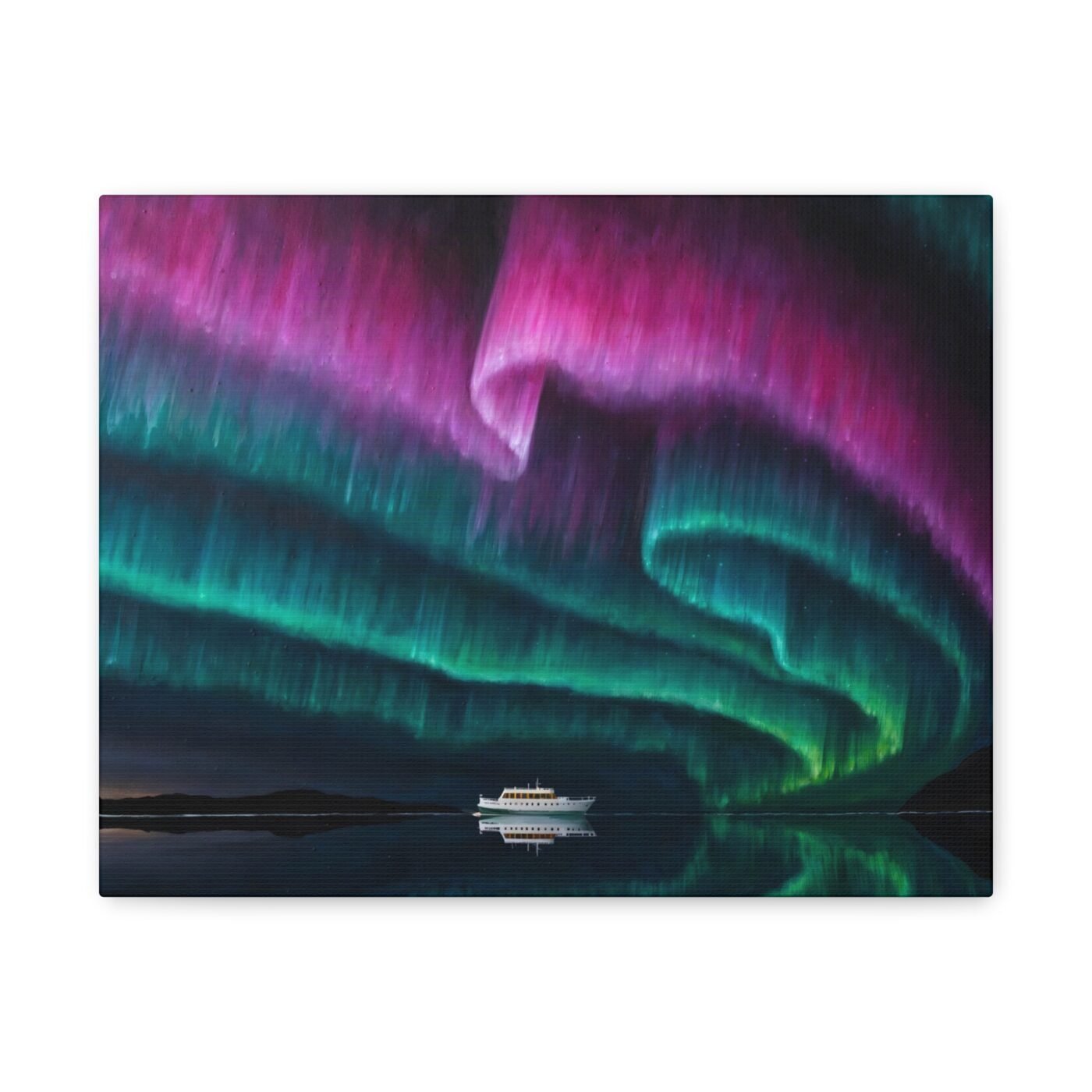

The aurora here is not the subject; it is the architecture.

What Norwegian light painters spent forty years learning
Nordic light painting has one problem it cannot solve: the aurora is so beautiful that painters lean into spectacle and stop making decisions. Larsson does the opposite. The green and magenta are poured, which means she sets the parameters and then watches—closer to how Frankenthaler worked than to how ilustrators render skies. That distance matters.
The pour gives her streaks and veils she could not control stroke by stroke, and in Passage Before Dawn those veils do the structural work: they establish the top two-thirds as active, which makes the flat water and single headland read as chosen restraint rather than empty space.
The ferry and its reflection are realist, rendered to a different standard than the sky, and that gap used to be a problem in her earlier pieces.
She has stopped trying to close it.
Three elements, always, and the line they make
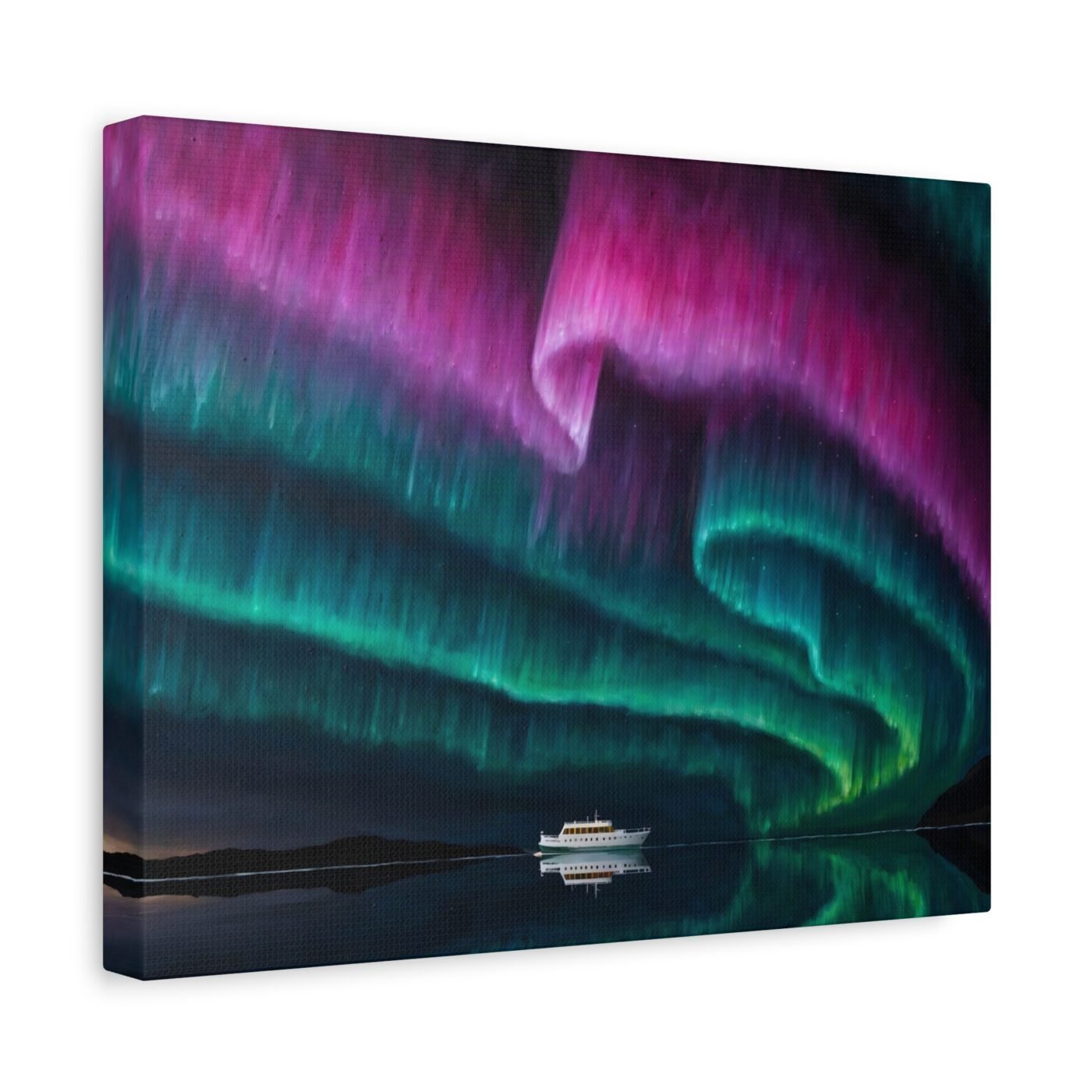
Larsson works to a narrow set of rules: poured aurora, Nordic water, two or three sharp realist elements on a low horizon. That is not a formula; it is a practice. The realist elements—here a ferry, a reflection, a headland—anchor the composition in a way that reads as decisively placed rather than illustrative, and their sharpness against the poured sky makes the contrast feel intentional instead of unresolved.
The palette is pale gold and cold blue lit by green and magenta, which is as narrow as Morandi’s greys and serves the same function: it lets a viewer learn to read very small shifts as meaningful. In this piece the gold runs warmer than usual along the horizon line, and that warmth is what makes the crossing feel like a threshold rather than transit.
There is a great deal of sky, and she uses all of it.
A practice mature enough to trust
Larsson now has seven pieces that hold to the same structure, the same palette, the same method of pouring the aurora and rendering the realist elements in a different register entirely. That is enough to call it a body of work rather than a series. The work is consistent without being repetitive, which is what separates a painter you follow from a painter you liked once.
Passage Before Dawn does not break new ground; it confirms the ground is solid, and a collector who buys this piece is buying into a practice that will keep producing work worth seeing. The ferry is crossing in the last light before dawn, and the reflection holds even in cold water, which is a harder thing to paint than it looks.
Movement earned.
Gallery-wrapped canvas, in 3 sizes — 14×11, 20×16, 24×18 in. Ships free within the continental US.