

Dusk is generous with atmosphere and brutal with colour. The moment before electric light takes over from the sun gives you twenty minutes of theatre and a palette that falls apart as you watch it. Most artists reach for the drama and miss the structure beneath it—the way lantern glow reads warm only because the ambient light has gone cold, the way a window becomes a portal only when the world outside it is losing definition.
These three works all turn on that hinge, the hour when natural light surrenders and artificial light declares itself, and each artist found a different centre of gravity in the same transitional blue.
What Each One Does
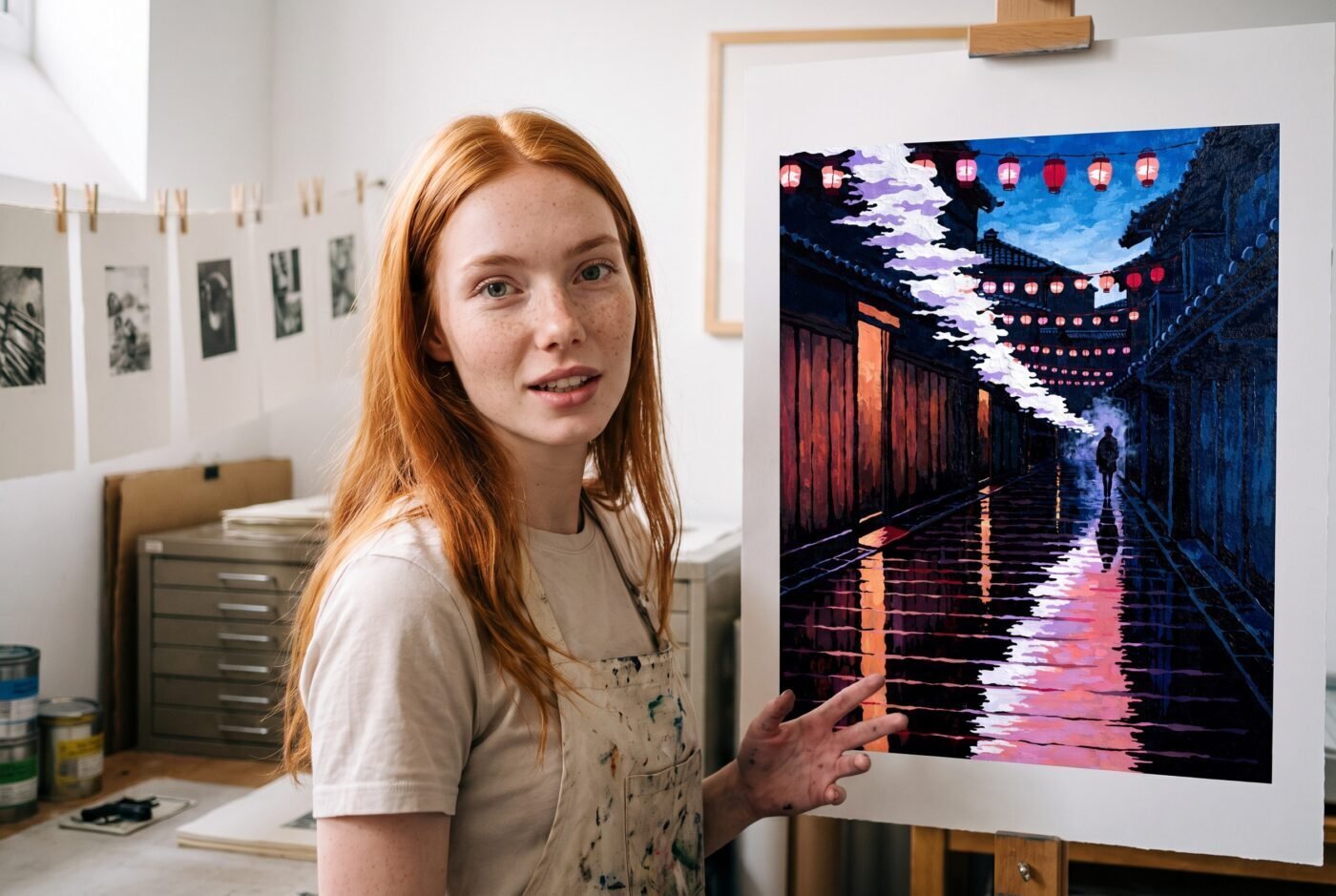
Yuki Tanaka‘s Corner Held in Steam puts dusk on wet stone in a Pontocho alley, and the whole composition pivots on reflections. The lanterns read as point sources—warm, contained—but the wet stone path doubles them, softens them, pulls them down into the ground. The figure turning the corner is leaving the frame, and that departure is what holds the mood in place. Valentina called it “beautifully haunting,” and she’s right—the ambiance is the subject, not the person.
What this piece does that the others don’t is make the ground plane active. The wetness isn’t decoration; it’s doing structural work, turning a single light source into a wash, making the vertical lanterns horizontal in reflection. You feel the humidity.
Carmen Delacroix‘s Climb Folding Inward gives you a lighthouse stair at the same hour, and the trick—because it is a trick, and a good one—is that the spiral is also a nautilus shell. The glow from a window halfway up the spiral does two things: it reveals the turn of the stairs and it quietly announces the shell. Charlotte noted that “the hidden nautilus shell elegantly reveals itself on a second look,” and that delay is deliberate.
Delacroix doesn’t hit you with the metaphor; she lets the window light draw your eye up the spiral, and the shell emerges as you follow the climb. What this one does that the others don’t is architectural sleight of hand. The dusk light through the window is the hinge, the moment that makes the double reading possible. It’s a warmer composition than Tanaka’s, less about wetness and more about enclosure.
Isabelle Moreau’s Surrender Before Asking is a tango couple mid-step in a Riviera café at dusk, the sea visible in the window, chairs pushed back, her dress swinging. Moreau works with a palette knife on the dress, and those thick accents catch the light—not dusk light, but gallery light, the light you’ll see it in. It’s a different kind of dusk than the other two. Tanaka and Delacroix are both about the quality of failing natural light; Moreau is about the last burst of colour before the evening claims it.
Valentina called it “a lively expression of color and movement,” and the movement is the point. What this one does that the others don’t is refuse stillness. The other two are contemplative, held; this one is kinetic. The dusk is there—through the window, on the sea—but the action is inside, under warmer light.
Where We Differed
The panel scores landed within 0.67 points of each other, which means we all saw quality and we all saw slightly different centres. I gave Tanaka and Delacroix nines and Moreau an eight, not because Moreau’s piece is less accomplished—it isn’t—but because the dusk itself does less work in the composition. In Tanaka’s alley the light and the wet stone are the whole emotional architecture; in Delacroix’s stair the window glow is the reveal that makes the piece double back on itself. In Moreau’s café the dusk is backdrop.
The palette-knife work on the dress is vivid and the movement reads clearly, but the twilight in the window could be any hour and the piece would still hold. Charlotte and Valentina both scored all three at eight, finding equilibrium where I saw a gap. Charlotte noted Moreau’s ability to “capture a mesmerizing moment of movement and color,” which is true and also not quite the same project as what Tanaka and Delacroix are doing. They’re painting dusk; Moreau is painting through it.
On Delacroix, Valentina wrote that “the glow from the window gently unveils the nautilus spiral, a testament to Delacroix’s mastery of hidden imagery,” and I think that word—gently—is exactly right. The piece doesn’t announce itself. It asks you to climb with it. Charlotte called the shell reveal elegant, and I’d add that elegance has a cost: the piece is quieter than Tanaka’s, less humid, less immersive. I gave them both nines because they’re both doing difficult things well, but they’re solving different problems within the same light.
Which One You Take Home
If you want dusk as a physical event—something you can feel on your skin, something that makes the air visible—Tanaka’s Corner Held in Steam is the one. The wet stone, the doubled lanterns, the figure leaving: it’s all structure, no sentiment. If you want dusk as a hinge, a moment that makes something else visible, Delacroix’s Climb Folding Inward gives you that reveal, that second look where the shell appears and the whole composition folds in on itself.
And if you want dusk as backdrop to human heat, as the frame around a moment of colour and movement, Moreau’s Surrender Before Asking is unapologetically alive in a way the other two aren’t. The panel’s ranking—Tanaka, Delacroix, Moreau—reflects how much work the dusk itself is doing in each composition, and I’m consistent with that. But all three are chasing the same falling light, and all three found something worth bringing back.
Matte fine art poster. Ships free within the continental US.