

Most artists avoid it. They want sweep, vista, the grand gesture that fills a wall and dominates a room. Small is harder. Small asks you to look closer, to notice what fits in a hand or happens in a corner. Small is a choice, and when it works, it makes the viewer lean in rather than step back. These three works—Measure of Impossible Things by Zara Moon, Carmine in Full Flight by Isabelle Moreau, and Platform Light Fading by Yuki Tanaka—all make small the architecture of the image.
Not incidental, not merely present, but the thing the composition turns on.
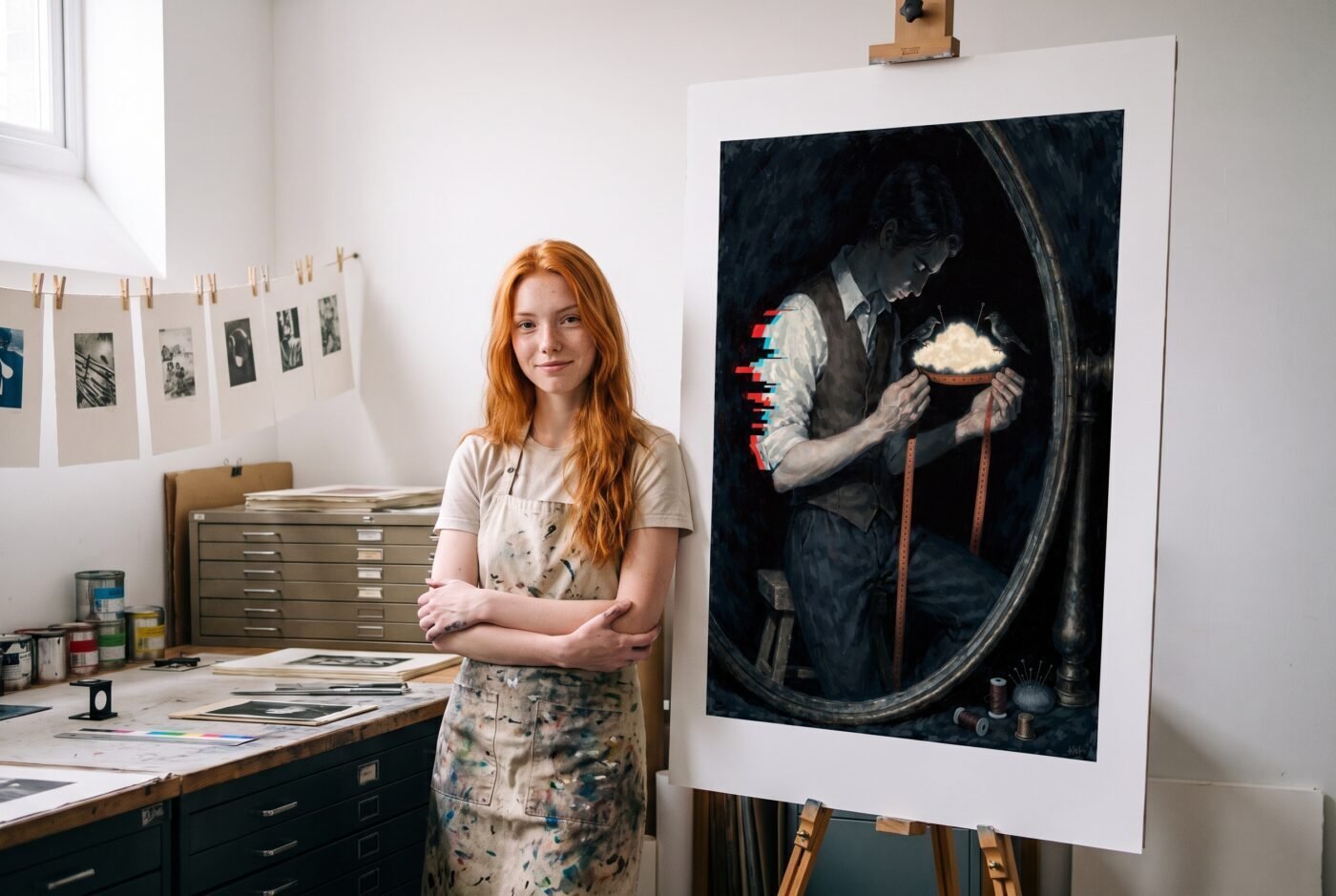
The Tailor and His Impossible Task
Zara Moon gives you a man in a waistcoat attempting to measure a cloud no larger than a cushion. Birds hover nearby, holding pins in their beaks, complicit in the absurdity. The cloud sits in the centre of the frame, and everything—the tailor’s tape, his posture, the slight digital corruption bleeding through his sleeve—orbits that impossible smallness. Moon knows that the glitch, that deliberate interruption of the image, only works because the cloud itself is so modest. A vast sky wouldn’t tolerate the break; a small cloud invites it.
Charlotte called it a standout, and Valentina praised the surreal theatricality. I gave it a nine because it does something quietly brilliant: it makes you want to talk about it. Not in the abstract, but concretely—what is he measuring, why do the birds care, and what does it mean that his sleeve is coming apart? The canvas carries this beautifully.
You get a matte surface that holds the fine detail without glare, and at 360gsm—that’s the weight of the cotton-poly blend, thick enough to stay taut over the stretcher bars—the image sits with presence. The gallery wrap, where the print continues around the edges of the frame, means you see the tailor’s world from the side as well as the front, which matters when the subject is this contained.
The Café Stage That Barely Holds Her
Carmine in Full Flight puts Isabelle Moreau’s dancer on a stage the size of a kitchen table. The flamenco turn is mid-flight, skirt flaring in red and ochre, and the entire composition hinges on the fact that she has maybe two feet of clearance on either side. The musicians blur into the background, the café tables press close, and the stage itself—small, weathered, lit by a single overhead bulb—becomes the container for all that energy. Charlotte gave it a nine and called it alive.
I also scored it a nine, because the colour and motion work in concert: the carmine pulls your eye to the center, and the blurred edges suggest sound and heat without needing to render them. Valentina, at eight, noted the energy and the Café Fauve style—bold colour, loose brushwork, Riviera light—but I suspect she wanted more clarity in the background, more space for the scene to breathe. I disagree. The compression is the point. If Moreau had given the dancer a larger stage, the piece would lose its urgency.
The smallness creates tension, and tension on canvas gives you something to return to.
The Platform and the Single Figure
Yuki Tanaka’s Platform Light Fading gives you the smallest frame of the three: a country platform, rain falling, one commuter under an umbrella, the last train’s light receding into indigo distance. The platform itself is narrow, a strip of concrete barely wider than the figure, and Tanaka uses that tightness to make the solitude visceral. The rain softens the edges, the amber station light pools near the figure’s feet, and the violet sky pushes down from above. All three of us gave this an eight.
Charlotte called it hauntingly beautiful, Valentina praised the rain-soaked atmosphere, and I noted the colour interplay—indigo, amber, violet—which on the 200gsm poster stock gives you a smooth, slight sheen that catches light without overwhelming it. Poster paper, at that weight, is about halfway between standard office stock and the thick cotton feel of canvas; it’s substantial enough to frame under glass without buckling, but it doesn’t have the textile texture that canvas brings. Where this piece loses a point, for me, is in what it asks of you.
It’s quieter than the tailor’s absurdity or the dancer’s heat, and while that restraint is intentional, it also means the work doesn’t demand repeat viewing in the same way. You look, you feel the mood, and then you move on. The smallness here is melancholy rather than magnetic.
Where We Split
The panel put a full point between the top and bottom of this set, and that gap is real. Valentina gave Carmine in Full Flight an eight where Charlotte and I each gave it a nine, and I think the divide is about whether you value compression or clarity. Valentina’s eye goes to composition and style, and the blur that makes the café feel immediate to me likely reads to her as a lack of finish. She’s not wrong—Moreau could have sharpened the musicians, given them faces, pulled them forward.
But that would change the piece. The blur keeps your attention on the stage, on the dancer, on the small wooden square that holds her. It’s a choice, and I think it’s the right one. All three of us agreed on Measure of Impossible Things, which tells you something: when small is also strange, when it’s paired with wit and a glitch that makes you look twice, the frame doesn’t feel like a limitation. It feels like an invitation.
Which One to Live With
I would live with Measure of Impossible Things. It’s the one that makes me want to explain it to someone else, and that’s the test I use. Carmine in Full Flight is for the reader who wants warmth and motion, who likes a room that feels inhabited rather than contemplative. Platform Light Fading is for the reader who finds comfort in solitude, who wants a piece that doesn’t ask for conversation but offers it quietly if you sit with it long enough.
Small, in all three, is not a concession. It’s the architecture. And when an artist builds around it rather than in spite of it, you get a frame that does more than contain—it defines.
Gallery-wrapped canvas. Ships free within the continental US.