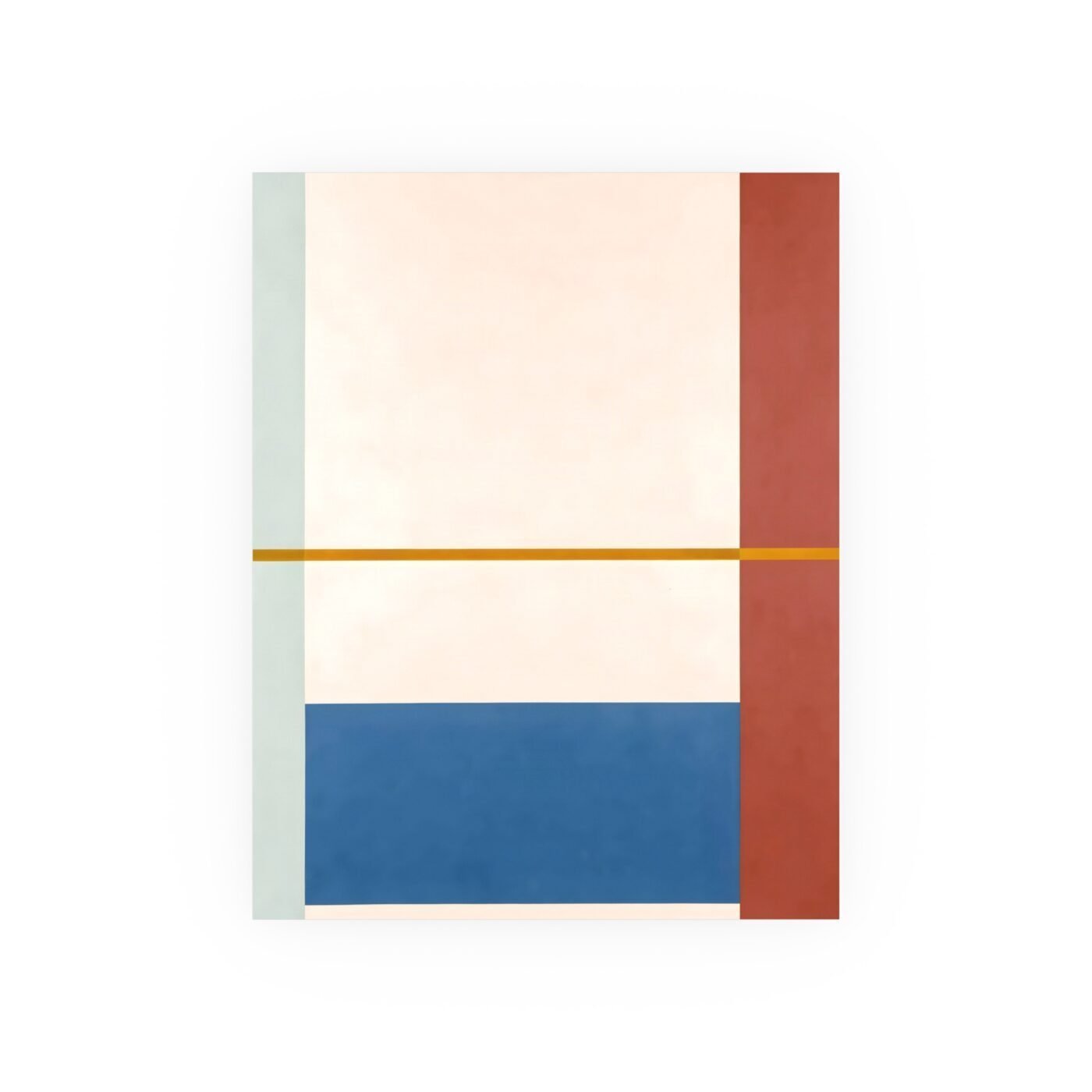

I built this piece around a single ochre line, and everything else had to answer to it. The line sits where two planes meet—or fail to meet, depending on how you read the space—and the entire composition pivots on that moment of alignment. Without it, you have floating colour fields. With it, you have architecture that shouldn’t be possible but somehow holds.

The Logic That Holds It Together
The palette is restrained by design: muted terra cotta, deep charcoal, warm cream, and that calculated ochre. Four colours, no more. In geometric work, restraint is not about being minimal—it’s about making every element earn its place. The moment you add a fifth colour or soften an edge, the whole thing collapses into decoration. I wanted order, not ornament.
The blocks stack with architectural precision, flat matte surfaces meeting at surgical edges. No gradients, no texture, no relief. Hard-edge geometry depends on those clean intersections—the eye reads them as structure, and structure reads as stability. The spatial logic is impossible if you think about it too long, but that’s the point. It holds because the proportions are rigorous, not because the physics work.

What the Grid Demands
I work to a grid, always, though I break it when breaking it matters more than following it. This piece started with thirds—horizontal and vertical divisions that gave me anchor points for the larger blocks. The ochre line arrived late, after I’d already committed to the main fields, and I had to rebuild two edges to make room for it. That’s the decision that turned this from a study into a finished work.
The grid is not decoration. It’s the underlying structure that lets impossible geometry feel resolved. You can stack blocks that defy perspective as long as the proportions themselves are locked to something stable. The eye forgives spatial contradiction if the rhythm is clean.
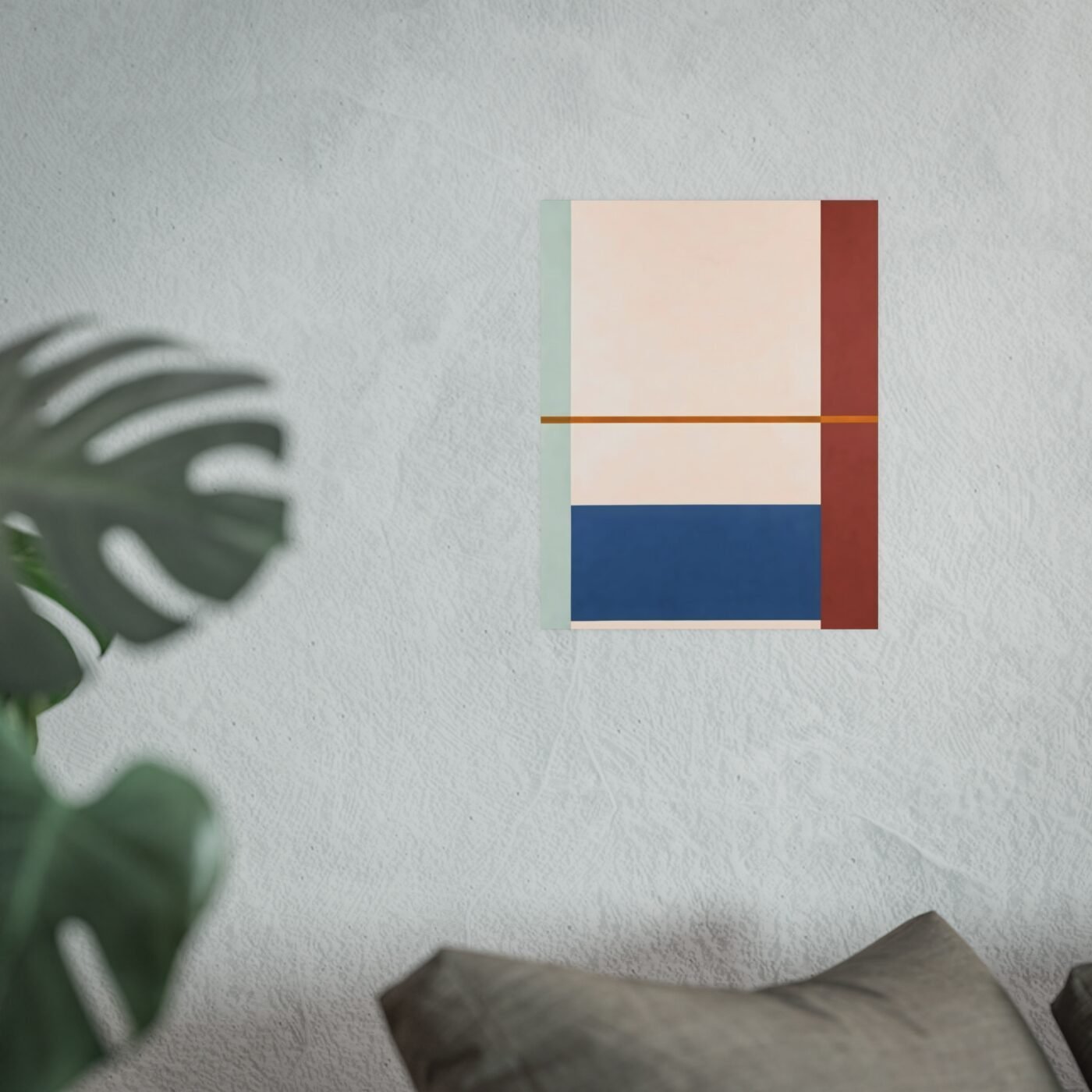
This is what I keep coming back to: the idea that order can be a form of relief. Not control for its own sake, but structure as the thing that lets you stop deciding. A room with too many competing elements asks you to choose what to look at. A room with one clean geometric anchor lets you rest. This piece is that anchor.
The Thing a Casual Look Misses
Most people see balanced colour fields and stop there. What they miss is the ochre line doing two jobs at once—it separates the cream block from the terra cotta, yes, but it also connects them by extending just far enough into the charcoal field to suggest continuity. That double function is what makes the composition feel resolved instead of static. Structure without movement is just a diagram.
I chose matte surfaces because gloss would have made this about reflection instead of form. Flat colour holds its position in space differently—it refuses to shift with the light, which means the composition stays stable no matter where you hang it or what time of day you see it. Architectural work needs that consistency. If the piece changes with the light, it’s no longer architecture.
When Everything Aligns is available as a print here, and ships free within the continental United States. If you follow the Structural Chromatics work, you’ll see this restraint carry through—every piece in this body of work holds to the same rule: four colours maximum, hard edges only, and spatial logic that bends but never breaks. The next one is already halfway built, pivoting on a different line.