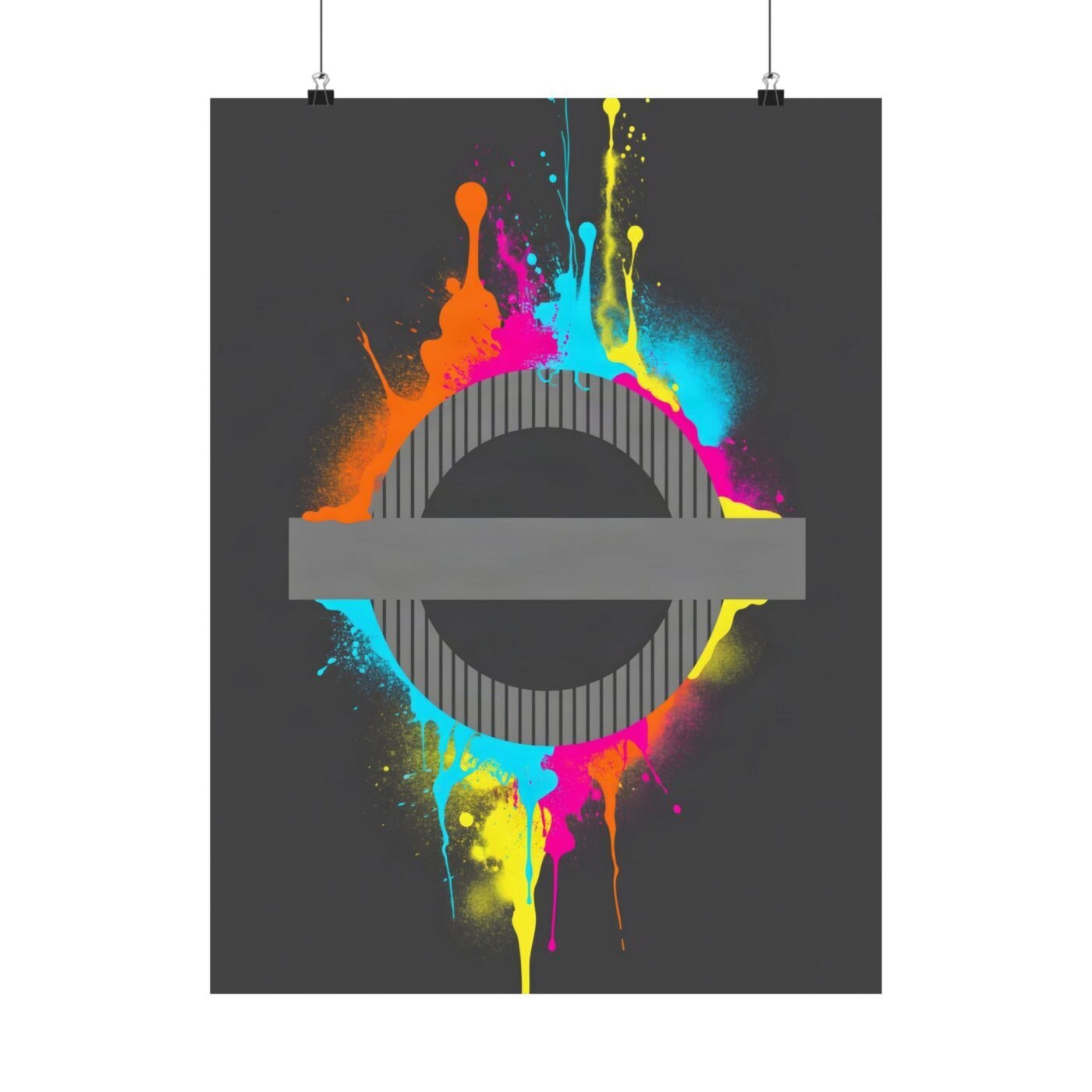

The vector stays put, the burst floats an inch forward, and you can measure the gap with your finger.

The grey holds a line you could rule
Kai Reynolds builds the Tube roundel in vectors — mathematically defined curves that print crisp at any scale. At 1440 dpi (dots per inch, the measure of how fine the printer can lay down a single drop), those edges read as drawn, not printed. The grey circle stays absolutely flat against the substrate. Matte archival paper has no shine to catch light, so the grey reads as one uninterrupted surface. You can run a finger across it and feel nothing.
Then the burst happens. Pigmented archival inks — particles suspended in liquid, not dyes that soak in — build colour in successive passes. Where they layer, they sit physically higher. The thickest deposits are in the saturated core: magenta meeting yellow, wet-look oranges that catch light at an angle. That dimensional difference is about a tenth of a millimetre, which is enough. Your eye reads it as closer. The burst lifts.

Two print methods colliding on one sheet
What makes this work as an object is that Reynolds uses the precision to frame the mess. The roundel’s inner edge is the hardest line in the piece, and it holds. When the aerosol bloom pushes past it, you see both: the vector that will not move and the ink that already has. It is the same trick screen printers use when they misregister on purpose, but here it is baked into the image at file resolution. The printer never wavers. The chaos is authored.
Museum-grade paper stock — lignin-free, acid-free, rated for a century under glass — means the magentas stay magenta. Cheaper stocks let fugitive pigments (the ones that fade first) slip within two years near a window. This one is printed to order in the USA and ships flat, unframed, free within the continental US. Framing it under UV-filtering glass will hold the colour past your lease.
Scale and the size that pays for the ink
The 12×18 is a test print. You get the idea but not the payoff: the burst needs room to land, and at that size it reads as contained. The 18×24 is the threshold. The eruption has enough real estate to feel like an event, and the grey circle stays large enough to hold its geometry. Past that, the 24×36 is where it becomes architectural. The burst is the size of a dinner plate. You hang it four feet up and it meets you at eye level.
The risk is in matching the wall. This piece wants a neutral ground — white, light grey, anything that lets the vector read as a shape and the colour read as an interruption. A patterned wall or a dark one will compete, and the border between order and disorder (which is the entire point) disappears.
Verdict: Poster, 18×24 or larger. The dimensional contrast between the vector and the layered ink is what makes this worth printing, and it needs scale to register. Digital gives you the composition but not the object. Canvas would flatten the finish and lose the matte/gloss split that makes the burst lift. The poster stock at 18×24 delivers the physics of the image at a price that does not require a committee. If you have the wall for 24×36, that is the one to order.
See Circle Disobeying Centre →
Matte fine art poster, in 3 sizes — 12×16, 18×24, 24×32 in. Ships free within the continental US.