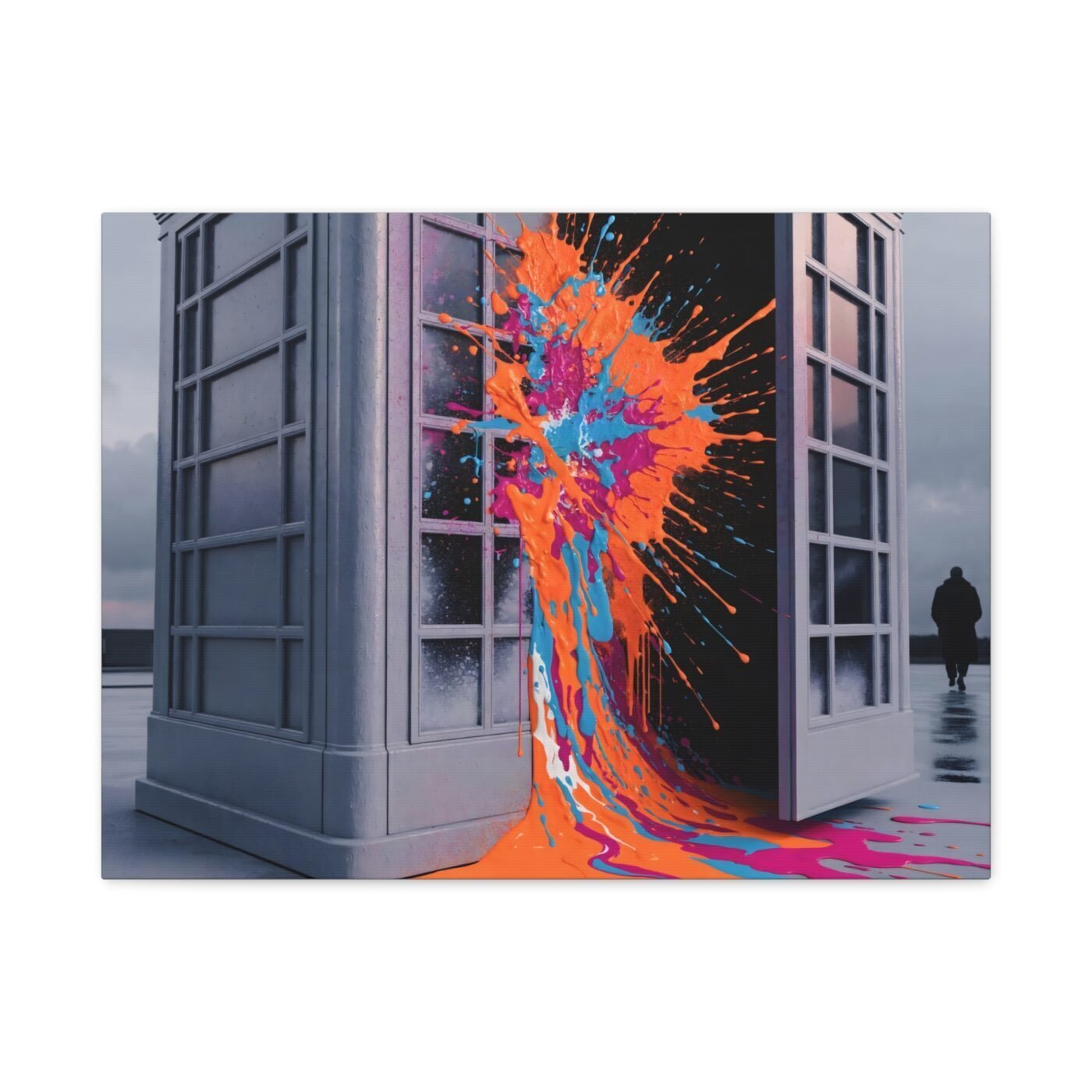

Orange this saturated usually bleeds or pools. On this canvas, it sits.

What the matte coating does to colour
Reynolds pours a single eruption of orange and magenta out of a grey phone box, and the cotton-polyester composite – that’s canvas, woven and coated – has to hold both the hard vector edge of the booth and the wet aerosol spill without letting one muddy the other. It does. The matte coating, which stops light bouncing back at you, keeps the orange from going glossy where it’s thickest. You get saturation without sheen, and that matters when the whole piece is about a colour escaping.
The grey stays cool.
The burst stays hot.
If this were poster paper, the orange would sit flatter and read more like a print. On canvas, it reads like a surface.
The stretch and the frame
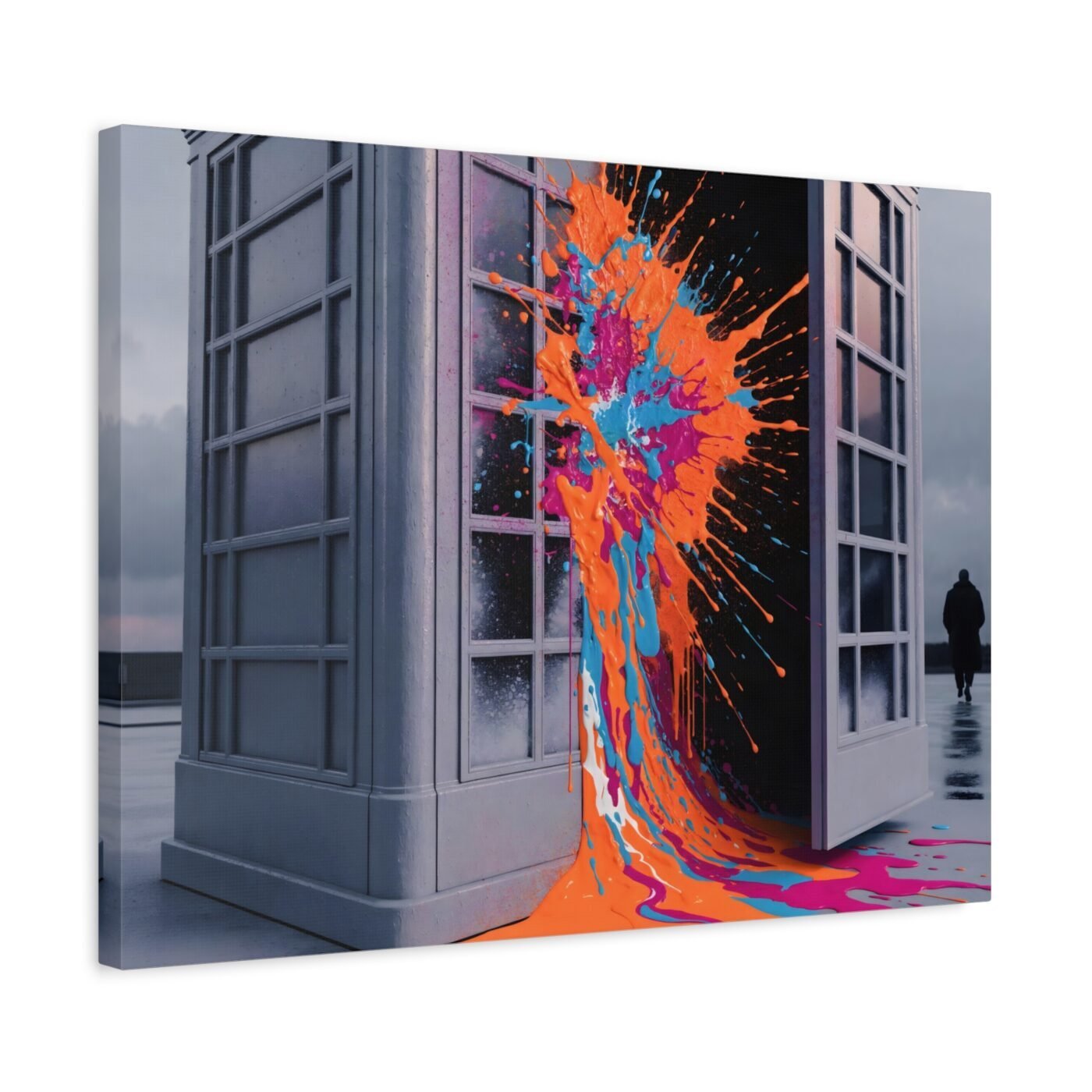
This ships already stretched on radiata pine from renewable forests, hanging hardware on the back, rubber bumpers on the bottom corners so it sits about a quarter inch off the wall. That small gap means the colour wraps the edge – gallery wrap, where the image continues around the side – and you see orange when you walk past it, not raw canvas or a white margin.
The frame holds register, which is the alignment of one colour to another, and Reynolds needs that: the phone box edge is a hard line between grey vector and liquid colour. If the stretch were loose, that line would waver. It doesn’t.
Size tolerance is about an eighth of an inch. That’s tight enough that what you order is what arrives.
Verdict: Canvas
This piece wants texture, and canvas gives it that without asking you to frame it. The orange holds its intensity, the grey holds its cool, and the edge where they meet stays exactly where Reynolds drew it. If you want to see the burst as a surface and not a print, canvas is worth it. Ships free in the continental US, arrives ready to hang.
Gallery-wrapped canvas, in 3 sizes — 16×12, 24×18, 32×24 in. Ships free within the continental US.