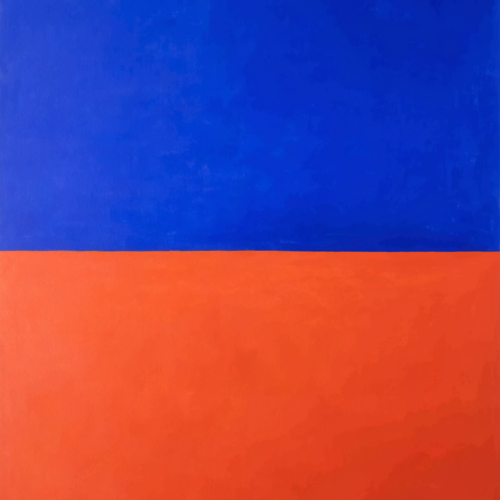

The terracotta does not ask permission. It takes the entire frame of Her Constant Ground, Naomi Brooks’s flat colour-ground study, and allows exactly one cream line to cross it. This is the field of colour she normally sets a figure against. Here the ground is the whole subject. Nobody stands in it, and nothing is missing. You already know which wall in your home has been waiting for something to happen to it.
What the terracotta in Her Constant Ground does to a room
Saturated, flat, even, a warm red-brown that reads as dry clay at nine in the morning and as embers by six.
The cream line runs straight through it. No blend, no feathering, no attempt to soften the place where the two colours meet.
Hard, confident division, and nothing else asked to carry the picture.
Warm colour shifts hour to hour, which is the part no photograph of a wall ever tells you: morning light cools the terracotta and pushes the cream close to white, then by late afternoon the field deepens and the line stops sitting on the surface and starts to glow.
Hang it where the daylight moves.
Why Naomi Brooks kept the colour and left the figure out
The critics split on it, usefully. Valentina: “The terracotta refuses to be interrupted, acknowledged only by a bold cream line.” Ruby went wider: “The interplay between rich terracotta and delicate cream is both intimate and expansive, capturing the brief perfectly.”
Charlotte was cooler, and said so: the two colours “engage, but they stop short of unforgettable.”
Which of them is right depends entirely on where you put it.
Where this one goes
Above a sideboard in a hallway, at the end of a corridor where the eye needs somewhere to land, or on the one bedroom wall that has stayed bare because everything you tried on it was too polite.
It holds a room without narrating one. Guests look for four seconds, then ask what the colour is called, not what it means.
Presence without performance. That is a harder thing to buy than it sounds.
The honest part
You are buying the artwork itself, as a file. Every other print in this gallery is a reproduction of a digital original; this is the original, at full resolution, in the medium it was actually made in. Nothing is lost on the way to paper, because there is no paper in between.
What lands in your hands:
- One JPEG, 7168 x 9728 px, sRGB colour
- Prints at up to 23.8 x 32.4 inches (60.6 x 82.3 cm) at 300 dpi
- Personal use: print it as many times as you like, at any size, for your own home, not for resale, redistribution or commercial use
- No frame, no paper, no physical object of any kind
That resolution means the wall decides how big this gets, not the file, because the cream edge stays a knife edge at full size and the terracotta holds even across the whole field with no banding.
Take it to any print shop or online printer and ask for matte or textured fine art paper, since gloss throws hotspots across a colour field this flat.
Measure the furniture underneath before you pick a size. Two-thirds of its width is the proportion that never looks wrong, which puts the full 23.8-inch width above a sideboard or bench of roughly 36 inches (91 cm).
$19. A free wallpaper falls apart past A4, a subscription only rents you images half the internet also has, and a framed print costs ten times this and cannot be replaced when four summers of sun pull the terracotta pale. You can print this one again, and again after that.
The link sits on your order confirmation page and in the confirmation email. Nothing is posted, so nothing can arrive damaged and there is nothing to wait for.
Order it tonight, hang it where the afternoon reaches, and watch the cream line come up out of the terracotta at four o’clock.