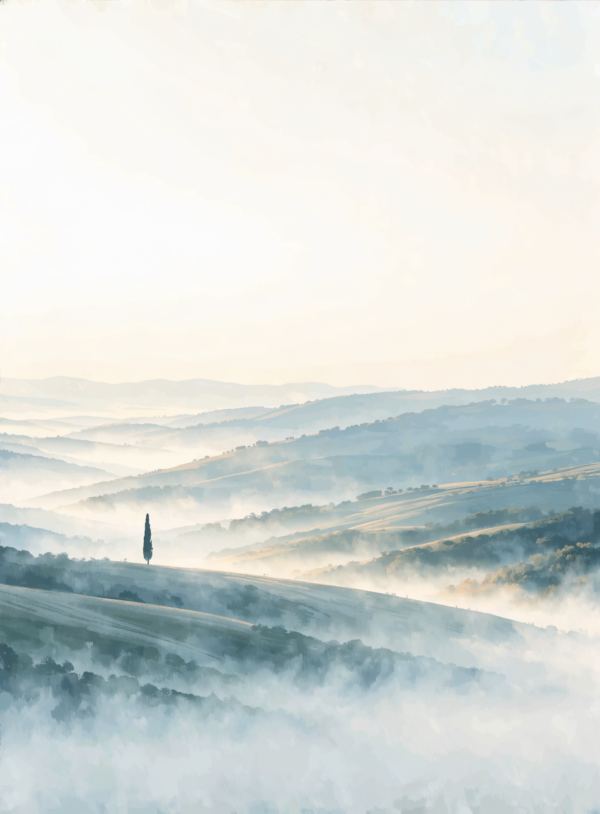
You already know which wall. First Heat Rising is Marco Bellini’s atmospheric Tuscan light study of morning haze burning off the hills — a vast sweep of sky running from pearl into butter, a horizon that only just declares itself, and one cypress holding all that dissolving space steady. Your room is furnished. It isn’t finished. Something above the sideboard has been almost right for three years, and you stopped seeing it in the second one.
What First Heat Rising is doing at six in the morning
Cool at the start, and warming as you look.
The sky carries nearly everything here: a patient run from pearl through grey-blue into butter, hazed where the heat is starting to win, thinning over hills that are barely hills yet.
Ruby, reviewing it: “The sky does all the work here: a vast, patient sweep from pearl into butter, with just enough horizon to make you feel the hills emerging.”
Then the cypress.
It is the only thing in the picture that has made up its mind, and once you have found it you will find it every time you walk past.
Everything else is air, colour and open space, which is exactly why this one sits above a sofa without shouting across the room at you.
Hang it where the daylight moves. In the morning the upper half stays cool and the room feels wide open; by late afternoon the warm band low in the picture catches the real light in your house and the whole thing leans toward gold; after dark, under a lamp, it closes in and the cypress reads almost black.
Never quite the same picture twice.
Valentina called it “Morning light held in vapour and colour, generous enough to make any room feel like a memory of Italy.” That is what people are actually buying: a wet February in a cold country, and one wall in the house that remembers heat arriving. Which room in your home needs that most?
Guests will ask you where that valley is, and where the road out of it goes.
Marco Bellini built this one flat, for light
This is not a photograph of a canvas, and not a print of anything.
Bellini’s Tuscan impasto canvases are built to be felt. This one was built to be seen: broad washes, no ridges, no hard graphic edges, nothing waiting to catch a shadow — because heat arriving has no edges.
What you buy is the artwork itself, at full size, in the medium it was made in. Nothing is lost on the way to paper, because there is no paper in between.
How big the Tuscan light study actually goes
One high-resolution JPEG, and these are the only numbers that matter:
- 7168 x 9728 pixels, sRGB colour, one JPEG file
- Prints to 23.8 x 32.4 inches (60.6 x 82.3 cm) at a full 300 dpi
- Portrait format, taller than it is wide
- Personal use: print it as often as you like, at any size, for your own home — not for resale, redistribution or commercial use
- No frame, no paper, no physical object of any kind
Large enough to print at that full stated size and still keep the grain in the haze, which means the wall decides how big this gets, not the file.
Nothing will look soft, because you are not enlarging a copy of something else.
For sizing, ignore taste and measure furniture: take about two-thirds of the width of the sideboard or sofa beneath it, so a 36-inch sideboard wants a print around 24 inches wide — which is where this file tops out at 300 dpi.
Any print shop or online printer can handle it. Ask for matte or textured fine art paper; gloss will fight the haze and win.
The honest part
Nineteen dollars.
A free wallpaper comes apart past A4. A subscription rents you other people’s stock. A framed print at ten times the price bleaches in four years and then it is simply gone — this one you print again, at whatever size the next room needs.
Charlotte: “The kind of image people print large and live with for years—it gets better the longer you own it.”
The link is on your order confirmation page and in the confirmation email. Nothing is posted, nothing can arrive damaged, and there is nothing to wait for.
One cypress, and the wall you already chose
Print it, hang it where the light moves, and let the first warm afternoon find it.
The cypress will still be standing there long after the haze has gone.