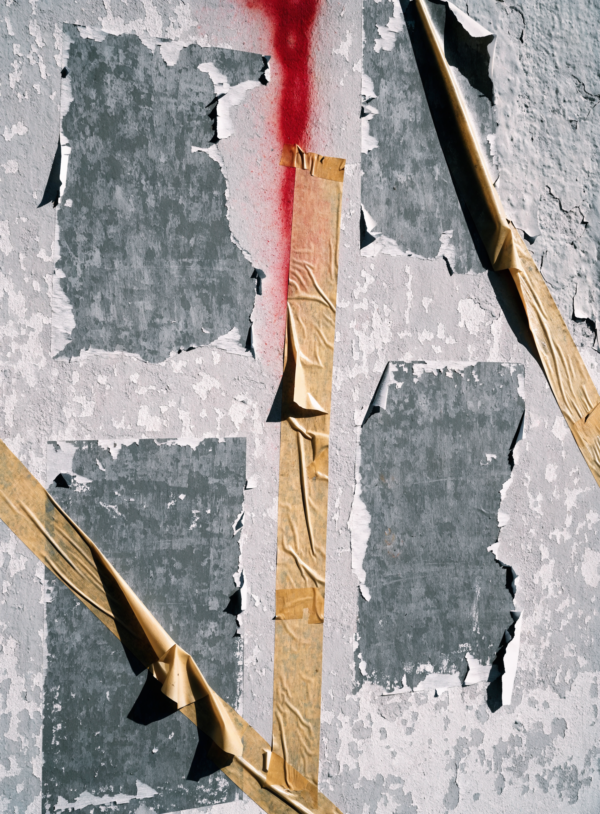
The posters came down. The wall kept the receipt. After the Show is Chris Vega working in his wheatpaste vernacular with the paste stripped out of it: sun-bleached paint over old plaster, the pale ghost of removed paper, tape shadows going grey at the corners, one faded spray fade drifting across the middle. No faces. No letters. Nothing to read. Just the surface that held everything else up. Which wall in your place has never once had an opinion?
What After the Show actually shows
Start at the top third, where plaster has been painted and repainted until the colour is more a memory of colour than a colour. Then the rectangle, a shade cleaner than everything around it, because paper sat there long enough to shield what it covered from the sun.
Tape shadows still hold the corners.
The spray fade runs across the centre and thins almost to nothing at one edge, the way paint goes when the can is nearly out and the hand keeps moving anyway.
Every other print in this gallery is paper standing in for a screen. This one is the artwork itself, at full resolution, in the medium it was made in.
Chris Vega’s wheatpaste vernacular, minus the poster
Texture is the entire subject here, which is a harder thing to carry than a stencil and a slogan. There is no image doing the work for you. There is grit, bleach, a seam of old repair, and the flat honesty of a surface that has been used.
Three critics landed on the same idea from three directions. Charlotte: “What remains after the crowd leaves often says more than what was there.” Ruby: “What remains when the spectacle leaves: a surface with memory, texture as testimony, and no apologies.”
Valentina put it plainest: “What remains after the poster is torn away is its own kind of statement: texture, time, and the grammar of the street made visible.”
Hang it where the daylight moves. Morning light comes in low and rakes across the grain, so the tape shadows sit up and the plaster looks like it could be scratched with a thumbnail. By four in the afternoon the whole thing has gone warm and quiet and the spray fade is the only thing left doing anything.
Under a lamp at night it flattens into one wide field of weather.
It goes in the hallway, above the sideboard, in the corner of the studio where the safe framed print has been hanging so long you stopped seeing it years ago. People stop in front of it. Then they ask what it says, and the answer is that it doesn’t say anything, and that is exactly the thing they came away thinking about.
The honest part
You get a file, and the file is the work.
- One high-resolution JPEG, sRGB colour, 7168 x 9728 px
- Prints to 23.8 x 32.4 inches (60.6 x 82.3 cm) at a true 300 dpi
- Instant: the link is on your order confirmation page and in the confirmation email
- Personal use, printed as often as you like, at any size, for your own home
- No frame, no paper, no physical object of any kind
Eighteen dollars. That buys the pixels, not a rental: no subscription renting you stock images by the month, no free wallpaper that turns to mush past A4, no framed print at ten times the price that you cannot replace when the sun bleaches it in four years. When that happens, you print this one again from the same file.
Take it to any print shop or online printer and ask for matte or textured fine art paper. Gloss fights a surface like this; matte lets the grain stay in the shadows. Size it to the furniture: keep the width to roughly two thirds of the sideboard or console beneath it, so a 36-inch unit takes this at full size, which is where the plaster reads at something close to life.
Nothing ships, so nothing can go wrong on the way
There is no parcel, no tube and nothing that can arrive damaged, because the whole thing lands in your inbox in the time it takes to close the tab.
You already know which wall. Print it this week, hang it where the afternoon reaches, and watch that pale rectangle hold the room long after the light has gone off it.