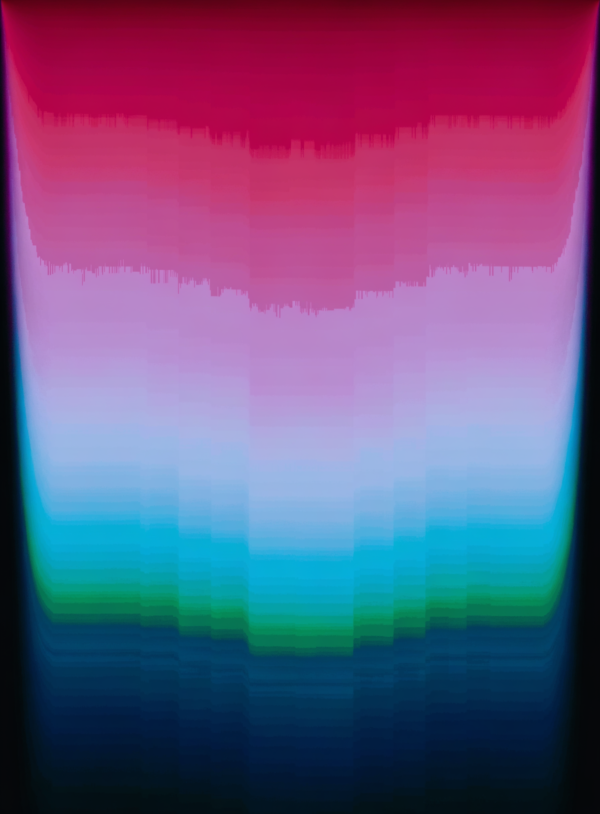
The colour gives up somewhere around the middle. Magenta holds at the top, dense and sure of itself, then starts to band into thin steps where a smooth fade should be, and by the time cyan takes over it has stopped pretending. Gradient Losing Nerve is Zara Moon’s slow-degradation gradient, the quiet end of her corrupted sublime work. No tearing, no blocks, no noise. Just a screen colour admitting it is tired. Which wall in your place has been blank long enough that you stopped seeing it?
What happens when the gradient stops holding
Look at the top of the frame.
The magenta up there is even and saturated, the kind of colour a screen makes and paint cannot reach. Follow it downward and the smoothness starts to cost something.
The banding arrives first: thin horizontal steps across a fade that was supposed to be continuous, as if the file ran out of room to describe itself.
Then the channels drift. A bruised violet edge opens between the magenta and the cyan, slightly out of register, slightly soft, and the longer you look the less it resolves.
By the lower third it has sunk into deep blue and lost its detail to compression. Nothing snaps. Nothing rips.
It loses its nerve gradually, and in public.
Zara Moon’s corrupted sublime, at the quiet end
Her poster work owns the aggressive corruption. This piece decays politely instead, which is why it survives being looked at every day.
Charlotte called it “A gradient watching itself fall apart. Beautiful enough to hang, honest enough to trust.” Valentina: “Beautiful decay, not violence—a gradient that admits its own technical failure as aesthetic event.” Ruby put it plainest: “Bruised magenta bleeding into cyan with just enough banding to make you believe the screen is tired—beautiful decay, not disaster.”
The piece behaves differently through a day. Flat morning light reads it almost clean, the bands sitting quiet; by mid-afternoon the magenta warms and the steps come forward one by one; under a single lamp at night the deep blue base goes almost black and the drift between the channels is the only thing left glowing.
Where this portrait gradient goes
It is tall and narrow, so it wants the wall that furniture cannot use. Beside a door frame. The dead strip at the end of a hallway. Directly above a desk, where you see it at eye level for eight hours at a stretch.
The first person who walks in will assume it is a photograph of a screen, then get close enough to see the banding is deliberate, and then ask you about it. You will have an answer, because the piece is the answer.
How much of the art you have bought before said anything at all about the year you bought it in?
The honest part
This is the artwork itself, not a print of it. Everything else in a gallery is a reproduction of something; this was made for a screen, and you get the file it was made as, at full resolution, with nothing lost on the way to paper because there is no paper in between.
- One high-resolution JPEG, sRGB colour, 7168 x 9728 px
- Prints to 23.8 x 32.4 in (60.6 x 82.3 cm) at 300 dpi, with the banding intact and the shadows still smooth
- Personal use: print it as many times as you like, at any size, for your own home. Not for resale, redistribution or commercial use
- No frame, no paper, no physical object of any kind
The link sits on your order confirmation page and in the confirmation email, within seconds. Nothing is posted and nothing can arrive damaged, because there is nothing to arrive.
Take it to any print shop or online printer and ask for matte or textured fine art paper. Gloss lays a shine across the bands, and the bands are the point.
Measure the furniture before you decide the size.
A 23.8-inch width sits correctly above a desk or console between 36 and 48 inches wide, and the wall decides how big this gets, not the file.
Why the file beats the frame here
Twenty-three dollars, paid once.
The free wallpaper you were half considering breaks apart above A4. A subscription rents you images other people also have. A framed print at ten times this price is one object, and when four years of afternoon sun bleach it, you own a faded thing.
You can print this one again, bigger, or on different paper, or for the next place you live.
The magenta at the top will hold for as long as you own it, and it will still give up two-thirds of the way down, in bands, honestly. Hang it where the daylight moves.