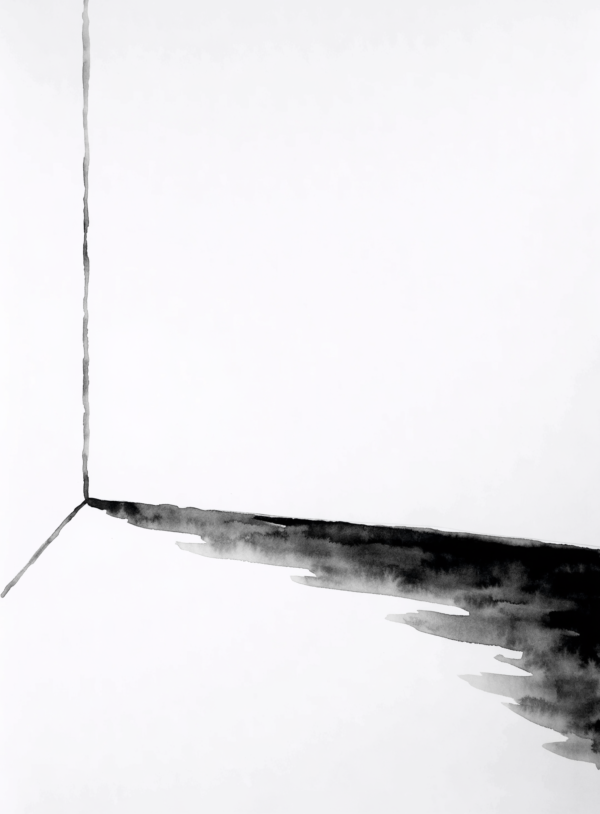
Most walls are working too hard. Room After Moving is Yuki Tanaka’s answer: a vast pale field of ink-on-paper, one soft diagonal shadow crossing it, one thin drawn line far off centre, and nothing else asking for attention. No figure. No horizon. Nothing left in the room to explain itself. You have thought hard about a space and then hung something on the wall that argues with it, so which wall is it?
Yuki Tanaka and the ma surrealism of an empty floor
The whole frame is paper and light. A shadow enters from one edge and travels on the diagonal, soft at its edges, thinning as it goes. Above it, a single line, placed where a lesser picture would have put a subject.
That line is the anchor.
Cover it with your thumb and the picture collapses.
This is ma surrealism in its plainest form: the emptiness that was around the figure, kept after the figure walked out. Restraint is not the mood of the piece. It is the piece.
What Room After Moving does between breakfast and dusk
Morning light reads it cool and the diagonal nearly disappears into the field. By four in the afternoon the paper has warmed, the shadow has weight again, and the wall behind you feels further away than it did at breakfast. Hang it where the daylight moves and you will not get the same picture twice in one day.
Three critics arrived at the same thought. Charlotte: “The room after moving out is the room finally at peace with itself.” Valentina: “One shadow and one line—everything a room needs to say when there is nothing left in it.” Ruby: “The kind of work that makes a thoughtful room feel intentional: one shadow, one line, the rest permission to breathe.”
It settles above a low sideboard, at the blind end of a hallway, in a bedroom where you want the eye to stop pulling at things. Guests notice it late, usually on the way out, usually after twenty minutes of sitting near it without knowing they were.
Then they ask what it is of, and you get to decide how much to say.
One more true thing before the numbers. Every print in this gallery is a reproduction of a digital original; this is not. This is the work itself, at full resolution, in the medium it was made in — there is no paper original in a studio and no photograph standing in for it, so nothing is lost on the way to your wall.
The honest part
What you buy is the file: the original digital artwork, one high-resolution JPEG in sRGB colour.
7168 x 9728 pixels.
At 300 dpi that prints to 23.8 x 32.4 inches (60.6 x 82.3 cm), and that is the honest ceiling rather than a rounded-up promise. At that size the shadow keeps its soft edge and the field keeps its grain, because there is no reproduction step in between to lose them in. The wall decides how big this gets, up to there.
- 7168 x 9728 px, sRGB JPEG
- 23.8 x 32.4 in (60.6 x 82.3 cm) at 300 dpi
- Personal use: print it as often as you like, at any size, for your own home. Not for resale, redistribution or commercial use
- No frame, no paper, no physical object of any kind
$19. A free wallpaper falls apart past A4. A subscription rents you stock images and takes them back the month you stop paying. A framed print at ten times this cannot be replaced when the sun bleaches it in four years, and this one can, as many times as you like.
Nothing ships, nothing waits, and nothing can arrive damaged, because there is nothing in transit.
Where Room After Moving hangs
The link is on your order confirmation page and in the confirmation email, so the file is yours a minute after you pay. Take it to any print shop or online printer and ask for matte or textured fine art paper. Gloss fights this work; it puts a shine exactly where the shadow needs to stay quiet.
For sizing, let the width of the piece sit at roughly two thirds the width of the furniture below it, which puts this one over a console or sideboard of about 36 inches. Alone on a wall, hang it slightly high and leave floor space beneath it, the way the shadow already does.
Then leave the rest of the wall alone.
One line, off centre, holding the whole room. That was the point.