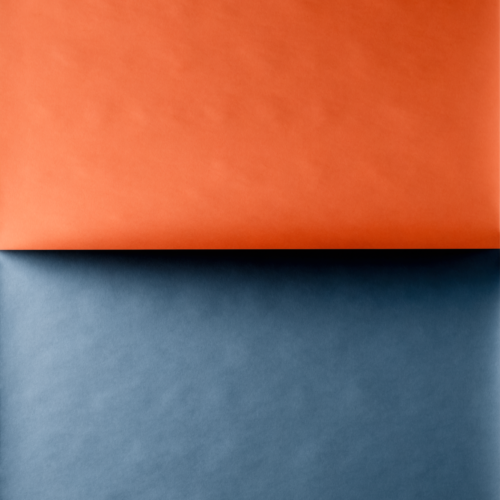
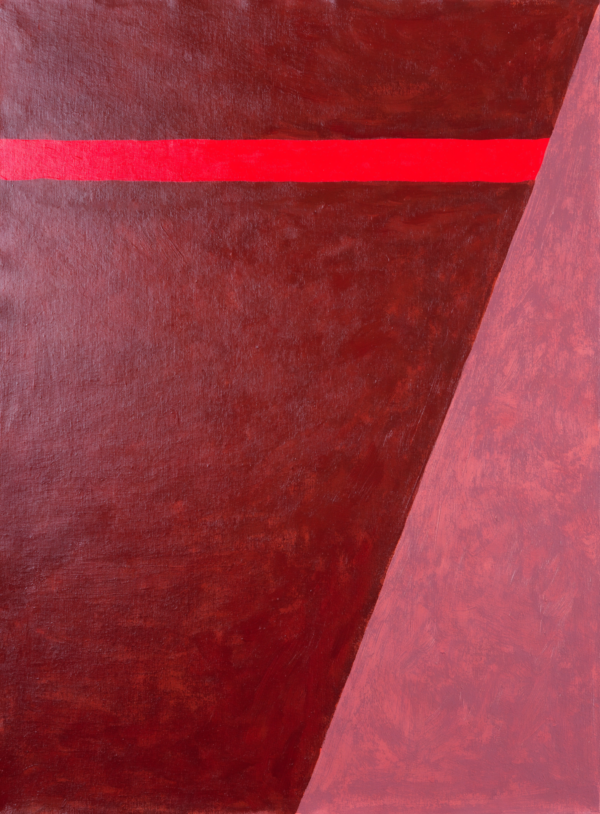
The wall does not need a face on it. In The Colour Behind Her, Naomi Brooks takes the saturated ground she usually sets a figure against and gives it the entire frame. Two unequal fields, terracotta and dusty rose, divided by one hard diagonal. A narrow architectural band crossing where they meet. Nobody in the picture at all, and the room still fills. You already know the wall you would put it on, and roughly how long you have been walking past it without looking up.
Two fields, one diagonal, nobody in the frame
The larger share is terracotta running toward burnt sienna, warm the way an interior wall goes warm at four in the afternoon. The smaller field is dusty rose, cooler, holding its corner without arguing. The division between them is a single confident line with no blur and no apology in it.
The architectural band is the part that rewards standing close.
It crosses the seam and pins the eye exactly where the two colours negotiate, so the piece works from the doorway as pure poster clarity and works again from two feet away as structure.
Morning gives the rose the advantage.
By late afternoon the sienna has taken the room, the diagonal reads harder than it did at noon, and everything you own in that space quietly agrees to be warmer.
Charlotte called it “poster-art clarity in burnt sienna and rose: a room backdrop that promises dignity before anyone enters it.” Ruby saw “two unequal fields in warm terracotta and dusty rose, divided by a single confident diagonal—the kind of backdrop that makes a room feel inhabited before anyone enters it.”
Where The Colour Behind Her goes
Hang it where the daylight moves across the wall rather than hits it flat.
It holds a hallway end, a stairwell, the space above a sideboard, the wall behind the chair nobody sits in. It is the colour a person would be photographed against, so the room starts behaving like a room that expects people.
Guests will ask what it is before they ask who painted it. That is the correct order.
Why this is not a print of the artwork
Every print hanging in this gallery is a reproduction of something that was made digitally. This is the digital original itself, at full resolution, in the medium it was actually made in. Nothing is lost on the way to paper, because there is no paper in between until you choose the paper.
The honest part
What you receive:
- One high-resolution JPEG, sRGB colour, 7168 x 9728 px
- Largest sensible print 23.8 x 32.4 inches (60.6 x 82.3 cm) at 300 dpi
- Instant delivery: the link sits on your order confirmation page and in the confirmation email
- Personal use licence: print it as many times as you like, at any size, for your own home. Not for resale, redistribution or commercial use
- No frame, no paper, no physical object of any kind
The price is $25.00, and flat fields of colour are exactly where cheap files fall apart, because a diagonal edge shows every compressed pixel. This one prints to 23.8 x 32.4 inches with the edge still clean and the sienna still sitting solid. The wall decides how big this gets, not the file.
Take it to any print shop or online printer and ask for matte or textured fine art paper. Gloss will fight the colour; matte lets the two fields sit down.
Sizing rule, not taste: the piece should span about two thirds of the furniture beneath it, so a 36 inch sideboard takes it near full size, and a narrow console takes it printed smaller.
Nothing ships, nothing waits in a depot, nothing can arrive damaged, because there is nothing physical in transit.
A free wallpaper collapses past A4. A subscription rents you images you never own. A framed print at ten times this asks you to buy it twice when four summers of sun have bleached it. You reprint this one from the same file, in a different size, for a different wall, whenever you want.
Print it once for the hallway and again, larger, when you move the sideboard.
Then wait for the first late afternoon when the light crosses that diagonal and the sienna takes the whole room.