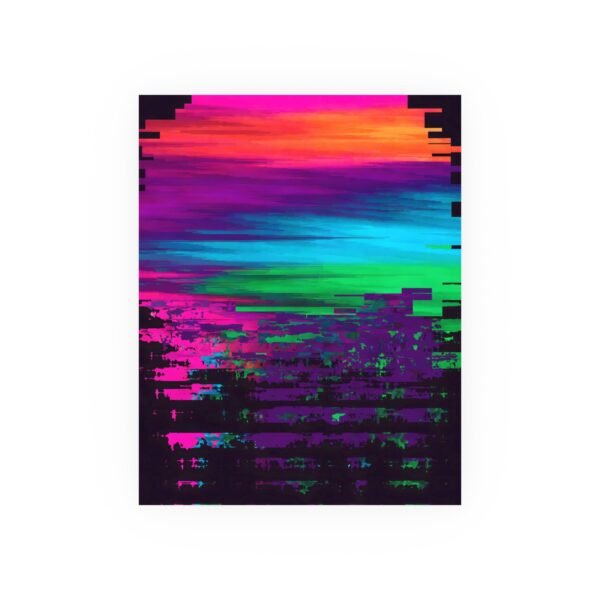
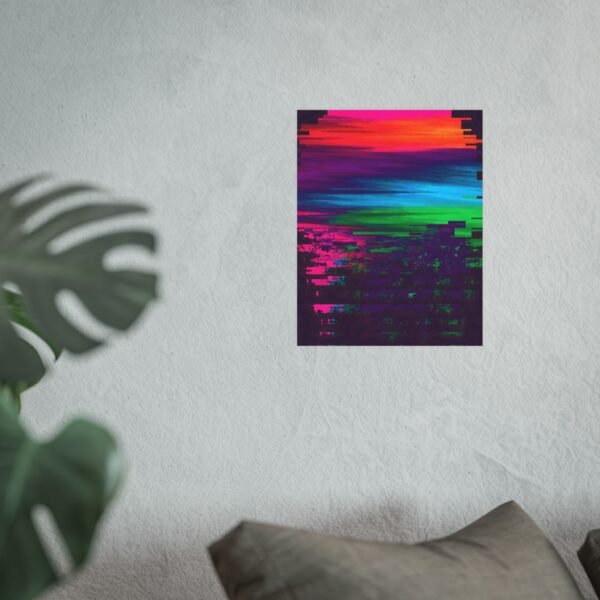
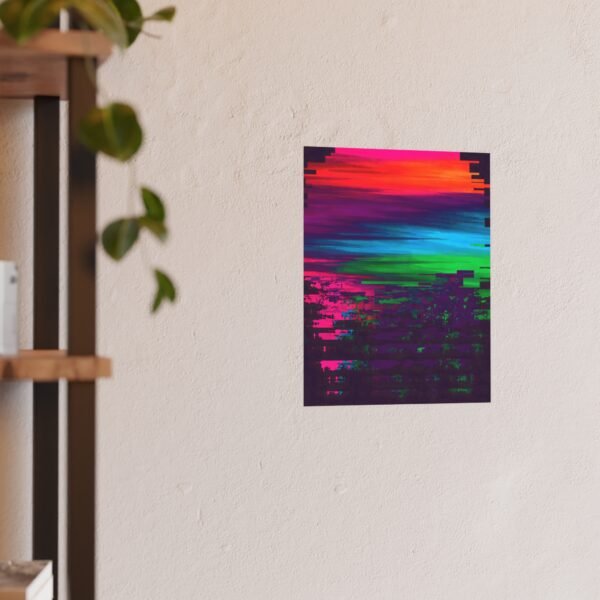
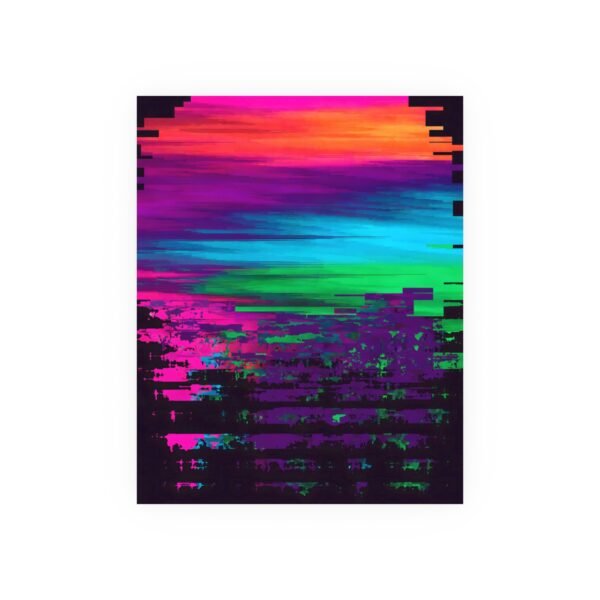
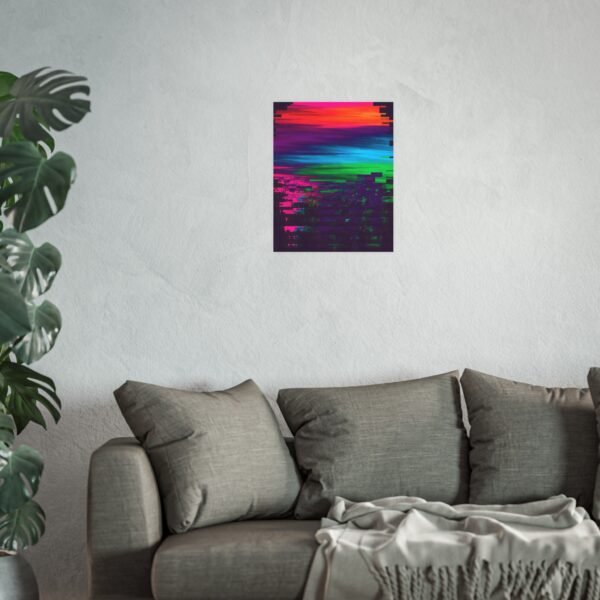
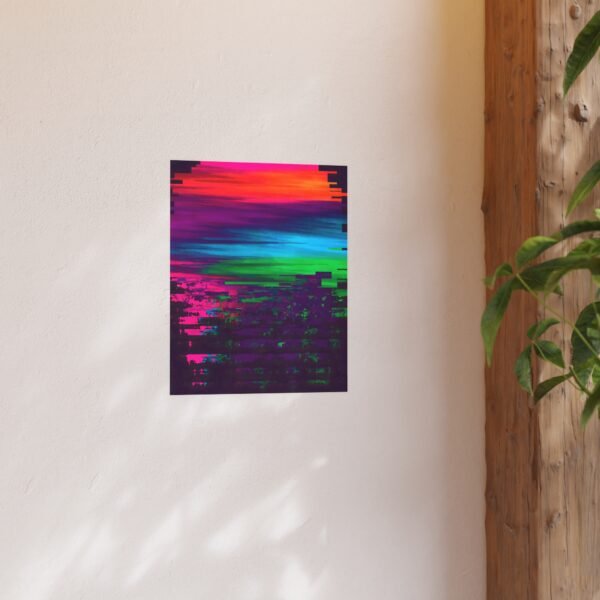
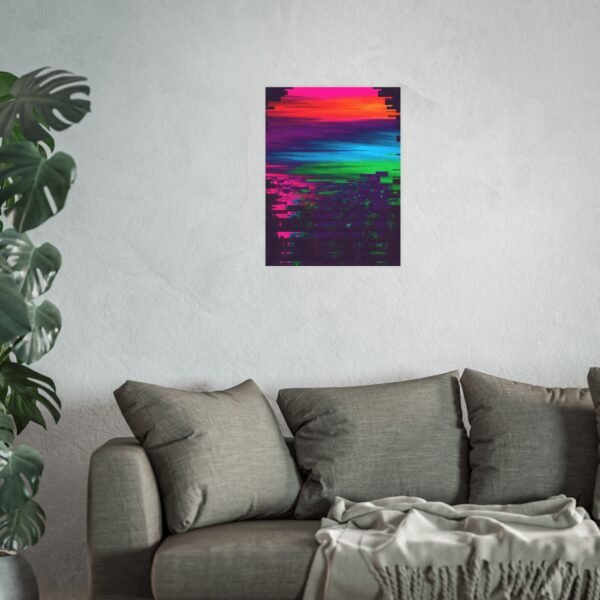
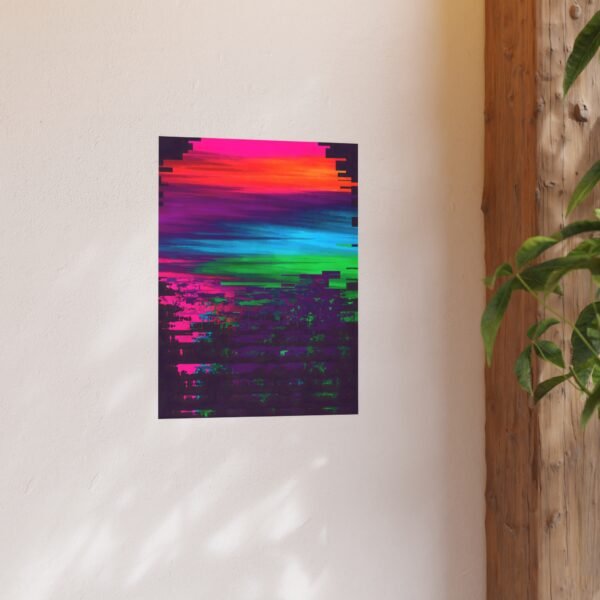
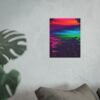
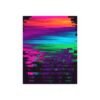
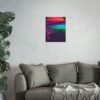
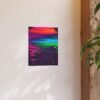
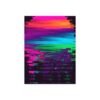
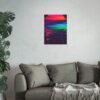
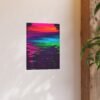
Four in the afternoon, and your room goes a bit strange. The light drops, the black in this print gets deeper, and the magenta starts doing something the rest of your wall cannot do. You will look up from your phone at it. That is the point.
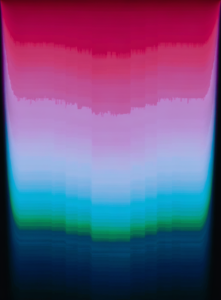
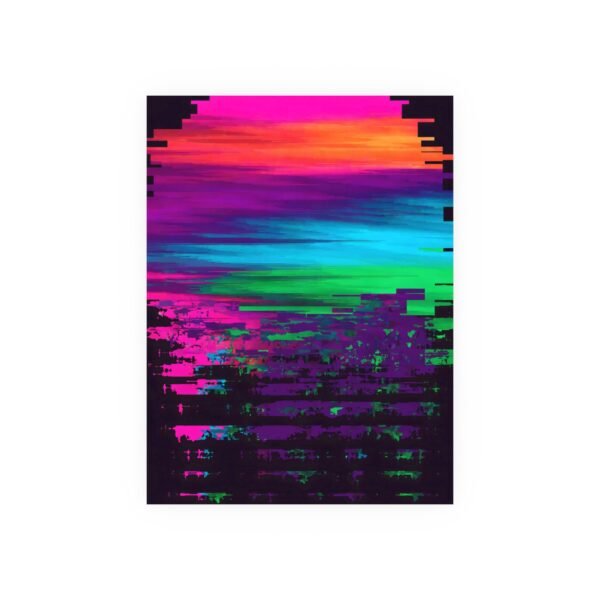
It is a sunset. It is also a sunset going wrong while you watch. The smooth fade you expect from a sky has given up and broken into steps – flat blocks of bruised neon stacked where a gradient should be. Magenta into cyan into acid green into violet, each one snapping to the next instead of blending.
The part you only see the second time
Look along the horizontal scanlines. The image is offset against itself – the colour channels have slipped sideways, so edges carry a ghost of themselves a few pixels over. Zara did not scatter that damage. Follow it and it repeats, it has a rhythm, it lands where it should. The collapse is composed. As one critic put it: a sunset that knows it’s breaking, and refuses to apologize for the beauty of its failure.
That is Zara Moon’s whole argument. Corruption as a drawing tool. Beauty that admits the system it came from.
What it does to the room
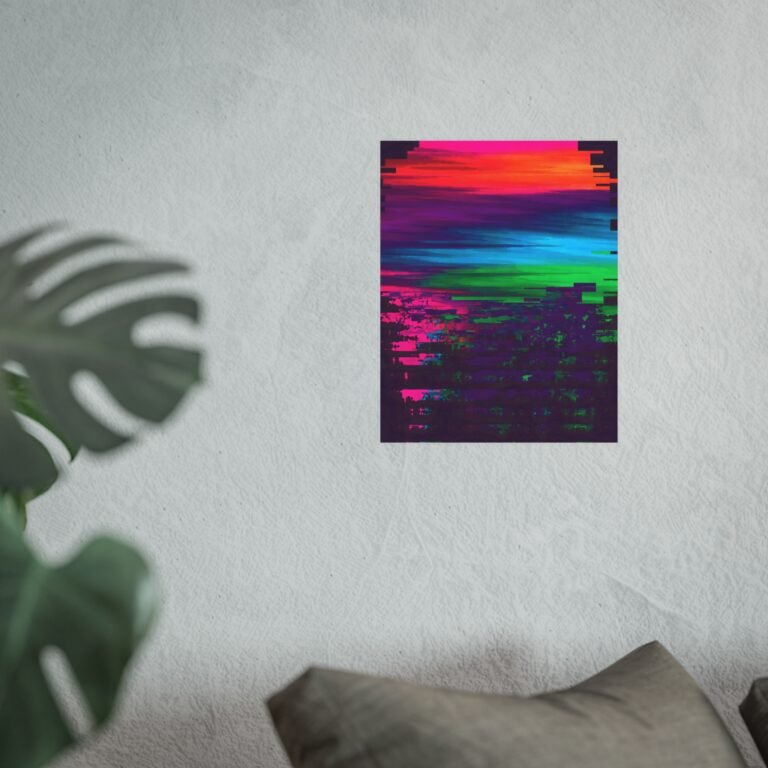 Guests do not say “nice print.” They lean in, squint at the stepped bands, and ask what happened to it. Then you get to explain that nothing happened to it.
Getting it up
Satin paper, not matte – matte would turn all that glowing neon into mud, and this needs the sheen to stay lit. Printed edge to edge, no white border, so the black runs right to the paper’s edge. It arrives rolled in a tube, ready for a frame you already own, and honest enough to look right pinned up bare.
Portrait. Most people take the 16 x 20 in (41 x 51 cm) at $79, which is the size preselected here. Free shipping in the continental US, and it is made to order, so nobody on your street has this one.
One honest thing
There is no cheerful colour in it. Nothing is soothing. If you want a wall that calms you down, this is the wrong print.
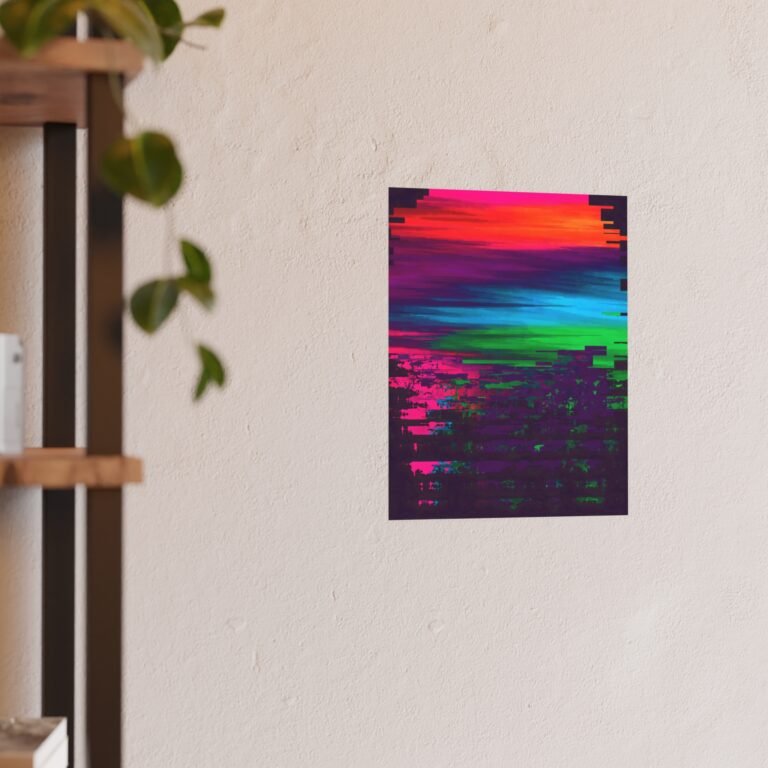 If that sounds like your kind of wall, take it home. Or go look at the rest of what Zara has made – and if you follow her, you will see the next one before the rest of us.
One is a piece. Two is a set. Three is a collection.
Almost nobody stops at one. A second work by the same hand turns a wall into a pairing. A third turns it into something you chose rather than something you bought. There is one other work by Zara Moon on the wall right now.